Managed IT for Dental Offices: 2026 Alaska Practice Guide
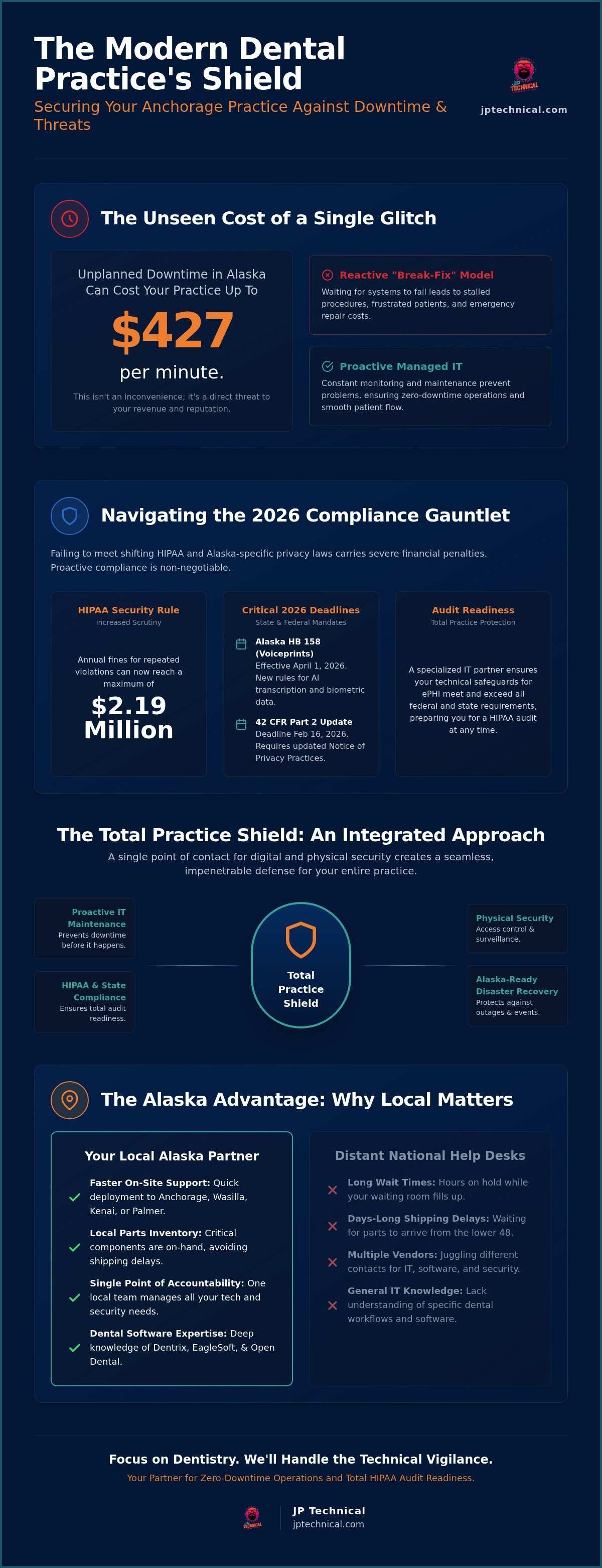
Imagine a busy Tuesday morning in Anchorage. Your waiting room is full, but EagleSoft is lagging, and your imaging software won’t pull up the x-rays you need for a critical procedure. In Alaska, where downtime can cost your practice up to $427 per minute, these technical glitches are more than just an inconvenience. They’re a direct threat to your reputation and your bottom line. Finding reliable managed IT for dental offices shouldn’t feel like a second job. You need a partner who understands that when your network goes down, your ability to care for patients goes with it.
It’s exhausting to juggle patient charts while worrying about the February 2026 HIPAA deadlines or Alaska’s new voiceprint privacy laws. You deserve the peace of mind that comes from knowing your data is secure and your systems are optimized. This guide will show you how to achieve zero-downtime operations and total HIPAA audit readiness through a localized, proactive approach. We will explore how a single point of contact for both IT and physical security creates a Total Practice Shield, allowing you to focus on dentistry while we handle the technical vigilance in the background.
Key Takeaways
Moving from a reactive break-fix model to proactive maintenance prevents expensive downtime and keeps your practice management software running smoothly.
Effective managed IT for dental offices ensures your practice meets 2026 HIPAA standards and complies with Alaska’s specific biometric privacy laws.
Integrating physical security and access control with your digital defenses creates a total practice shield that protects both patient data and your physical assets.
A true disaster recovery plan tailored for the Alaska environment ensures your clinic stays operational during power outages, winter storms, or seismic events.
Partnering with a local team provides a single point of accountability and faster on-site support compared to distant national help desks.
Table of Contents
Why Specialized Managed IT is Critical for Modern Dental Practices
Specialized managed IT for dental offices is more than a standard help desk. It’s the engine that keeps your clinical and administrative operations running smoothly. In a high-traffic clinic, every workstation and intraoral sensor must work perfectly every time. This specialized field of Health Information Technology (HIT) requires a deep understanding of how patient data flows through your specific office layout. A reactive approach is no longer sustainable in a competitive market.
To better understand how professional management impacts your daily operations, watch this helpful video regarding practice efficiency:
By 2026, most offices have transitioned toward cloud-hybrid models. These systems combine local server speed with cloud-based accessibility for remote billing or chart reviews. If your internet connection or local bridge fails, your entire workflow stops. We implement a “Total Practice Shield” that monitors your digital network and integrates physical security to protect your physical assets. This comprehensive strategy ensures that both your server room and your front door are under professional vigilance.
The High Cost of Dental Office Downtime
Downtime is a silent profit killer. If you have four operatories and your imaging server lags, you aren’t just losing time. You’re losing revenue. Research shows that unplanned downtime in 2026 can cost Anchorage businesses between $137 and $427 per minute. Proactive maintenance prevents those “Monday morning surprises” where the staff arrives to find the system offline. Local teams in Wasilla, Kenai, or Palmer can arrive on-site quickly to swap hardware. Maintaining a local inventory of critical components is essential in Alaska to avoid shipping delays that can stretch for days. National help desks might leave you waiting for hours while your patients sit in the waiting room.
Practice Management Software: Beyond the Installation
General IT providers often struggle with the specific nuances of Dentrix, EagleSoft, or Open Dental. These platforms aren’t standard office software. They require precise database configurations to communicate with 3D imaging sensors and Dexis software. A specialized partner ensures that software updates don’t break your database links or crash your workstations. We bridge the gap between your practice management software and your hardware. When your IT team understands the dental workflow, they can anticipate needs before they become emergencies. This specialized knowledge means fewer support tickets and a faster return to patient care.
Optimizing for HIPAA Compliance and Data Security in 2026
Data security in 2026 is no longer a “set it and forget it” task. For a modern clinic, managed IT for dental offices must include a constant cycle of monitoring and adjustment. The HIPAA Security Rule standards dictate that you protect electronic Protected Health Information (ePHI) with specific administrative, physical, and technical safeguards. As of January 2026, the Department of Health and Human Services (HHS) adjusted penalty tiers. Fines for repeated violations can now reach a maximum of $2.19 million per year. Relying on basic encryption or a standard firewall isn’t enough to meet these rigorous demands.
The 2026 HIPAA Landscape for Alaska Dentists
Alaska practices face unique regulatory hurdles this year. Effective April 1, 2026, House Bill 158 classifies voiceprints as protected biometric identifiers. If your office uses AI-based transcription or scribing tools, you’re now legally obligated to delete audio and voice embeddings immediately after the note is generated. Additionally, the February 16, 2026, deadline for 42 CFR Part 2 requires all practices to update their Notice of Privacy Practices to align with new confidentiality protections. We take the lead in preparing for a HIPAA audit by ensuring your technical safeguards match these shifting state and federal requirements. Our team acts as your compliance guardian, handling the background technicalities quietly and reliably.
Cybersecurity: Defending Against Ransomware
Dental offices are lucrative targets for cybercriminals because patient records contain valuable personal and financial data. A standard antivirus program cannot stop modern fileless ransomware or sophisticated data extortion tactics. We implement Endpoint Detection and Response (EDR) on every workstation to catch suspicious behavior in real time. If a threat is detected, the affected device is isolated immediately before the infection spreads. This proactive stance is essential for maintaining a stable practice. Beyond the hardware, we provide straight-shooter employee training. Your staff is your first line of defense. If they can spot a phishing attempt before clicking, they prevent a breach that could cost your practice its reputation. If you aren’t sure where your vulnerabilities lie, a free IT assessment can help identify gaps in your current security posture.
Integrating Physical Security and Access Control
Physical security is the often-overlooked foundation of a secure practice. While digital firewalls protect your network, HIPAA mandates tangible safeguards to prevent unauthorized access to hardware and paper records. Comprehensive managed IT for dental offices bridges this gap by merging your network security with physical access controls. This unified approach ensures that your servers, workstations, and patient files are protected by more than just a password. Managing these systems through a single local provider simplifies accountability. If a camera goes offline or a door badge fails, you have one point of contact to resolve the issue immediately.
Integrating these layers is a core component of Disaster Recovery and Business Continuity. If your physical office is compromised, your ability to provide care is halted just as surely as if a server failed. By securing the physical perimeter, you ensure that your digital assets remain behind a locked door that only authorized personnel can open.
Commercial Security Cameras for the Dental Lobby
Security cameras in a dental setting require a careful balance. You must protect your assets without infringing on patient privacy in clinical areas. Modern high-definition cameras with night vision provide clear evidence in the event of theft or patient disputes in the lobby or parking lot. Remote mobile viewing allows you to check on your office from anywhere in Alaska, providing peace of mind during winter storms or after hours. For many clinics, professional security camera installation in Anchorage is the first step toward a complete security posture. These systems act as a silent deterrent and a reliable witness when you need one most.
Keyless Entry and Access Control Systems
Traditional keys are a liability. They are easily lost, duplicated, or forgotten by departing staff members. Keyless entry systems using door badges or fobs eliminate the “lost key” headache. You can grant or revoke access instantly through a central dashboard. This is particularly critical for restricting access to server rooms or areas containing sensitive patient files. These systems also generate digital access logs. If you ever face a security audit, you can prove exactly who entered your server room and when. This data integrates seamlessly with your digital security reports, providing a 360-degree view of your practice safety and operational integrity.
Disaster Recovery and Business Continuity in Alaska
In Alaska, a winter storm or a power grid failure isn’t just an inconvenience. It’s a total stop to your patient care. Many dentists confuse a simple backup with true business continuity. A backup is just a copy of your files stored elsewhere. Business continuity is the ability to keep your practice running even if your main server dies. Professional managed IT for dental offices prioritizes this distinction to ensure you aren’t turning patients away during an emergency. We follow the 3-2-1 backup rule. This means keeping three copies of your data on two different types of media, with at least one copy stored off-site. In our environment, seismic events and unpredictable weather make this redundancy essential. Our goal is to have your clinic resume operations in under an hour after a total hardware failure.
Cloud Backup vs. On-Premise Recovery
Cloud-only backups are popular, but they have a major flaw in the Alaska business environment. Restoring a large imaging database over a standard internet connection can take days. If your server fails, you don’t have time to wait for a 500GB download. We use local failover servers that can take over immediately if your primary hardware crashes. This hybrid approach provides the speed of local recovery with the safety of the cloud. It’s about maintaining practice momentum when things go wrong. For a deeper look at these strategies, see our 2026 Guide to Business Continuity.
Redundancy for Remote Alaska Practices
Practices in Wasilla, Kenai, and Palmer often deal with less reliable utility infrastructure than those in downtown Anchorage. If your primary internet line goes down, your ability to process insurance claims and check schedules vanishes. We implement secondary internet failovers using LTE or satellite connections. This ensures your front desk stays online even when the main line is cut. We also provide proactive server maintenance to prevent hardware fatigue caused by power fluctuations and harsh climate conditions. Local accountability means we understand these regional challenges and prepare for them before they become emergencies. Schedule your free IT assessment today
Choosing the Right Local IT Partner for Your Practice
Selecting a partner for managed IT for dental offices is a long-term commitment that affects every aspect of your patient care. You need more than just technical skill; you need local accountability. National “call center” providers often offer attractive initial rates, but they lack the physical presence required to handle hardware emergencies in Alaska. If a critical server fails in Anchorage or a workstation goes down in Wasilla, a remote technician in a different time zone cannot provide on-site support. You need a partner who acts as a neighborly guardian, understanding the specific logistical and environmental challenges of our region.
Predictability is essential for your clinic’s annual budget. A flat-rate pricing model is generally superior to a “break-fix” approach because it aligns your interests with your IT provider’s goals. In a flat-rate model, your provider is incentivized to keep your systems running perfectly rather than waiting for things to break so they can bill for hours. Before signing any service agreement, ask about their experience with HIPAA-compliant data migrations. A professional transition from your current provider should occur quietly in the background, ensuring you don’t lose a single patient record or imaging file during the move.
The JP Technical Difference: Local Vigilance
Being based in Anchorage since 1996 gives us a unique perspective on the needs of local clinics. We don’t believe in high-pressure sales tactics or confusing technical jargon. Our “Straight-Shooter” communication style means you always know where your practice stands regarding security and performance. We focus on being a dedicated ally rather than a distant vendor, providing the technical mastery to handle threats before they impact your workflow. You can review our Managed IT pricing and service levels to see how we provide long-term stability for your operations.
Next Steps: Securing Your Practice
The first step toward a more efficient clinic is a comprehensive technology audit. This process identifies hidden vulnerabilities in your network and physical security before they lead to expensive downtime. We help you create a clear roadmap for 2026 that prioritizes system speed, data integrity, and regulatory compliance. By scheduling a free IT assessment for your dental office, you gain a professional evaluation of your current technical health. This assessment provides the data you need to make informed decisions about your practice’s future, ensuring your team can focus on dentistry while we handle the vigilance.
Securing the Future of Your Dental Practice
Your dental practice deserves a technology partner that works as hard as you do. By choosing specialized managed IT for dental offices, you eliminate the constant stress of system lag and the technical uncertainty of 2026 HIPAA audits. A true total practice shield integrates your digital network with physical access controls, ensuring every part of your operation remains secure and predictable. We’ve been a trusted local partner since 1996. Our Anchorage-based team understands the specific demands of the Alaska business environment, from power grid instability to the need for immediate on-site support.
We specialize in HIPAA-compliant dental workflows, so you don’t have to spend your time worrying about voiceprint privacy laws or server failovers. If you’re ready to move away from reactive repairs and toward a stable, proactive partnership, we’re here to guide you. You can focus on providing exceptional patient care while we maintain the protective vigilance your practice requires to thrive in the long term. Get Your Free Dental IT Assessment Let’s build a more resilient and efficient future for your clinic together.
Frequently Asked Questions
Is managed IT for dental offices really necessary for a small practice?
Yes, proactive managed IT for dental offices is essential because even a single operatory going offline halts your ability to generate revenue. Small practices are often more vulnerable to downtime because they lack redundant systems. We provide the technical vigilance to catch hardware fatigue or software conflicts before they cause a total shutdown. This ensures your staff can focus on patient care instead of troubleshooting network issues or sensor connections.
How does managed IT help with HIPAA compliance?
We implement the mandatory technical safeguards required by the HIPAA Security Rule. This includes managing unique user IDs, automatic log-offs, and end-to-end encryption for patient communications. Our team monitors your system for unauthorized access and maintains the audit logs necessary for regulatory compliance. We also help you navigate 2026 updates, such as Alaska’s specific biometric privacy laws regarding voiceprints, keeping your practice ready for any sudden audit.
What is the response time for on-site support in Anchorage or Wasilla?
We prioritize rapid response times for our local partners in Anchorage, Wasilla, Kenai, Palmer, and Fairbanks. Because our team is based right here in Alaska, we can be on-site quickly to handle physical hardware failures that remote help desks simply cannot fix. If a critical server or sensor bridge fails, we arrive with the tools and expertise to restore your operations. This local accountability is the foundation of our neighborly guardian approach.
Can you manage my specific dental software like Dentrix or EagleSoft?
Yes, we specialize in managing the complex requirements of Dentrix, EagleSoft, and Open Dental. These platforms require precise database configurations and seamless integration with imaging software like Dexis. We handle the patch management and updates for these systems to ensure they don’t crash your workstations. Our deep experience with dental-specific technology allows us to resolve software conflicts much faster than a general IT provider who lacks clinical workflow knowledge.
What is the difference between a general IT company and a dental-focused MSP?
A general IT provider treats your office like any other business, but a dental-focused MSP understands your clinical workflow. We know that a laggy intraoral sensor is just as disruptive as a server crash. We specialize in the intersection of patient management software, imaging hardware, and HIPAA regulations. This expertise allows us to provide a more stable environment where your technology supports your dentistry rather than creating obstacles for your team.
How much does dental managed IT support typically cost?
We utilize a predictable, flat-rate pricing model that allows you to budget your IT expenses with confidence. This approach removes the anxiety of hourly billing and ensures our goals are aligned with yours. If your system runs perfectly, our work is successful. While national averages vary based on the number of users and devices, we focus on providing a customized plan that covers your digital network and physical security needs without hidden fees.
Do you provide both digital cybersecurity and physical security cameras?
Yes, we provide a unified security solution that covers both your digital network and your physical office. We install professional security cameras and keyless entry systems that integrate with your overall security posture. This “Total Practice Shield” approach ensures that your server room is just as protected as your patient database. Having a single point of contact for both IT and physical surveillance simplifies your operations and strengthens your HIPAA physical safeguard compliance.
What happens if our server fails during a busy day of appointments?
If your server fails, our business continuity plan takes over to minimize downtime. We utilize local failover servers that can resume your operations in under an hour. By following the 3-2-1 backup rule, we ensure your patient data is always protected and accessible. You won’t have to wait for days to download large imaging databases from the cloud. Our goal is to keep your practice moving so you don’t have to reschedule patients.
 Article by
Colter Hobbs