Business Cybersecurity in Anchorage: The 2026 Local Defense Guide
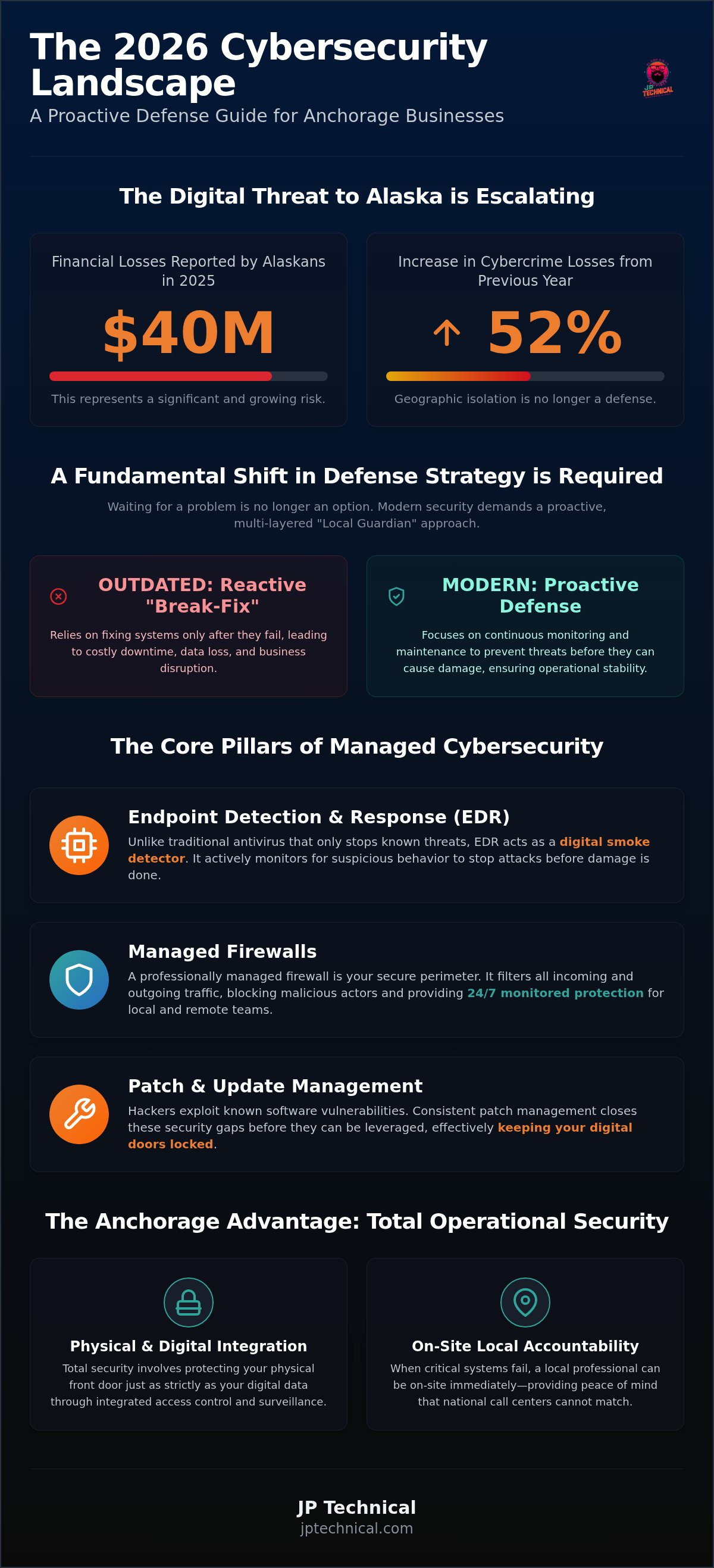
Alaskans reported nearly $40 million in financial losses due to cybercrime in 2025, which marks a 52% increase from the previous year. For a local business owner, these numbers aren’t just statistics; they represent the very real threat of a data breach during your peak season. You likely feel the pressure of evolving regulations like the Alaska Insurance Data Security Act or the 2026 HIPAA requirements for ambient AI. It’s frustrating to deal with national IT vendors who don’t understand our local logistics or the importance of having someone who can physically show up when things break.
We agree that your focus should be on growth, not deciphering complex regulatory hurdles. This 2026 guide explains how to implement a robust strategy for business cybersecurity Anchorage companies can rely on for long-term stability. You’ll learn how to blend advanced network defense with physical security and local accountability. We’ll preview the essential steps to achieve total operational security and regulatory compliance, ensuring your assets remain protected by a guardian who actually knows your neighborhood.
Key Takeaways
Modern defense requires a proactive approach that moves beyond basic antivirus to include real-time threat hunting and endpoint detection.
Building a strategy for business cybersecurity Anchorage organizations can trust means integrating managed firewalls with advanced, continuous network monitoring.
Total operational security involves securing the physical front door just as strictly as your digital data through integrated access control and surveillance.
Staying ahead of 2026 HIPAA amendments and Alaska-specific regulations requires a partner who manages the entire regulatory environment, not just your software updates.
Local accountability provides the peace of mind that a seasoned professional can physically be on-site if your critical systems face a disruption.
Table of Contents
The 2026 Cybersecurity Landscape for Anchorage Businesses
The digital landscape for Anchorage businesses has shifted dramatically. In 2025, Alaskans reported nearly $40 million in financial losses due to cybercrime, which represents a 52% increase from the previous year. This surge proves that our geographic isolation no longer provides a buffer against digital threats. Modern business cybersecurity Anchorage strategies must move beyond reactive “break-fix” habits. Instead, a “Local Guardian” model focuses on proactive, multi-layered defense systems that protect every entry point of your operation.
Effective security relies on core cybersecurity principles such as confidentiality, integrity, and availability. For a business in the Last Frontier, this means ensuring that your digital continuity remains intact even when local infrastructure faces challenges. If you wait for something to break before calling for help, you’ve already lost the battle. Proactive maintenance, including EDR and antivirus, creates a shield that stops threats before they reach your server room.
Why Small Businesses in Alaska Aren’t ‘Too Small’ to Target
Cybercriminals often use automated scripts to find “low-hanging fruit.” These bots don’t care if you’re a global corporation or a local medical practice in Midtown. In our tight-knit community, a single data breach can cause permanent reputational damage. If your clients lose trust in your ability to protect their data, recovering that relationship is much harder than fixing a server. Being remote doesn’t make you invisible; it often makes you a target for those who assume your business cybersecurity Anchorage defenses are outdated.
The True Cost of Downtime in the Last Frontier
The average cost of a data breach in the United States reached $10.22 million in 2026. While your specific costs might vary, the hourly impact of an IT outage is often staggering when you factor in lost productivity and missed opportunities. In Anchorage, logistics can complicate recovery. If your systems fail and you rely on a national vendor, you’re stuck in a phone queue while your office sits idle. A local partner provides a predictable response. Proactive management prevents the “emergency service” price spikes that occur when systems crash during your busiest season. To understand your current risk level, you can request a free IT assessment to identify vulnerabilities before they become expensive failures.
Core Pillars of Managed Cybersecurity Defense
Building a robust defense requires more than just a single piece of software. It involves a coordinated system that protects your data from every angle. For business cybersecurity Anchorage teams, this means implementing four core pillars: endpoint detection, managed firewalls, patch management, and disaster recovery. These layers work together to ensure that if one defense is tested, another is ready to respond. Following established FTC cybersecurity guidance helps local owners understand that security is an ongoing process rather than a one-time setup.
Proactive Monitoring vs. Traditional Antivirus
Legacy antivirus software is no longer sufficient in 2026. Traditional tools rely on a database of known threats, meaning they can only stop an attack after it has already been identified elsewhere. Modern Endpoint Detection and Response (EDR) operates differently by monitoring behavior. JP Technical’s EDR solutions identify suspicious patterns, such as unauthorized file encryption, before the damage is done. EDR is the digital smoke detector for business networks.
The Role of Managed Firewalls in Local Networks
A consumer-grade router might work for a home office, but it lacks the sophisticated inspection capabilities needed for a professional business cybersecurity Anchorage strategy. Managed firewalls act as a secure perimeter, filtering incoming and outgoing traffic to block malicious actors. This protection is critical for teams supporting remote workers in Wasilla or Kenai. 24/7 monitoring ensures that network anomalies are detected and addressed immediately, maintaining a secure tunnel for your data regardless of where your employees are logging in.
Software updates are often your first line of defense. Hackers frequently exploit known vulnerabilities in common applications. Consistent patch and update management ensures these gaps are closed before they can be exploited. If your systems are out of date, you’re essentially leaving your front door unlocked. We handle these updates quietly in the background so your operations remain smooth and secure.
Alaska’s unpredictable environment makes backup and disaster recovery essential. Whether it’s a cyberattack or a local power disruption, your business must have the ability to restore data quickly. A proactive strategy ensures that your “Last Frontier” operations don’t come to a halt when the unexpected happens. You can start strengthening your defenses today by requesting a comprehensive look at your current systems to see where these pillars might need reinforcement.
The Missing Link: Integrating Physical and Digital Security
Many business owners view cybersecurity as a purely digital concern, focusing entirely on firewalls and encryption. However, a server room is only as secure as its door lock. If an unauthorized person gains physical access to your hardware, even the most sophisticated digital defenses can be bypassed. This is why modern business cybersecurity Anchorage strategies must account for the convergence of IT and physical security. Following FTC Cybersecurity Guidance reminds us that protecting physical assets is just as critical as protecting data on a screen.
JP Technical bridges this gap by offering a unified approach. We manage your network security while simultaneously overseeing your Physical Security Solutions. This integration ensures there are no blind spots in your defense. When your IT partner understands your camera systems and access controls, you gain a streamlined response to threats. It’s much more efficient to have one local team that can troubleshoot a network outage and a malfunctioning door controller in the same visit.
Access Control and Door Badge Systems
Digital access controls replace traditional keys with trackable badge systems. These systems prevent unauthorized physical entry into sensitive areas like server rooms or executive offices. One of the biggest benefits is the creation of audit logs. If a security event occurs, you can see exactly who entered or exited a specific door at any given time. This layer of accountability is vital for maintaining compliance and internal safety. If an employee leaves the company, you can deactivate their access instantly across the entire facility without needing to re-key locks. For more information on how to build these defenses, check our guide on Security Camera Installation in Anchorage.
Professional Surveillance for Data Protection
Security cameras serve as a powerful deterrent for both external intruders and internal threats. When your surveillance is integrated with IT monitoring, you get a “single pane of glass” view of your entire operation. We often recommend local storage solutions for camera feeds rather than relying solely on the cloud. This approach respects Alaska’s unique bandwidth constraints, ensuring your network stays fast while your high-definition footage remains accessible. High-resolution video can consume significant data; by keeping the storage on-site, we prevent your internet from slowing down during peak business hours. Having a local guardian who can physically show up to adjust a camera or check a server rack provides the peace of mind that a national, remote-only vendor simply cannot match.
HIPAA Compliance and Regulatory Standards in Alaska
Alaska’s medical community faces unique regulatory pressure in 2026. The HIPAA Privacy Rule has been amended this year to include new regulations governing ambient AI in healthcare settings, specifically addressing patient consent. Federal penalty caps have also increased, with total penalties for willful neglect potentially reaching over $2.19 million. For providers focused on business cybersecurity Anchorage standards, it’s vital to realize that “HIPAA-compliant software” isn’t a magic shield. Even the best software can be configured incorrectly. True compliance comes from professional IT management that monitors how data is accessed, stored, and shared across your entire network.
We prepare local clinics for audits by documenting every security measure and technical control. This proactive approach transforms compliance from a source of anxiety into a manageable, transparent part of your operations. When an auditor asks for proof of your security posture, you’ll have the logs and records ready. This level of preparation is a core element of our HIPAA Compliant IT Services.
Data Security for Healthcare Providers
Encryption at rest and in transit are non-negotiable requirements for any modern practice. If your patient data isn’t encrypted while sitting on a drive or moving through an email, you’re in direct violation of federal standards. We ensure these protocols are active and documented so there’s no question about your data’s safety. Additionally, a critical part of your strategy involves Business Associate Agreements (BAAs). As your local partner, we provide a BAA to confirm our shared responsibility in protecting patient information. You can explore our specific HIPAA Solutions to see how we structure these protective layers for Anchorage clinics.
Cybersecurity Audits and Vulnerability Scans
Annual risk assessments aren’t just a recommendation; they’re a requirement for staying compliant. These audits identify “weak spots” like outdated hardware or improper user permissions that could lead to a breach. In 2025, Alaska saw at least six significant healthcare data breach events that affected over 126,000 individuals. We conduct thorough vulnerability scans to find these gaps before they can be exploited. This process is a fundamental part of maintaining business cybersecurity Anchorage organizations need to protect their reputation. By identifying risks early, we can implement patches and updates that keep your practice secure and compliant. You can learn more about this process in our guide to Managed Cybersecurity in Anchorage. Get your professional HIPAA risk assessment
Choosing an Anchorage Cybersecurity Partner
Choosing a partner for business cybersecurity Anchorage is a decision that determines your long-term operational stability. Many national providers promote a “virtual” model, relying on remote troubleshooting and small satellite offices. While these models claim to offer national scale, they often lack the depth of local resources needed when hardware fails or local networks go down. A true local partner provides a level of accountability and responsiveness that a distant help desk cannot match.
When evaluating potential partners, check for specific experience in Alaska’s regulated industries, such as healthcare and the oil and gas sector. These fields require an understanding of local compliance hurdles that national vendors might overlook. Your provider should also possess the technical mastery to handle physical hardware and surveillance systems, ensuring your front door is as secure as your firewall. Look for a partner who offers a transparent, flat-rate pricing model. This predictability allows you to budget for total security without worrying about unexpected costs for every support ticket.
The Value of ‘Boots on the Ground’ in Alaska
Remote-only support is helpful for software glitches, but it fails during critical hardware malfunctions or local connectivity outages. In these moments, having a technician who can physically show up at your Anchorage office is the difference between a quick fix and days of downtime. We’ve served the local business community since 1996, providing a stable presence that national vendors cannot replicate. This history allows us to understand the unique challenges of the Alaskan market, from our remote geography to our specific regulatory environment. We treat our clients as neighbors, prioritizing human connection over automated interactions.
Taking the First Step: The Free IT Assessment
Strengthening your business cybersecurity Anchorage strategy shouldn’t involve guesswork. A professional security evaluation provides a clear baseline of your current strengths and weaknesses. During this assessment, we analyze your network defenses, physical access controls, and compliance readiness. This data allows you to prioritize your security spend based on actual risks to your business continuity. Instead of a generic list of services, you receive a structured plan tailored to your specific office needs. You can take the first step toward peace of mind by requesting a Free IT Assessment to identify and close your most critical security gaps.
Securing Your Anchorage Business for the Future
Building a resilient operation in 2026 requires a “Local Guardian” approach that integrates network defense, physical surveillance, and strict regulatory compliance. We’ve seen that modern threats don’t discriminate based on business size. The costs of downtime in Alaska are simply too high to leave to chance. Protecting your assets with a comprehensive strategy for business cybersecurity Anchorage organizations can trust ensures your operations remain predictable and compliant.
JP Technical has been serving Anchorage businesses since 1996. Our local technicians are based right here in Alaska, providing specialized expertise in HIPAA and physical security integration that national vendors often miss. We are committed to showing up when things get difficult, acting as a dedicated ally for your long-term success. Secure Your Business with a Free IT Assessment from JP Technical Take the first step toward total operational peace of mind. Your business deserves a defense strategy that’s as rugged and reliable as the community it serves.
Frequently Asked Questions
What are the most common cyber threats for Anchorage businesses in 2026?
The most frequent threats in 2026 include AI-powered phishing, business email compromise, and ransomware. Cybercriminals are increasingly using sophisticated automation to target local infrastructure. In 2025, investment fraud and romance scams were among the costliest in Alaska, but business email compromise followed closely with $7 million in reported losses. A strong business cybersecurity Anchorage strategy addresses these human-centric attacks through consistent security awareness training and proactive network monitoring to block malicious traffic before it reaches your team.
Is a local MSP better than a national cybersecurity firm for Alaska businesses?
A local provider offers a level of accountability and responsiveness that national firms often struggle to replicate. While national vendors might use remote-only models or outsourced satellite offices, a local partner understands the specific logistics and connectivity challenges unique to Alaska. If a critical server fails or your physical access control malfunctions, having a technician who can physically show up at your office is essential for minimizing downtime and maintaining long-term stability.
How much does managed cybersecurity cost for a small business in Anchorage?
Costs for managed services in the local market depend on several factors, including your total number of users, the complexity of your network, and whether you require specialized HIPAA compliance. Instead of the unpredictable “break-fix” billing of the past, most modern businesses prefer a predictable, flat-rate model. This approach covers proactive maintenance, patch management, and remote support, allowing you to budget for your security needs without worrying about unexpected hourly fees when a problem arises.
What is the difference between HIPAA-compliant hosting and HIPAA-compliant IT support?
Compliant hosting only secures the server where your data is stored. HIPAA-compliant IT support is much broader, covering how your staff interacts with that data on their local workstations and mobile devices. This includes managing user permissions, ensuring encryption is active on every device, and maintaining the necessary Business Associate Agreements (BAAs). It’s the difference between having a secure vault and ensuring that every person with a key follows the correct security protocols.
Does my Anchorage business really need security cameras for cybersecurity?
Physical security is an essential pillar of a complete defense strategy. If an unauthorized person gains access to your server room or a workstation, they can bypass many digital firewalls. Modern business cybersecurity Anchorage solutions integrate professional surveillance and access control to monitor who is physically entering your premises. This convergence allows you to track both digital and physical events through a single, coordinated system, providing total operational security for your assets and your employees.
How long does it take to recover from a ransomware attack with professional IT support?
Recovery times vary significantly based on your backup and disaster recovery strategy. If you have a professional, managed system in place, critical operations can often be restored within hours of an incident. However, businesses relying on unmanaged or outdated backups may face weeks of downtime and permanent data loss. Proactive monitoring helps identify threats early, while a robust recovery plan ensures that even if a breach occurs, your business continuity remains intact.
Can JP Technical support my offices in Wasilla and Fairbanks as well?
Yes, we provide comprehensive support across several key regions in Alaska. Beyond our core services in Anchorage, our technicians regularly assist businesses in Wasilla, Kenai, Palmer, and Fairbanks. This regional presence allows us to maintain the “Local Guardian” approach for organizations with multiple offices. Whether you need managed IT in the Mat-Su Valley or physical security solutions in the Interior, we have the local resources to show up and support your team.
What is EDR, and why is it better than standard antivirus?
Standard antivirus relies on a database of known threats to block attacks. Endpoint Detection and Response (EDR) is more advanced because it monitors for suspicious behavior in real time. If a file begins encrypting data unexpectedly, EDR identifies the anomaly and stops the process before it can spread across your network. It acts as a digital smoke detector, hunting for threats that haven’t been identified by traditional software yet, which is critical for stopping modern zero-day exploits.
 Article by
Colter Hobbs