Business Security Camera Systems in Alaska: The 2026 Comprehensive Guide
Can your current surveillance hardware survive twenty hours of winter darkness and a forty-below cold snap without blinking? In our environment, standard equipment often becomes a liability when the mercury hits rock bottom. You’ve likely seen cameras fail during a freeze or struggled with grainy, useless footage during the long nights. Selecting effective business security camera systems Alaska companies can actually trust requires a focus on ruggedized hardware that doesn’t quit when the weather turns. It’s frustrating to invest in protection only to have it fail when you need it most.
We believe your security should be as resilient as your business. This guide provides a clear roadmap for protecting your assets with technology that meets strict HIPAA and APIPA compliance standards while surviving the sub-arctic. You’ll discover how to integrate high-resolution 4K optics with secure, managed IT networks that keep your footage safe from cyberattacks. We will cover everything from AI-powered video analytics to remote access solutions that work whether you’re in Anchorage, Wasilla, or Fairbanks. By the end of this article, you’ll know how to build a surveillance perimeter that remains vigilant even in the harshest conditions.
Key Takeaways
Identify the specific IP ratings and heater requirements necessary to prevent hardware failure when temperatures drop to minus 40 degrees Fahrenheit.
Discover how AI-powered video analytics and edge computing reduce network strain while providing proactive alerts rather than just passive recording.
Evaluate the trade-offs between cloud and on-premise storage to find the right balance for your local internet bandwidth and high-resolution needs.
Understand the legal landscape of business security camera systems Alaska companies must navigate, including APIPA data protection and audio recording laws.
See why integrating your physical security with managed IT services creates a more resilient defense against both physical intruders and cyber threats.
Table of Contents
Why Standard Surveillance Fails in Alaskas Extreme Environment
Cloud vs. On-Premise: Evaluating Storage for Local Businesses
The Managed Security Advantage: Why Integration with IT is Crucial
Why Standard Surveillance Fails in Alaskas Extreme Environment
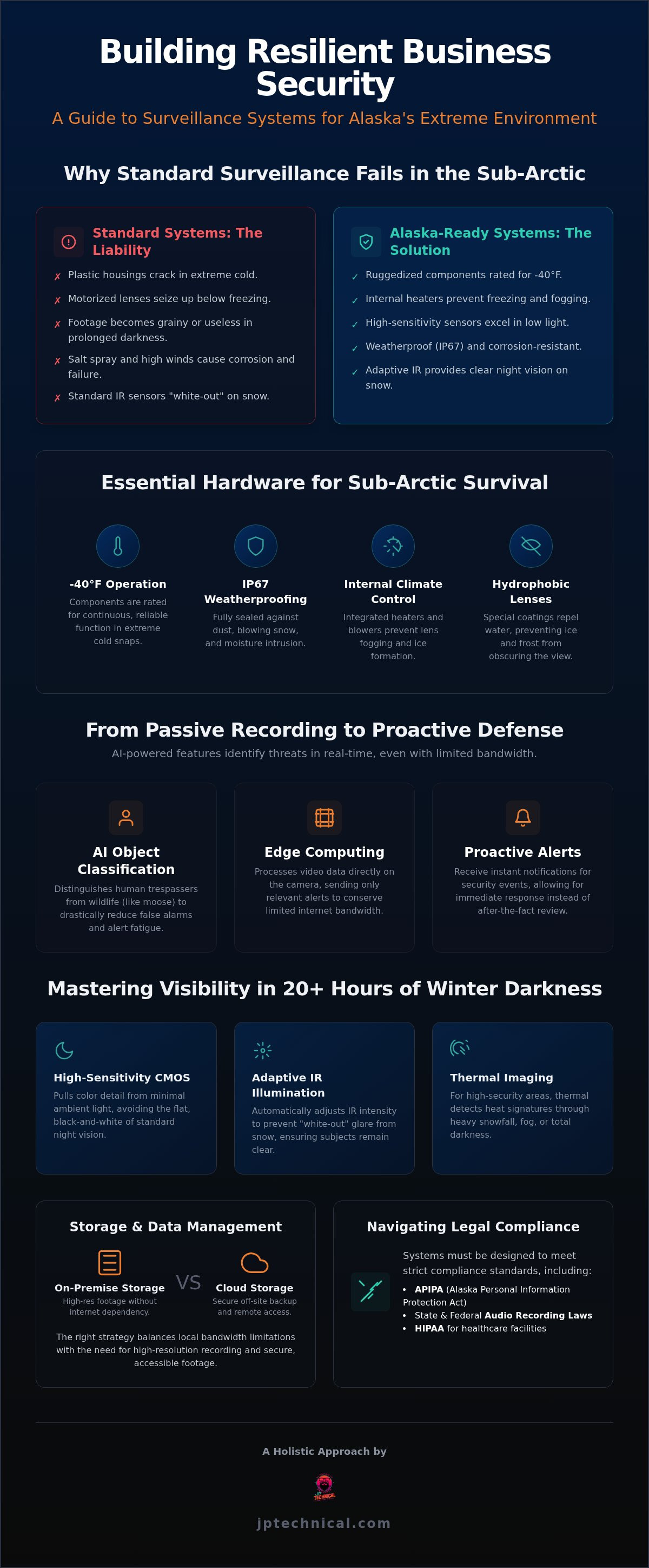
Business owners in the Lower 48 often buy off-the-shelf cameras and expect them to last for years. In our state, that same equipment often fails before the first major snowfall in November. We call this the “Alaska Tax” on generic hardware. When you choose Closed-circuit television (CCTV) components designed for temperate climates, the internal electronics simply aren’t built to handle the thermal contraction caused by a sudden drop to minus forty degrees.
Standard plastic housings crack, and lubricant in motorized lenses can seize up entirely. If your business is located in coastal areas like Kenai or Anchorage, you also face high wind loads and salt spray that corrodes standard mounts. Reliable business security camera systems Alaska relies on must be built from the ground up to withstand these specific environmental stressors. Without ruggedized components, you’re looking at a system that works in July but goes dark when you need it most during the winter months.
Ruggedization Beyond the Spec Sheet
For businesses in Fairbanks and the Interior, an IP66 or IP67 rating is just the starting point. You need internal heaters and blowers to keep the internal temperature stable and prevent the lens from fogging. Hydrophobic coatings are also essential; they cause moisture to bead off the glass, which prevents ice and frost from obscuring your view during a freeze-thaw cycle. An Alaska-ready hardware standard for 2026 means every external component is rated for continuous operation at -40°F with integrated thermal management.
Low-Light and IR Performance in Winter Darkness
Alaska presents a unique lighting challenge known as the “Noonday Moon.” During the peak of winter, you might face 20 hours of darkness. Standard infrared (IR) sensors often struggle here. If the IR is too powerful, it “whites out” the image when it reflects off the snow-covered ground, leaving you with a bright blur instead of a clear face. We prioritize high-sensitivity CMOS sensors that can pull color detail from minimal ambient light, alongside adaptive IR that adjusts its intensity based on the surroundings. In some high-risk perimeters, thermal imaging becomes necessary to detect heat signatures through heavy snowfall or dense fog when traditional optics fail.
Protecting your facility starts with choosing hardware that doesn’t quit when the weather gets difficult. By investing in physical security solutions tailored for the sub-arctic, you ensure your vigilance remains constant year-round. It’s about more than just having a camera; it’s about having a reliable witness that can handle the cold.
Essential Features for 2026: AI Analytics and Compliance
Modern business security camera systems Alaska companies install are no longer just passive recording devices. In the past, you only checked your footage after a theft or incident occurred. Today, the shift toward proactive security means your system identifies threats in real time. By using artificial intelligence, these systems can alert you the moment an unauthorized person enters a restricted area, allowing for a response before damage is done. This transformation from reactive to proactive protection is essential for businesses operating in remote or high-risk environments.
AI-Powered Detection and Analytics
One of the most practical applications of AI in Alaska is object classification. Traditional motion sensors are often triggered by wildlife, leading to “alert fatigue” for business owners. Modern AI can distinguish between a moose wandering through a lot and a human trespasser near a loading dock. In hubs like Wasilla, license plate recognition (LPR) helps logistics firms manage busy delivery yards by automatically logging vehicle entries. Meanwhile, retail managers in Anchorage use heat mapping to see which aisles get the most foot traffic, turning their security investment into a tool for operational efficiency.
Managing this data requires a smart approach to bandwidth. Many remote Alaska locations rely on limited internet connections, making it difficult to stream high-definition video to the cloud constantly. Edge computing solves this by processing video data directly on the camera hardware. Only relevant alerts or compressed clips are sent over the network, similar to the high-efficiency standards for extreme weather monitoring equipment used in scientific research. This ensures your system stays online without choking your office internet.
Surveillance and HIPAA Compliance
Security cameras are also a critical component of regulatory compliance. If you operate a healthcare clinic or a financial office, your surveillance must do more than just record; it must protect sensitive data. HIPAA regulations require strict physical safeguards for areas where patient records or servers are stored. Your cameras act as a digital paper trail, providing the audit logs and access tracking necessary for a robust HIPAA strategy. This includes ensuring that all transmitted and stored video data uses high-level encryption to prevent cyberattacks.
True security comes from a unified defense. By integrating your cameras with physical access control systems, you can verify that the person swiping a keycard is actually the authorized employee. If a door is forced open, the nearest camera can automatically pivot and zoom to capture the event. If you aren’t sure if your current setup meets these modern standards, a free IT assessment can help identify gaps in your physical and digital perimeter.
Cloud vs. On-Premise: Evaluating Storage for Local Businesses
In Alaska, the decision between cloud and on-premise storage isn’t just about preference; it’s about infrastructure reality. While cloud storage offers convenience, our remote regions often struggle with the bandwidth required to upload constant 4K streams. If your internet connection is unreliable, a pure cloud system can leave you with gaps in your footage during an outage. Choosing the right storage architecture for business security camera systems Alaska requires balancing accessibility with local network limitations.
On-premise Network Video Recorders (NVRs) provide a stable solution for many. They store high-resolution footage directly on-site, ensuring you never lose data due to a dropped connection. For businesses in Fairbanks and Anchorage, hybrid-cloud solutions often provide the most resilient path. These systems store footage locally for immediate access while syncing critical events to the cloud when bandwidth allows. This approach ensures you have the high-definition evidence you need without choking your daily business operations.
Calculating Your Storage Requirements
High-definition 4K video provides incredible detail, but it consumes significant storage space. A single 4K camera running at high frame rates can fill a terabyte of storage in just a few days. To manage this, we utilize H.265 compression, which reduces file sizes by up to 50% without losing image quality. You should also define clear retention policies based on your industry. Most local businesses aim for at least 30 days of archived footage. If your facility requires advanced AI analytics and compliance standards, your storage hardware must be sized to handle that extra metadata alongside the video files.
Securing the Surveillance Network
Every internet-connected device is a potential entry point for cyber threats. Security cameras are frequently targeted because they are often left on default factory settings. To protect your company, we implement VLAN segmentation. This process isolates surveillance traffic from your primary business data, ensuring that a breach in one area doesn’t compromise your entire operation. Proactive managed cybersecurity is the final layer of defense. It involves regular firmware updates and active monitoring to keep your physical hardware secure from evolving digital threats. A local guardian doesn’t just watch the door; they protect the digital locks as well.
Strategic Planning: Designing Your Alaska Business System
Effective security starts with a plan, not a purchase order. We begin by conducting a thorough vulnerability assessment to identify blind spots in your perimeter. It’s common to find that while the front door is covered, a side loading dock or a dark corner of the parking lot remains exposed. Designing business security camera systems Alaska owners can rely on means thinking like an intruder. We look for the path of least resistance and ensure every angle is accounted for before the first cable is pulled.
You must also navigate the legalities of surveillance in our state. While recording in public areas and sales floors is generally permissible, Alaska law protects a reasonable expectation of privacy. This means cameras are strictly prohibited in restrooms, locker rooms, or changing areas. Additionally, federal laws regarding audio recording require the consent of at least one party, so we often recommend disabling microphones in common areas to maintain compliance. Integration with door badge systems further strengthens your posture, allowing you to link a specific entry event with a high-definition video clip of the person at the door.
Camera Placement Strategies
A one-size-fits-all approach to lens selection usually leads to poor results. We use wide-angle lenses to provide broad coverage of parking lots and warehouses, ensuring you see the big picture. For high-value assets like cash registers or safes, we deploy telephoto lenses that provide the detail necessary to identify currency or faces. In the sub-arctic, your cabling needs as much protection as your cameras. We use rigid metal conduit for exterior runs to prevent cables from becoming brittle and snapping in the cold or being damaged by heavy ice accumulation.
Remote Management for Multi-Location Businesses
Scalability is a core requirement for a growing company. If you are expanding from a single shop in Palmer to five branches across Anchorage and Fairbanks, you need a centralized way to manage your security. A modern system allows you to view every location from a single dashboard on your laptop or mobile device. This level of visibility ensures you stay vigilant even when you are off-site. Maintaining this uptime requires proactive IT maintenance to ensure your network remains stable and your firmware stays current. Schedule your free IT assessment to begin your security plan.
The Managed Security Advantage: Why Integration with IT is Crucial
Many business owners treat surveillance as a “set it and forget it” task. They install the hardware and only check the footage when something goes wrong. In our climate, this approach is a significant risk. If a camera fails during a mid-winter power surge or loses its network connection, you might not realize it’s offline until you actually need the evidence. Relying on unmanaged business security camera systems Alaska companies install can lead to a false sense of safety that disappears exactly when you need it most.
The solution is to treat your surveillance as a critical part of your IT infrastructure. When your camera system is managed by your IT provider, every camera becomes a monitored node on your network. We don’t just wait for you to call with a problem. We monitor the health and connectivity of your hardware around the clock. If a lens becomes obscured or a storage drive fails, we’re often working on the resolution before you even notice a gap in your feed. This proactive vigilance bridges the gap between simple hardware and true network reliability.
The Problem with Fragmented Vendors
Working with separate vendors for your IT and your physical security often leads to finger-pointing when failures occur. If your cameras stop recording, the security contractor might blame your network switches, while your IT person blames the camera hardware. This leaves you caught in the middle with a broken system and mounting costs. By using a single point of contact for all your technology, you eliminate this friction. It’s more efficient, it’s more accountable, and it’s often more cost-effective to bundle these managed services under one local guardian who understands your entire digital and physical perimeter.
Next Steps: Your Security Assessment
Every business has different needs based on its location and industry. A retail shop in Anchorage faces different risks than a remote utility site near Fairbanks. That’s why we don’t offer generic, out-of-the-box packages. During a professional security and IT audit, we examine your current network strength, identify physical blind spots, and ensure your system meets all necessary compliance standards. We then build a customized plan that balances rugged hardware with secure data storage.
Ready to secure your premises? Schedule your free IT and security assessment today to ensure your business remains protected regardless of the weather or the threat.
Future-Proof Your Alaska Business Security
Building a surveillance perimeter in the sub-arctic requires more than just standard hardware. It demands ruggedized components that can withstand minus forty degrees and AI-driven analytics that distinguish between a security threat and the local wildlife. If you integrate your cameras with a managed IT network, you ensure that your data remains secure and your footage is always accessible when you need it. This holistic approach turns a simple camera into a proactive tool for business continuity.
Since 1996, our Anchorage-based team has acted as a seasoned guardian for businesses from Fairbanks to the Kenai Peninsula. We are HIPAA compliance specialists who understand that physical security is inseparable from network health. Selecting the best business security camera systems Alaska offers is a vital step toward long-term stability and protection. We bring the technical mastery needed to handle complex regulatory hurdles and environmental challenges quietly in the background. Secure your Alaska business with a Free IT & Security Assessment We look forward to helping you build a resilient defense that stands strong against the elements and evolving threats. Your peace of mind is our priority, and we are ready to show up when things get difficult.
Frequently Asked Questions
Do security cameras work in -40 degree weather in Alaska?
Yes, but only if the hardware is specifically rated for sub-arctic temperatures. Standard cameras often fail when the mercury drops, but ruggedized models equipped with internal heaters and blowers can operate reliably at -40°F. We ensure your business security camera systems Alaska setup includes housings that prevent internal components from freezing or cracking. Without these thermal management features, the camera’s electronics and motorized lenses will likely seize up during a typical Fairbanks or Anchorage cold snap.
Is cloud or local storage better for businesses in Fairbanks?
A hybrid solution is typically the most reliable choice for Fairbanks businesses. Pure cloud storage relies heavily on consistent internet bandwidth, which can be a hurdle in remote regions or during heavy network congestion. Local storage on a Network Video Recorder (NVR) ensures you capture high-resolution footage even if your connection drops. By using a hybrid approach, critical alerts are backed up to the cloud while the bulk of your data stays safe on-site.
What are the legal requirements for business surveillance in Alaska?
Alaska businesses must comply with the Alaska Personal Information Protection Act (APIPA) regarding stored data. Legally, you can record in public areas where no reasonable expectation of privacy exists. However, surveillance is strictly prohibited in private spaces like restrooms or locker rooms. For audio recording, federal law requires the consent of at least one party. It’s best to consult with a specialist to ensure your camera placement and data handling meet all current state and federal regulations.
Can I view my Anchorage business cameras from my phone while traveling?
Yes, modern systems allow for secure remote viewing from anywhere in the world. As long as you have an internet connection, you can access live feeds or recorded footage through an encrypted mobile app. This capability is essential for owners who manage multiple branches in Anchorage, Wasilla, or Fairbanks. We configure these remote access points behind secure firewalls to ensure that your private business footage remains protected from unauthorized external access while you are away.
How often do security camera systems need maintenance?
We recommend a professional maintenance check at least twice a year to account for Alaska’s seasonal shifts. In the fall, it’s vital to verify that internal heaters are functioning before the freeze. Spring maintenance focuses on cleaning lenses of salt spray or dust and checking for cable damage caused by ice expansion. Proactive maintenance prevents unexpected downtime and extends the lifespan of your investment by catching small hardware issues before they lead to total system failure.
Does my surveillance system need to be HIPAA compliant?
Your surveillance system must be HIPAA compliant if cameras monitor areas where Protected Health Information (PHI) is visible or stored. This includes server rooms, file cabinets, and patient check-in desks. Compliance requires strict access controls, encrypted transmission, and detailed audit logs of who viewed the footage. We specialize in designing HIPAA-compliant business security camera systems Alaska medical practices trust to secure their physical premises while meeting all federal data protection standards.
What is the average cost of business security camera installation in Alaska?
The cost of a professional installation depends on the number of cameras, the level of ruggedization required for the climate, and your storage needs. Factors like conduit installation for exterior wiring and high-sensitivity sensors for winter darkness also influence the final investment. Because every facility has unique requirements, we recommend a site assessment to determine the most cost-effective way to secure your perimeter without sacrificing reliability in extreme weather conditions.
Can AI cameras distinguish between animals and people?
Modern AI-powered cameras use object classification to accurately distinguish between humans, vehicles, and wildlife. This technology is particularly useful in Alaska to prevent false alerts caused by moose or bears wandering through your property. By filtering out these non-threatening movements, your security team can focus on actual trespassers. This reduces alert fatigue and ensures that when your phone pings at 3:00 AM, it’s for a situation that truly requires your attention.
 Article by
Colter Hobbs