Medical Office IT Support in Alaska: The 2026 Compliance & Reliability Guide
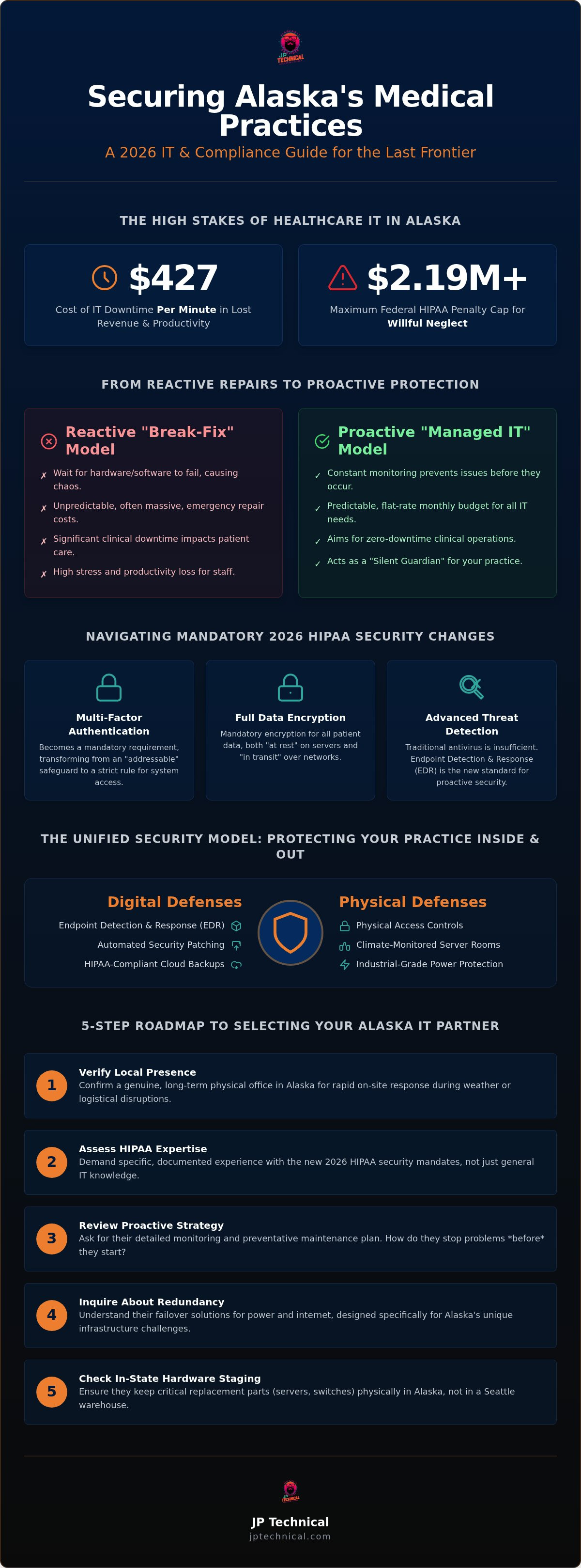
For an Alaska medical practice in 2026, every minute of IT downtime costs up to $427 in lost revenue and staff productivity. When you combine that with federal HIPAA penalties now capped at over $2.19 million, the stakes for your technology infrastructure have never been higher. You deserve a partner who understands that a slow response from a distant vendor isn’t just an inconvenience; it’s a direct threat to patient care and your bottom line.
We agree that keeping a clinic running smoothly in the Last Frontier requires a level of reliability that off-the-shelf solutions can’t provide. This guide teaches you how to secure your practice using medical office IT support Alaska professionals trust for HIPAA-compliant infrastructure and unified physical security. You’ll learn how to achieve zero-downtime operations while staying ahead of the strict 2026 regulatory changes.
We’ll walk through the mandatory new safeguards for electronic health records, the implications of Alaska’s 2026 AI scribe laws, and the benefits of having a single local point of contact for your entire security posture. By the end, you’ll have a clear roadmap to transition from reactive repairs to a proactive “silent guardian” model that protects your clinic around the clock.
Key Takeaways
Understand why local accountability is the only way to prevent clinical downtime during extreme Alaska weather events and logistical disruptions.
Navigate the mandatory 2026 HIPAA security overhaul and learn how to document your compliance to protect your practice from escalating federal penalties.
Discover how switching from reactive repairs to proactive medical office IT support Alaska creates a predictable budget and zero-downtime clinical operations.
Learn the “Unified Security” model that integrates digital defenses with physical access controls to secure both your server room and your front door.
Follow a five-step roadmap to vet potential IT partners for deep HIPAA expertise and a genuine, long-term physical presence in the state.
Table of Contents
Resilient Medical IT: Navigating Alaska’s Environmental and Logistical Stakes
Managed IT vs. Break-Fix: A Reliability Framework for Alaska Clinics
Unified Security: Integrating Digital Defense with Physical Access Control
Resilient Medical IT: Navigating Alaska’s Environmental and Logistical Stakes
Alaska’s environment is a constant variable for healthcare providers. If a winter storm hits the Mat-Su Valley or Fairbanks, the “Isolation Factor” becomes a physical reality. Remote-only call centers based in the Lower 48 cannot help when a transformer blows or a local fiber line is severed. Selecting medical office IT support Alaska requires finding a team that can actually reach your clinic when the Glenn Highway is closed or flights are grounded.
To better understand how technology bridges the gap in our unique geography, watch this helpful video:
Proactive server maintenance acts as your first line of defense against environmental volatility. We don’t wait for hardware to fail in the middle of a flu season rush. Instead, we monitor thermal levels and power stability to catch issues before they cause clinical downtime. This steady vigilance ensures that your systems remain operational even when the weather turns unpredictable.
Overcoming the Isolation of Remote Clinics
Establishing reliable connectivity in Kenai and Palmer requires a deep understanding of local ISP infrastructure. We don’t just set up a router and hope for the best. We build in secondary failovers using diverse paths to ensure your EMR stays online. We prioritize local hardware staging, meaning critical replacement parts are already in the state rather than sitting in a warehouse in Seattle. This allows for rapid on-site deployment when every minute of downtime impacts patient care. Resilient infrastructure for an Alaska clinic is a redundant system designed to maintain clinical operations and data integrity despite power outages, connectivity failures, or extreme environmental shifts.
Infrastructure that Stands Up to the Last Frontier
Sensitive medical equipment requires more than just a standard plug. We implement industrial-grade battery backups and surge protection to shield your diagnostic tools from the “dirty power” often found in rural grids. Our cloud-hybrid strategies ensure that patient records remain accessible even if the local internet goes dark. Following HIPAA regulations means ensuring data availability, which is why we emphasize ruggedized IT setups. JP Technical’s approach focuses on high-tolerance components that handle the dry, static-prone air of Fairbanks winters and the humidity of the coast. By integrating these systems with physical security measures like climate-monitored server enclosures, we protect the heart of your practice from both hackers and the elements.
Maintaining HIPAA Compliance and Data Integrity in 2026
The regulatory environment for 2026 is tightening. The U.S. Department of Health & Human Services is expected to finalize a major update to the HIPAA Security Rule by May 2026. This shift transforms many “addressable” safeguards into mandatory requirements. Practices must implement multi-factor authentication and full encryption for data at rest and in transit. If your current medical office IT support Alaska provider hasn’t discussed these specific mandates with you, your practice could face federal penalties that now exceed $2.19 million for willful neglect. We help you stay ahead of these changes by building compliance into your daily workflow.
Traditional antivirus is no longer a sufficient defense against modern healthcare ransomware. We replace reactive software with Endpoint Detection and Response (EDR) to monitor system behavior and stop threats in real-time. This is paired with automated patch management to ensure security holes are closed as soon as they are discovered. This proactive approach acts as a silent guardian for your clinical data, allowing your staff to focus on patient outcomes rather than technical vulnerabilities.
Navigating the 2026 42 CFR Part 2 Deadlines
The February 16, 2026, deadline for 42 CFR Part 2 updates requires substance use disorder (SUD) records to align more closely with HIPAA standards. You must ensure that patient consent is tracked digitally and that SUD records are properly segregated within your network. Additionally, Alaska’s HB-158 law, effective April 1, 2026, requires specific handling of voiceprints if you use AI scribes. Managing these complex requirements requires a partner who understands both federal and state technical nuances. Learn more about our HIPAA compliance services to see how we handle these record segregation and biometric data rules.
The HIPAA Audit Trail: Documentation and Risk Management
A “set it and forget it” mindset is a significant liability during a federal audit. If you cannot produce a log showing who accessed a record and when, you are technically out of compliance. We create a verifiable digital paper trail for every access point in your network. This includes performing annual penetration testing and vulnerability scans every six months to identify gaps before an auditor does. Keeping your documentation current is the only way to demonstrate your protective vigilance and avoid costly fines. If you are unsure about your current posture, you can schedule a free IT assessment to identify and resolve potential compliance gaps.
Managed IT vs. Break-Fix: A Reliability Framework for Alaska Clinics
Many Alaska medical practices still operate under a “Break-Fix” model. This approach is the technical equivalent of waiting for a pipe to burst before calling a plumber. In a clinical setting, this reactive mindset is inherently anti-compliance. It ignores the core administrative safeguards required by the HIPAA Security Rule Standards, which mandate continuous risk analysis and proactive protection of patient data. Waiting for a system failure to occur before seeking medical office IT support Alaska providers offer is no longer a viable business strategy.
Managed IT services act as a “Silent Guardian” for your operations. Instead of receiving an invoice only when things go wrong, you pay a predictable monthly fee for constant vigilance. This model aligns our goals with yours: we both want your network to stay up and running. We handle patch management, security updates, and system optimizations in the background so your staff can focus entirely on patient care without technical interruptions.
The Hidden Price of Clinical Downtime
Downtime is a silent profit killer. For a small business in 2026, the cost of IT downtime is estimated to be between $137 and $427 per minute in lost revenue and staff productivity. Beyond the financial loss, system outages erode patient trust and can lead to dangerous delays in treatment. Break-fix vendors often charge an “emergency premium” for urgent repairs. While standard reactive rates in Alaska typically range from $125 to $250 per hour, emergency or after-hours rates can reach $500 per hour. View our transparent IT pricing structure to see how a fixed monthly investment prevents these volatile expenses.
Managed Services: Partnership Over Transactions
A managed service provider (MSP) is a long-term partner, not just a vendor. In the 2026 threat landscape, where AI-driven phishing attacks are constant, 24/7 monitoring is a necessity. We don’t just wait for you to call; we identify and neutralize threats before they reach your workstations. Having local support in Anchorage, Wasilla, and Fairbanks ensures that if a physical hardware failure occurs, you have “boots on the ground” ready to help. While national MSPs often leave Alaska clinics stranded due to logistical delays and time zone differences, a local support team provides immediate, on-site resolution to keep your practice moving. This local accountability is the foundation of a truly resilient medical practice.
Unified Security: Integrating Digital Defense with Physical Access Control
HIPAA compliance isn’t limited to what happens on a computer screen. Physical safeguards are a mandatory component of federal regulations. If an unauthorized person can walk into your server room or sit at an unattended terminal, your digital encryption is irrelevant. Most medical office IT support Alaska vendors treat IT and physical security as separate silos. We use a “Unified Security” model to bridge this gap. By protecting both the front door and the server rack, we ensure your practice remains a fortress against all types of intrusion.
This integrated approach provides a “Silent Guardian” effect for your clinic. You gain the peace of mind that comes from knowing your digital data and physical assets are monitored by a single, accountable partner. We don’t just manage your firewalls; we manage the environment those firewalls live in. This consistency reduces the complexity of your operations and ensures that no security gaps are left between your software and your hardware.
Securing the Facility: Cameras and Access Control
Strategic camera placement is essential for patient safety and the protection of sensitive areas like drug lockers. High-definition surveillance acts as a deterrent and provides a clear record for liability mitigation. When you integrate these cameras with keyless entry systems, you gain granular control over your facility. Door badge systems allow you to manage personnel turnover effortlessly. If an employee leaves the practice, you can revoke their access instantly in the software. This eliminates the high cost and logistical headache of re-keying the entire building. Explore our physical security and surveillance solutions to see how we protect your clinical space.
The Intersection of Physical Privacy and HIPAA
Protecting patient privacy requires preventing unauthorized physical access to record terminals. We help you design layouts and access protocols that ensure only authorized staff can view sensitive data. This includes maintaining detailed audit logs for physical spaces. You should be able to produce a report showing exactly who entered the records room and when. These logs are a core requirement of the HIPAA Security Rule and are often the first thing an auditor requests. For a deeper look at the hardware involved in these setups, read our guide on Commercial Security Camera Installation in Anchorage. Schedule your unified security assessment
Selecting Your Alaska IT Partner: A 5-Step Roadmap
Selecting a partner to manage your clinical infrastructure is a decision that impacts every aspect of your patient care. You need more than a technician; you need a guardian who understands the specific hurdles of the Last Frontier. A reliable roadmap for choosing medical office IT support Alaska practices can depend on starts with verifying local accountability. Ask if the provider has a physical office in the state and if their staff are members of the communities they serve. This localized presence is the only way to ensure they will show up when things get difficult.
Your vetting process should then move to technical depth. A qualified partner must demonstrate a clear understanding of the 2026 HIPAA Security Rule overhaul and the specific split-retention requirements of Alaska’s HB-158. They should provide a robust technical stack that includes Endpoint Detection and Response (EDR), backup, and a disaster recovery plan that accounts for local power and connectivity failures. This steady, methodical approach ensures that your practice isn’t just compliant on paper, but truly resilient against modern threats.
The Value of On-the-Ground Support in Anchorage and Beyond
Remote-only support models often fail when hardware physically breaks or when a localized disaster strikes. Having “boots on the ground” in Anchorage, Fairbanks, or the Mat-Su Valley means a specialist can be on-site to swap a failed server or repair a security camera when remote troubleshooting reaches its limit. This local presence fosters a deeper sense of partnership and community roots. It allows for a “no-nonsense” work ethic that prioritizes human connection over automated tickets. For a detailed look at localized compliance, see our guide on HIPAA Compliant IT Services in Anchorage.
Starting with a Free IT and Security Assessment
A professional relationship should begin with a thorough understanding of your current environment. During a professional IT audit, we identify “low-hanging fruit” security gaps, such as unpatched legacy systems or weak physical access points. This assessment provides you with a clear, prioritized list of risks without the pressure of an immediate sales pitch. It serves as a baseline for your 2026 compliance journey and ensures that any future technical solutions are tailored to your specific clinical needs. Schedule your free IT assessment today to begin securing your practice with a partner who values honesty and direct communication.
Securing Your Practice for a Resilient 2026
The technical and regulatory landscape for 2026 requires a level of protective vigilance that goes beyond standard software updates. You need a unified strategy that secures your patient records while simultaneously protecting your physical facility. By moving from reactive repairs to a proactive managed model, you eliminate the high cost of clinical downtime and gain the peace of mind that comes from true local accountability.
Serving Alaska businesses since 1996, our 100% local Anchorage-based team understands the unique logistical stakes of the Last Frontier. We provide the specialized medical office IT support Alaska clinics need to bridge the gap between digital defense and physical access control. We remain committed to showing up when things get difficult; this ensures your practice stays compliant and operational throughout the year. Request Your Free HIPAA & IT Security Assessment Taking this first step toward a more stable infrastructure allows you to focus on what matters most: providing exceptional care to your patients. We’re ready to help you build a secure foundation for the future.
Frequently Asked Questions
Does HIPAA require my medical office to have professional IT support?
HIPAA mandates specific technical and administrative safeguards that are difficult to manage without professional expertise. While the law doesn’t explicitly name “IT support,” it requires continuous risk assessments and data protection that standard office staff aren’t trained to handle. Failing to meet these standards leads to willful neglect penalties. Professional medical office IT support Alaska providers ensure your practice meets these complex federal requirements through documented maintenance and proactive security.
How does the 2026 42 CFR Part 2 update affect my Alaska practice?
The February 2026 deadline requires substance use disorder records to align more closely with HIPAA standards for consent and data sharing. This means your IT systems must support granular access controls and digital consent tracking. Additionally, Alaska’s HB-158 requires specific handling of biometric data like voiceprints. We help you implement the necessary record segregation and technical workflows to remain compliant with both federal and state privacy mandates.
What is the difference between EDR and standard antivirus for healthcare?
Standard antivirus relies on a database of known threats to block attacks, which often fails against new, “zero-day” ransomware. Endpoint Detection and Response (EDR) monitors system behavior in real-time to identify and isolate suspicious activity before it spreads. For medical practices, EDR provides a higher level of protective vigilance. It allows us to investigate how a threat entered and ensure no patient data was compromised during the event.
Can JP Technical support remote clinics in places like Kenai or Fairbanks?
Yes, we provide full support across Kenai, Fairbanks, and the Mat-Su Valley. Our team understands that remote clinics face unique logistical challenges, especially during extreme weather. We maintain a local presence to ensure we can provide on-site assistance when hardware fails or connectivity drops. This local accountability is why we’ve been a reliable partner for Alaska businesses since 1996, offering both remote and physical support.
How does physical access control help with HIPAA compliance?
Physical access control is a mandatory safeguard under the HIPAA Security Rule. It ensures that only authorized personnel can enter server rooms or areas where patient records are stored. By using keyless entry and badge systems, your practice generates an audit trail of every entry and exit. This documentation is critical during a federal audit. It also allows you to instantly revoke access for departing employees without re-keying the entire facility.
What happens if my internet goes out during a storm? Can I still access records?
We implement cloud-hybrid strategies and local backup solutions to ensure your clinical operations continue during outages. If the local grid fails or a storm severs your fiber connection, a local backup server allows your staff to access essential patient records. Once connectivity returns, the system automatically synchronizes with the cloud. This redundancy prevents clinical downtime and ensures that patient care isn’t interrupted by Alaska’s unpredictable environmental factors.
Is managed IT more expensive than hiring an in-house IT person?
Managed IT is typically more cost-effective than a full-time in-house hire in Anchorage. An experienced IT manager in Alaska can command a salary between $95,000 and $140,000 annually, not including benefits or training. Our managed services provide a team of specialists for a predictable monthly fee. You gain access to a broader range of expertise and 24/7 monitoring without the high overhead of a single employee.
How long does it take to get my office fully HIPAA-compliant?
Compliance is an ongoing process rather than a one-time setup. While we can often resolve “low-hanging fruit” security gaps within the first few weeks, full documentation and workflow integration typically take several months. We start with a comprehensive assessment to prioritize your most critical risks. Our team then works systematically to implement the technical and physical safeguards required for 2026, ensuring your practice remains protected as regulations evolve.
 Article by
Colter Hobbs