Managed Cybersecurity ROI: 2026 Anchorage Guide
Could your Anchorage business survive a $10.22 million financial hit? With the average cost of a U.S. data breach reaching that staggering figure in 2026, understanding the ROI of managed cybersecurity services has become a financial necessity. You’ve likely noticed your cyber insurance premiums climbing and felt the frustration of trying to find skilled IT talent here in Alaska. It’s a heavy burden for any local business owner or medical practice manager to carry alone.
We understand that every dollar you spend needs to justify its place on the ledger. Investing in a proactive defense isn’t just about avoiding a catastrophe; it’s about creating a predictable environment where your team can work without the constant threat of downtime or HIPAA non-compliance fines. If you’ve been treating IT as a reactive “break-fix” expense, it’s time to see how a steady partnership actually keeps more money in your pocket over the long term.
This guide provides a clear framework to justify your security spend. You’ll learn how to navigate the requirements of Alaska’s SB 134 law and why a local guardian approach is the most cost-effective way to secure your future. We’ll show you how to lower your insurance costs while building a defense that works quietly in the background.
Key Takeaways
Shift your perspective from viewing security as an expense to seeing it as a “continuity dividend” that protects your daily operations.
Understand why the reactive “break-fix” model is financially ruinous compared to the predictable, steady costs of proactive managed IT services.
Learn how a structured defense can lower your cyber insurance premiums and protect your practice from the high costs of HIPAA non-compliance.
Use our clear framework to calculate the ROI of managed cybersecurity services by measuring the avoided costs of downtime and data loss.
Discover the long-term value of partnering with a local Anchorage expert who understands the unique regulatory landscape of the Last Frontier.
Table of Contents
Beyond the Price Tag: Why Cybersecurity ROI is Now a Risk Management Calculation
The True Cost of “Break-Fix” IT in Alaska vs. Managed Security
Quantifying the “Hidden” ROI: Compliance, Insurance, and Physical Security
Step-by-Step: How to Calculate Your Business’s Cybersecurity ROI
Maximizing Your Security Spend with JP Technical’s Managed Solutions
Beyond the Price Tag: Why Cybersecurity ROI is Now a Risk Management Calculation
Many Anchorage business owners look at their IT bill and see a simple line item. In 2026, that’s a dangerous perspective that ignores the reality of modern digital threats. Calculating the ROI of managed cybersecurity services isn’t about finding the cheapest vendor; it’s about measuring the avoided cost of a total operational shutdown. If you only pay for IT when things break, you’re essentially gambling your company’s future on a roll of the dice. Cybersecurity ROI is the net financial benefit of mitigated risk minus the cost of the security service.
Modern Managed security services (MSS) provide a layer of protection that the old “break-fix” model simply cannot match. When you rely on reactive repairs, you’re already losing money to downtime before a technician even arrives. The shift from “if we get hacked” to “when we are targeted” changes the math entirely. If you assume a breach is inevitable, the value of a fast, managed recovery becomes much higher than the cost of the monthly service.
To better understand this concept, watch this helpful video:
The 2026 Threat Landscape for Alaska Businesses
The game has changed for the Last Frontier. AI-driven phishing attacks now target Anchorage medical practices and law firms with frightening precision, using local references that bypass traditional filters. Because our Alaska supply chain is so tightly linked, a single digital disruption at a local distributor can ripple through Fairbanks and the Kenai Peninsula in hours. Many small firms still believe they’re too small to be noticed, but “security by obscurity” is a failed strategy. Modern hackers use automated tools to scan every IP address in the 907 area code, looking for any unlocked door or unpatched system.
From Cost Center to Strategic Asset
When you stop treating security as a burden, it becomes a tool for growth. Robust protection allows you to adopt cloud technologies and scale your operations without fear. We call this the “Continuity Dividend.” It’s the competitive advantage that comes from predictable uptime and knowing your data is safe. While some see security as a cost center, smart leaders recognize it as the foundation for business stability. This shift in mindset is the first step toward realizing the true ROI of managed cybersecurity services. By partnering with a local guardian that has been active since 1996, you ensure your defense is built on experience rather than just automated scripts.
The True Cost of “Break-Fix” IT in Alaska vs. Managed Security
Many businesses in Anchorage still operate on a reactive “break-fix” model. They wait for a server to crash or a workstation to freeze before calling for help. This approach creates a volatile budget and leaves you vulnerable to the “Alaska Downtime Tax.” In 2026, the ROI of managed cybersecurity services becomes clear when you compare the cost of prevention against the catastrophic price of an emergency. If you’re only paying for IT when things break, you’re paying a premium for your own misfortune.
Cost Category Reactive “Break-Fix” IT Managed IT Services
Labor Costs High emergency hourly rates Predictable monthly fee
Downtime Unplanned and extended Minimized via proactive care
Security Risk High (waiting for a breach) Low (active threat hunting)
Budgeting Volatile and unpredictable Stable and easy to forecast
Calculating Your Hourly Downtime Cost
To understand the real stakes, you need a clear formula: (Average Hourly Wage x Number of Employees) + Lost Revenue per Hour. In Alaska, our labor rates are often higher than the Lower 48 average. This means every minute your team sits idle costs you more than a similar firm in Seattle or Denver. If your 10-person office in Anchorage goes dark for four hours, you aren’t just losing time; you’re losing thousands in overhead and missed opportunities. Implementing Proactive IT Maintenance prevents these spikes by catching hardware failures and software conflicts before they cause a shutdown.
Beyond the immediate financial loss, reactive IT carries hidden costs that eat into your bottom line. Customer trust evaporates when you can’t access their records or process orders. Employee burnout spikes when your team has to work overtime to recover lost data. Looking at enterprise case studies on cybersecurity ROI, it’s clear that businesses that invest in stability see much better long-term returns than those constantly firefighting.
The Emergency Labor Premium
If a crisis hits in Wasilla or Kenai, finding an on-site technician who isn’t already buried in tickets is difficult. National vendors often charge “queue jumping” fees or high travel premiums for remote support during regional outages. As your local guardian, we’re already on your network, monitoring things quietly in the background. We eliminate the need for emergency calls because we address the root cause of issues during our regular maintenance cycles. If you’re curious about your current vulnerabilities, you can request a professional evaluation of your systems to see where your biggest risks hide.
Quantifying the “Hidden” ROI: Compliance, Insurance, and Physical Security
Direct costs like hourly downtime are easy to spot on a ledger. The hidden costs, such as rising insurance premiums and compliance penalties, are where the ROI of managed cybersecurity services often proves its greatest value. In Alaska, where the regulatory environment is tightening, these “avoided costs” represent a significant portion of your financial return. Protecting your business requires looking beyond the firewall to the broader financial risks of operating in 2026.
Cyber insurance providers have fundamentally changed how they evaluate Alaska businesses. They no longer simply offer coverage; they demand proof of active defense. Companies that implement managed security often see their annual premiums drop by 20% to 30%. This shift is partly driven by the Alaska Insurance Data Security Law (SB 134), which requires licensees to conduct risk assessments and implement comprehensive security programs by January 1, 2026. Meeting these standards isn’t just a legal hurdle; it’s a direct way to lower your overhead.
There is also a unique synergy between digital and physical safety that many national vendors overlook. Integrating physical access controls with your IT network reduces your overall insurance liability. If a server room is physically breached, your digital defenses might hold, but your insurance company may still view the lack of physical barriers as a high-risk failure. A unified approach ensures every entry point, whether a keyboard or a front door, is accounted for in your risk calculation.
HIPAA Compliance as a Revenue Protector
For Anchorage medical practices, compliance is a primary revenue protector. A single data breach requires you to send notification letters to every patient, which can cost thousands in postage and administrative labor alone. This doesn’t include the devastating impact on patient trust. Utilizing HIPAA Compliant IT Services ensures you avoid the heavy hand of HHS audits and civil penalties. In 2026, the typical fine range for “willful neglect” under HIPAA starts at $10,000 per violation and can quickly exceed $50,000 for a single incident.
The Insurance “Hard Market” in Alaska
The insurance market in Alaska has become exceptionally strict. Most carriers now require Endpoint Detection and Response (EDR) and Multi-Factor Authentication (MFA) as absolute prerequisites for even issuing a quote. Without these, your business might be uninsurable or forced into high-risk pools with massive deductibles. Our team provides the detailed documentation and “checklist readiness” needed for your annual insurance renewals. This proactive posture is a core component of the ROI of managed cybersecurity services, turning a high-stress renewal process into a routine verification of your existing defenses.
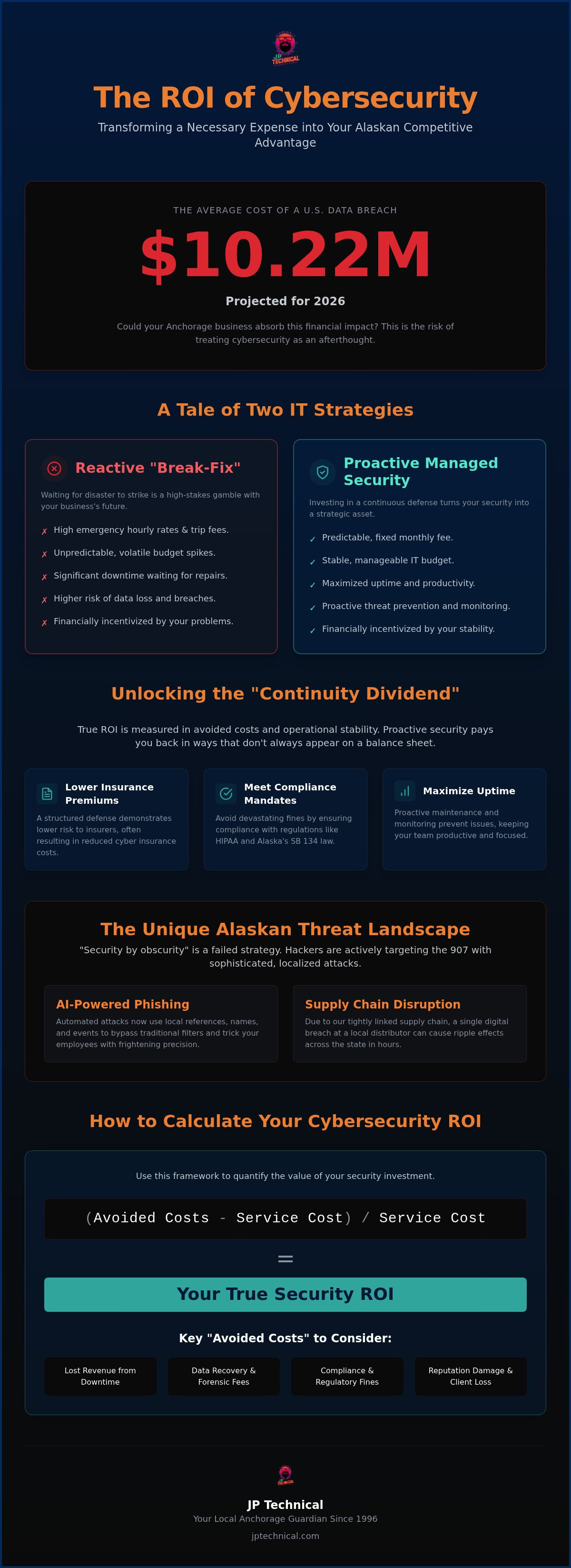
Step-by-Step: How to Calculate Your Business’s Cybersecurity ROI
Calculating the ROI of managed cybersecurity services doesn’t have to be a theoretical exercise. You can find concrete numbers by following a systematic process that accounts for both risk and operational performance. This approach moves beyond guesswork and gives you the data needed to make an informed decision for your Anchorage business. If you’re managing a local firm, this math is the best way to justify your security budget to stakeholders.
Step 1: Inventory your digital assets. List every critical business process and the data required to run it. This includes patient records, financial software, and internal communication tools.
Step 2: Assign a “Cost of Failure.” Determine how much money you lose every hour those assets are unavailable. Use the hourly downtime formula we discussed in the previous sections.
Step 3: Factor in the “Probability of Event.” Use 2026 industry data to estimate how often a breach or significant outage might occur. With U.S. data breach costs averaging $10.22 million, the risk is statistically significant for any size business.
Step 4: Compare the Annual Loss Expectancy (ALE) to the cost of services. Weigh the potential yearly loss against the predictable price of a managed service.
Step 5: Calculate the final ROI percentage. Use the formula: (ALE - Managed Service Cost) / Managed Service Cost.
The ALE Formula for Anchorage Business Owners
The core of your calculation is the Annual Loss Expectancy (ALE). You find this by multiplying the Single Loss Expectancy (SLE) by the Annual Rate of Occurrence (ARO). For a typical 20-person Anchorage office, an SLE might include the total cost of a single ransomware event, including recovery labor and lost revenue. If the probability of such an event is once every three years (an ARO of 0.33), your ALE is the yearly “tax” you pay for being unprotected. You can use our Free IT Assessment to help identify these baseline numbers for your specific environment. Request your Free IT Assessment today.
Factoring in Productivity Gains
While risk mitigation is the primary driver, don’t overlook the value of “No-Friction” IT. This represents the time saved when your team isn’t struggling with slow logins or waiting for support tickets to be resolved. Proactive patching and update management reduce the frequency of those minor disruptions that quietly eat into your daily productivity. When your staff can focus on core tasks without technical hurdles, the ROI of managed cybersecurity services increases through improved employee peace of mind and higher output. A stable network isn’t just a safety net; it’s an engine for your company’s growth.
Maximizing Your Security Spend with JP Technical’s Managed Solutions
Choosing a cybersecurity partner is a long-term commitment that directly impacts your bottom line. At JP Technical, we’ve served as a local guardian for Anchorage businesses since 1996. This deep history in the community means we understand the unique operational hurdles Alaska firms face every day. While national call centers offer generic support, our team provides the steady reliability of a neighbor who knows your network inside and out. The true ROI of managed cybersecurity services comes from a partnership built on transparency and local accountability.
Hidden fees are the enemy of any clean financial calculation. Our transparent pricing model eliminates ROI-killing surprises, allowing you to forecast your IT spend with total confidence. We don’t believe in “queue jumping” fees or complex billing cycles that leave you guessing. Instead, we offer a holistic approach that integrates digital defense with physical security. This unified strategy ensures that every vulnerability, from a weak password to an unsecured server room door, is addressed under one predictable management plan.
For medical practices, we turn the anxiety of compliance into a manageable operational cost. We create customized HIPAA roadmaps that align with your specific practice size and patient volume. This proactive stance protects your brand equity and prevents the devastating financial impact of notification requirements and civil penalties. By treating compliance as a routine part of your business continuity plan, you ensure your practice remains a trusted pillar of the Anchorage healthcare community.
Why Local Accountability Matters for ROI
Waiting for a technician from the “Lower 48” to understand Alaska’s unique infrastructure is a cost you shouldn’t have to bear. Regional internet outages or hardware shipping delays require a partner who can pivot quickly and provide on-site support in Anchorage, Wasilla, or the Kenai Peninsula. We take a straight-shooter approach to IT budgeting. This means we tell you exactly what you need to stay safe without the high-pressure marketing jargon. We show up when things get difficult, providing the calm, professional authority you need during a crisis. This local presence is a vital component of the ROI of managed cybersecurity services, as it slashes the time between a problem appearing and a resolution being reached.
Next Steps: Securing Your 2026 Budget
Presenting these ROI findings to your board or partners requires a focus on risk mitigation and operational gains. Use the calculations we’ve outlined to demonstrate how managed security pays for itself through lower insurance premiums and avoided downtime. If you need more precise data for your specific environment, requesting a customized Security Gap Analysis is the next logical step. We’ll help you refine your math by identifying the exact vulnerabilities in your current setup. This clear, data-driven perspective makes it easy to justify your security spend as a strategic investment in your company’s future stability. Schedule your Free IT Assessment today to start your ROI journey.
Securing Your Business Continuity in the Last Frontier
Navigating the digital landscape in 2026 requires more than just technical fixes. It demands a proactive strategy that treats security as a fundamental pillar of your business stability. By moving away from the volatile “break-fix” model, you protect your company from the hidden costs of downtime, insurance hikes, and compliance fines. Calculating the ROI of managed cybersecurity services shows that a steady defense isn’t just a safety measure; it’s a financial advantage that pays for itself through predictability and risk mitigation.
Since 1996, we’ve helped Anchorage businesses and medical practices build resilient defenses with specialized HIPAA and physical security expertise. We provide transparent, predictable pricing that eliminates the fear of hidden emergency fees. You deserve a local partner who understands the unique challenges of doing business in Alaska and remains vigilant so you don’t have to. Taking the first step toward a more secure future is simpler than you might think. Get Your Free IT & Security Assessment Protecting your livelihood is a long-term journey, but you don’t have to walk it alone. We’re here to provide the steady guidance and technical mastery your business needs to thrive in a complex world.
Frequently Asked Questions
Is managed cybersecurity actually cheaper than an in-house IT hire in Anchorage?
Yes, for most small to medium businesses in Alaska. An in-house IT professional requires a full salary, benefits, and specialized training that can be difficult to source locally. A managed team provides a broader range of expertise for a fraction of that total cost. You won’t have to worry about vacation coverage or single-point-of-failure risks. It turns a large, fixed labor cost into a scalable operational expense.
How much does a typical data breach cost a small business in Alaska in 2026?
The average cost of a data breach in the United States has reached $10.22 million in 2026. While small businesses might see lower raw totals, the impact is often more devastating relative to their revenue. In Alaska, these costs include forensic investigations, legal fees, and the high price of local downtime. Many local firms never fully recover from the financial and reputational damage of a major security event.
Can managed cybersecurity services really lower my insurance premiums?
Yes, insurance carriers now prioritize businesses with active, documented defense systems. Implementing managed security can lead to premium reductions of 20% to 30%. Insurers often require proof of Multi-Factor Authentication and Endpoint Detection and Response before they’ll even issue a quote. By maintaining a high security standard, you qualify for better coverage tiers and lower deductibles, which directly improves your company’s bottom line.
What is the average ROI for a managed service provider (MSP) investment?
Mid-sized enterprises often see the ROI of managed cybersecurity services exceed 300% when accounting for risk prevention. This figure includes the avoided costs of ransomware, data recovery, and lost productivity. By shifting from reactive “break-fix” IT to a proactive model, you eliminate the unpredictable spikes in emergency labor costs. This stability allows your business to reinvest capital into growth rather than constant technical firefighting.
How does HIPAA compliance factor into my cybersecurity ROI calculation?
HIPAA compliance acts as a significant revenue protector for Alaska medical practices. Fines for “willful neglect” in 2026 can exceed $50,000 per incident. When you calculate the ROI of managed cybersecurity services, you must include these avoided penalties and the saved cost of mandatory patient notifications. Compliance ensures your practice remains operational and maintains the trust of the local Anchorage community while avoiding catastrophic legal expenses.
What happens if we pay for managed security and still get hacked?
No system is 100% impenetrable, but managed services ensure you have a resilient recovery plan in place. If a breach occurs, our team provides immediate remote support and disaster recovery to minimize downtime. The goal is to detect threats early so they don’t become catastrophic events. Having a seasoned professional already on your network significantly reduces the time and cost required to return to normal operations.
How do I explain the ROI of “preventing something that hasn’t happened” to my boss?
Frame the conversation around risk transfer and business continuity. Explain that paying for security is like buying insurance for your digital assets. Use the Annual Loss Expectancy math to show the statistical likelihood of a breach based on current 2026 data. Demonstrating that the cost of even a single day of downtime outweighs the monthly service fee makes the financial logic clear to any decision-maker.
 Article by
Colter Hobbs