Integrating Physical and Cybersecurity in Anchorage: The 2026 Convergence Guide
If an intruder walks through your front door because of an unpatched badge reader, did they just bypass your entire digital firewall too? In 2026, the boundary between a physical lock and a network login has vanished. You likely feel the headache of managing separate vendors for your cameras and your IT, or perhaps you worry that integrating physical and cybersecurity Anchorage systems might compromise your network speed. It is a valid concern, especially when a single weak link can lead to a HIPAA violation or a data breach costing upwards of $11.5 million.
We understand that you need a security strategy that works quietly in the background without complicating your daily operations. This guide shows you how to eliminate those dangerous gaps by unifying your digital and physical defenses into a single, resilient strategy. You will learn how to achieve a unified security posture that is easy to manage and fully compliant with federal regulations. We will walk through the steps to ensure a physical breach never turns into a digital disaster, giving you the peace of mind to focus on your business while we stand watch.
Key Takeaways
Modern security treats every locked door and surveillance camera as a network endpoint rather than an isolated hardware piece.
You can eliminate the “finger-pointing” problem between different vendors by adopting a single, unified security strategy for your local business.
A practical 5-step roadmap will help you consolidate your identity management and close the gaps that lead to costly HIPAA violations.
Integrating physical and cybersecurity Anchorage allows you to protect your perimeter without compromising your network speed or operational efficiency.
A unified posture ensures that a physical breach won’t lead to a data breach, providing the long-term stability and peace of mind your organization needs.
Table of Contents
What is Physical and Cybersecurity Convergence?
Convergence is the formal integration of your physical security hardware and your IT infrastructure. In 2026, security is no longer about isolated silos. Every door lock, camera, and badge reader is a node on your network. If you treat them as separate entities, you create a fragmented defense that sophisticated attackers can easily exploit. To understand the technical foundation of What is Security Convergence?, one must look at how digital and physical protocols have merged into a single operational framework.
For Anchorage businesses, this shift is critical. Successfully integrating physical and cybersecurity Anchorage means moving away from the old model where security guards and IT departments never spoke. Today, a unified approach ensures that your protective measures are as rugged as the terrain we live in. We act as a Local Guardian for our clients because we understand that Alaska’s unique geography often leads to isolated networks that require specialized, integrated care.
To better understand this concept, watch this helpful video:
The Vanishing Border Between Digital and Physical
A physical badge reader on your warehouse door is no longer just a piece of plastic and wire. It’s a gateway to your server room. If that reader is unpatched, it becomes an entry point for malware. Many local firms struggle with shadow IoT, where surveillance equipment is installed without IT oversight. This lack of coordination leaves your network exposed. A free IT assessment can help identify these hidden vulnerabilities before they’re exploited.
Common Overlapping Controls in 2026
Convergence simplifies your life through shared controls. Identity management is a primary example. If you use the same credentials for door access and PC logins, you’ve consolidated your security perimeter. Modern IP cameras are now high-bandwidth network endpoints that require the same patching as your company laptops. Consider incident response. If a physical break-in occurs, your converged system can trigger an immediate digital lockdown. This prevents a physical intruder from also becoming a digital thief.
Why Your Cameras and Badge Readers are Now IT Assets
The transition from old analog CCTV to modern IP-based surveillance has fundamentally changed your office infrastructure. Your cameras and badge readers aren’t just hardware anymore; they are sophisticated computers running specialized software. Because they live on your network, they require the same level of care as your workstations and servers. This overlap is why integrating physical and cybersecurity Anchorage has become a necessity for local business owners who value long-term stability.
Power over Ethernet (PoE) is the backbone of this modern setup. It allows a single network cable to deliver both power and data to your devices. This makes installation cleaner, but it also means every outdoor camera is a potential physical entry point into your digital environment. If an intruder can access the cable, they might find a way to intercept your internal traffic. This is a risk that traditional security vendors often overlook because they don’t understand the underlying network architecture.
Protecting these devices requires a professional approach to Physical Security Solutions. You must treat your badge readers and cameras as vulnerable endpoints. If you leave their firmware unpatched, you’re essentially leaving a digital window unlocked. Regular updates are the only way to close the security holes that manufacturers discover after the hardware is installed. We believe in a proactive approach that treats every piece of hardware as a critical asset in your defensive lineup.
The Vulnerability of the ‘Smart’ Building
Insecure cameras are a favorite target for hackers looking to deploy ransomware. Many businesses fail to change default passwords, making it easy for automated scripts to take control of the hardware. Network Segmentation is the primary defense strategy that isolates your IoT devices so a compromised camera cannot reach your financial records. Without this separation, a single weak camera can compromise your entire business operation.
Integrating Surveillance with Managed IT
Your Network Video Recorder (NVR) is just as critical as your file server. It requires active monitoring and patch management to stay secure. In Anchorage, we often see 4K camera systems overwhelm local network speeds if they aren’t configured properly. We balance the bandwidth load to ensure your surveillance stays crisp without lagging your essential business applications. If you aren’t sure where your gaps are, a free IT assessment can help you map out a more secure future for your facility.
The High Cost of Siloed Security for Alaska Businesses
Managing separate vendors for your door locks and your laptops is a recipe for financial leakage. When you maintain these silos, you pay twice for administrative overhead and often miss the critical gaps where the two systems meet. For many organizations, integrating physical and cybersecurity Anchorage is the only way to ensure that a hardware failure doesn’t turn into a massive liability. Maintaining separate contracts for IT and surveillance often results in redundant fees and a lack of clear oversight.
We often see the finger-pointing problem in local offices. If a surveillance camera stops recording, the security vendor blames the network, while the IT vendor blames the hardware. This back-and-forth wastes valuable time while your facility remains vulnerable. In a converged model, there’s only one point of accountability. This streamlined approach leads to faster incident response times because the person fixing the camera also understands the switch it’s plugged into. You can read more about how this impacts medical practices in our guide on HIPAA Compliant IT Services in Anchorage.
HIPAA and Physical Security Convergence
The HIPAA Security Rule isn’t just about passwords; it specifically mandates physical access controls to protect workstations and data centers. If a visitor can simply walk into your records room or see a patient’s screen, you’re looking at a serious violation. This is where “Visual Hacking” becomes a threat that integrated cameras can help mitigate. By utilizing our HIPAA Compliance Services, you ensure that your physical hardware and digital logs work together to satisfy federal auditors. A camera that triggers a network alert when an unauthorized person enters a sensitive area is a powerful compliance tool.
The Operational Inefficiency of Multiple Vendors
Consider the burden on your office manager during employee offboarding. In a siloed environment, they must disable the email account in one portal and the building badge in another. It’s double-entry that invites human error. A unified provider eliminates this friction and reduces the security fatigue that comes from managing too many disconnected dashboards. We’ve seen local Anchorage offices save significant overhead simply by consolidating their IT and physical security under one roof. This allows managers to focus on growth instead of vendor management while ensuring no former employee retains access to the building or the server.
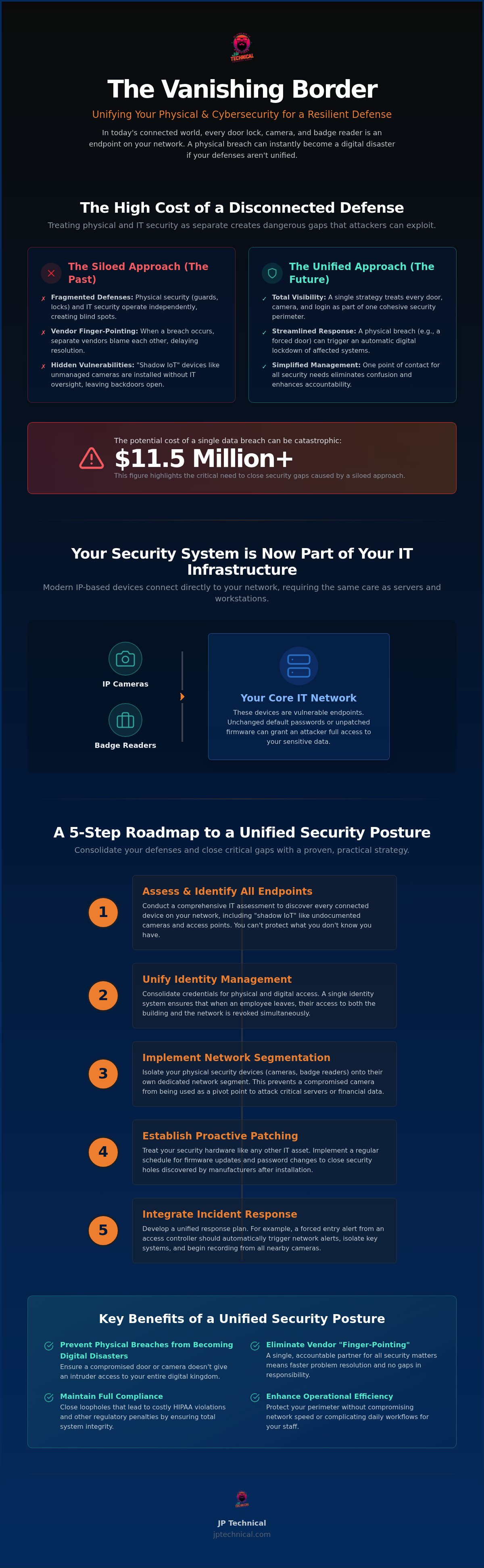
A 5-Step Roadmap for Security Convergence
Moving toward a unified posture isn’t an overnight task. It’s a methodical shift in how you view your business’s perimeter. Successfully integrating physical and cybersecurity Anchorage requires a structured approach to ensure no hardware or software is left exposed to modern threats. By following these five steps, you can bridge the gap between your server rack and your front door.
Step 1: Conduct a Unified Security Audit. You can’t protect what you haven’t mapped. This audit evaluates your physical locks and surveillance cameras alongside your digital firewalls and password policies to find overlapping vulnerabilities.
Step 2: Consolidate Identity and Access Management (IAM). Simplify your operations by using a single set of credentials for both building access and network logins. This ensures that when an employee leaves the company, their access is revoked across all systems simultaneously.
Step 3: Secure the Physical-to-Digital Bridge. Use network segmentation to isolate your IP cameras and badge readers. This prevents a compromised camera from being used as a jumping-off point to reach your financial data or client records.
Step 4: Implement Centralized Monitoring and Alerting. Use a single dashboard that displays both network traffic anomalies and physical access logs. If a door is forced open after hours, your IT team should see that alert on the same screen they use to monitor server health.
Step 5: Train Staff on Converged Security Protocols. Your team needs to understand that security is a shared responsibility. Training helps them recognize that a physical breach is often the first step of a sophisticated cyberattack.
Conducting a Local Security Assessment
Anchorage businesses face unique environmental hurdles that impact hardware reliability. Extreme temperatures and local power fluctuations can stress your physical security components. If your battery backups fail during a winter storm, you need to know if your server room door will remain locked and logged. Your assessment must look at these local factors and the physical grade of your locks. We recommend starting with a Free IT Assessment to identify where your environmental risks meet your digital vulnerabilities. Schedule your local security assessment today
Training for the 2026 Threat Landscape
The human element remains a primary concern for any security strategy. Tailgating occurs when an employee holds a secure door for an unverified visitor; it’s a polite gesture that creates a massive cybersecurity risk. We teach your staff to report suspicious activity on the premises just as they would a phishing email in their inbox. This proactive mindset is essential for maintaining a resilient defense. Security Culture is the collective mindset where every staff member acts as a vigilant guardian of the company’s assets.
Securing Your Perimeter and Your Network with JP Technical
You need a security partner who acts as a straight-shooter, someone who tells you exactly where your vulnerabilities lie without the marketing fluff. We have been serving the Alaska business community since 1996, providing the steady reliability required to manage complex technical environments. Successfully integrating physical and cybersecurity Anchorage is not just about installing new hardware; it is about building a long-term partnership with a local guardian who understands your specific operational needs.
Our approach ensures that your security isn’t managed in disconnected pieces. When you utilize our Managed IT Services, we include physical oversight as a core component of your business continuity plan. This means we don’t just watch your servers; we watch the doors that lead to them. We provide this comprehensive protection for local business owners across Anchorage, Wasilla, Kenai, and Fairbanks, offering the peace of mind that comes from true professional vigilance.
Why a Local Partner Matters for Convergence
If a critical badge reader fails or a surveillance node goes offline, a distant vendor cannot help you quickly. A local partner provides rapid on-site response to ensure your physical perimeter remains intact. We also possess a deep understanding of the regulatory landscape unique to the State of Alaska. This includes staying ahead of requirements like the Alaska Insurance Data Security Law (SB 134), which became effective on January 1, 2026, and the Alaska Personal Information Protection Act (APIPA). We act as a local guardian for your data and your doors, ensuring that your compliance documentation is always ready for an audit.
Next Steps: Toward a Unified Defense
Investing in a converged strategy offers a significant long-term ROI. By unifying your defenses, you often qualify for lower insurance premiums and drastically reduce the risk of a breach that could cost millions. You can review our pricing for integrated services to see how consolidation actually simplifies your monthly technology spend. We invite you to take the first step toward a more predictable and secure future by reaching out for a professional evaluation of your current posture. Contact JP Technical for a Converged Security Review
Building a Resilient Future for Your Anchorage Business
The security landscape in 2026 demands more than just separate locks and firewalls. By integrating physical and cybersecurity Anchorage businesses can close the dangerous gaps that siloed systems often leave behind. You’ve seen how badge readers and cameras have become critical network endpoints that require proactive patching and monitoring. Consolidating your defense under a single provider not only streamlines your operations but also ensures you meet strict HIPAA and state regulations without the typical vendor finger-pointing.
Since 1996, we’ve provided local boots-on-the-ground support to help our neighbors navigate these complex technical shifts. As HIPAA compliance specialists, we understand that protecting your data starts with securing your server room door. We’re here to act as your local guardian, providing the steady vigilance your organization deserves. We take the technical burden off your shoulders so you can focus on running your business. Secure Your Business with a Free Converged Security Assessment Your peace of mind is our priority. We’re ready to help you build a safer, more predictable future for your team and your clients.
Frequently Asked Questions
What is the biggest risk of not integrating physical and cybersecurity?
The biggest risk is a security blind spot where a physical breach enables a digital catastrophe. If an intruder gains physical access to your server room because of a disconnected badge system, they can plant hardware keyloggers or bypass firewalls entirely. Without integration, your IT team won’t receive real-time alerts from the door system. This delay often leads to undetected data theft or ransomware deployment that could have been stopped.
Can my existing analog cameras be part of a converged security system?
Yes, you can integrate existing analog cameras by using encoders that convert their signals into digital data for your network. However, these legacy systems often lack the advanced encryption and AI-driven threat detection found in modern IP hardware. While encoders provide a temporary bridge, we recommend a phased upgrade to IP cameras. This ensures your surveillance acts as a secure network endpoint rather than a weak entry point.
How does physical security impact my HIPAA compliance in Anchorage?
Physical security is a mandatory pillar of the HIPAA Security Rule because it protects the workstations and servers where patient data lives. By integrating physical and cybersecurity Anchorage, you ensure that every access attempt to sensitive areas is logged and verifiable for auditors. If a physical lock fails or a camera is bypassed, your converged system provides the digital trail needed to prove you maintained reasonable safeguards.
Will integrating these systems slow down my office internet speed?
Integration won’t slow down your internet if your network is architected correctly with dedicated VLANs and high-quality switches. We use network segmentation to keep camera traffic on its own path, preventing high-bandwidth 4K video streams from interfering with your primary business applications. Proper configuration ensures that your surveillance stays crisp while your team continues to work at full speed without any noticeable latency or connection drops.
Do I need a separate vendor for my door badge system and my IT support?
No, using a single vendor for both systems is the safer and more efficient choice for local businesses. Having one point of contact eliminates the “finger-pointing” problem where different vendors blame each other for connectivity issues. A unified provider ensures that your badge system is patched and secured with the same level of vigilance as your email servers, firewalls, and other essential digital assets.
What happens to my physical security if my business network goes down?
Most professional-grade access control systems are designed to store permissions locally on-site, allowing badges to continue working even if the main network connection is lost. Once the network is restored, the system automatically syncs the access logs. We also implement battery backups to ensure your locks remain operational during local power fluctuations. Your building stays secure even when the internet is temporarily unavailable or during winter storms.
How often should I audit my converged security system?
We recommend a comprehensive audit at least twice a year to account for employee turnover and hardware wear. During these reviews, we verify that former employees have had their access revoked across both digital and physical platforms. Regular audits also involve checking camera angles, testing battery backups, and ensuring that firmware updates are current for all IoT devices. This proactive approach prevents your hardware from becoming an entry point.
Is keyless entry safer than traditional locks for my Anchorage office?
Keyless entry is significantly safer because it provides a granular audit trail that physical keys can’t match. If a traditional key is lost, you must rekey the entire building, which is expensive and slow. Integrating physical and cybersecurity Anchorage allows you to deactivate a single lost badge in seconds. You can also set time-based permissions, ensuring that staff can only enter the building during their specifically scheduled shifts.
 Article by
Colter Hobbs