HIPAA Risk Management: 2026 Guide for Alaska Healthcare
A single unaddressed security gap in your Anchorage clinic is often the only invitation a federal auditor needs to dismantle years of hard work. While many Alaska providers view HIPAA compliance risk management as a digital chore to be checked off once a year, the reality is much more personal. It’s about protecting the neighbors who trust you with their most sensitive information. If your current strategy relies on outdated templates or distant IT support that doesn’t understand the unique workflows of a local medical practice, you’re likely leaving your data exposed to more than just technical glitches.
It’s completely normal to feel overwhelmed by the technical jargon and the looming threat of massive fines. You want to focus on patient care, not deciphering complex regulatory requirements. This 2026 guide will help you master the essentials of HIPAA risk management so you can protect your patient data and ensure your practice remains audit-ready. We’ll break down the specific steps for a thorough risk analysis, explain how to bridge the gap between physical and digital security, and show you how a local partner can simplify your compliance roadmap.
Key Takeaways
Understand how the 2026 threat landscape, including AI-driven phishing, makes proactive identification of vulnerabilities a requirement for every Alaska clinic.
Master the three pillars of HIPAA compliance risk management to ensure your administrative, physical, and technical safeguards work together to protect patient data.
Learn the critical difference between a risk assessment and a risk analysis so you can provide the specific documentation federal auditors expect.
Build a clear, documented roadmap that transforms compliance from a stressful annual event into a steady, manageable part of your daily operations.
Discover how partnering with a local specialist simplifies security hurdles by combining managed IT services with physical surveillance for total practice protection.
Table of Contents
The Three Pillars of HIPAA Safeguards: Administrative, Physical, and Technical
HIPAA Risk Assessment vs. Risk Analysis: Clearing the Confusion
Understanding HIPAA Compliance Risk Management in 2026
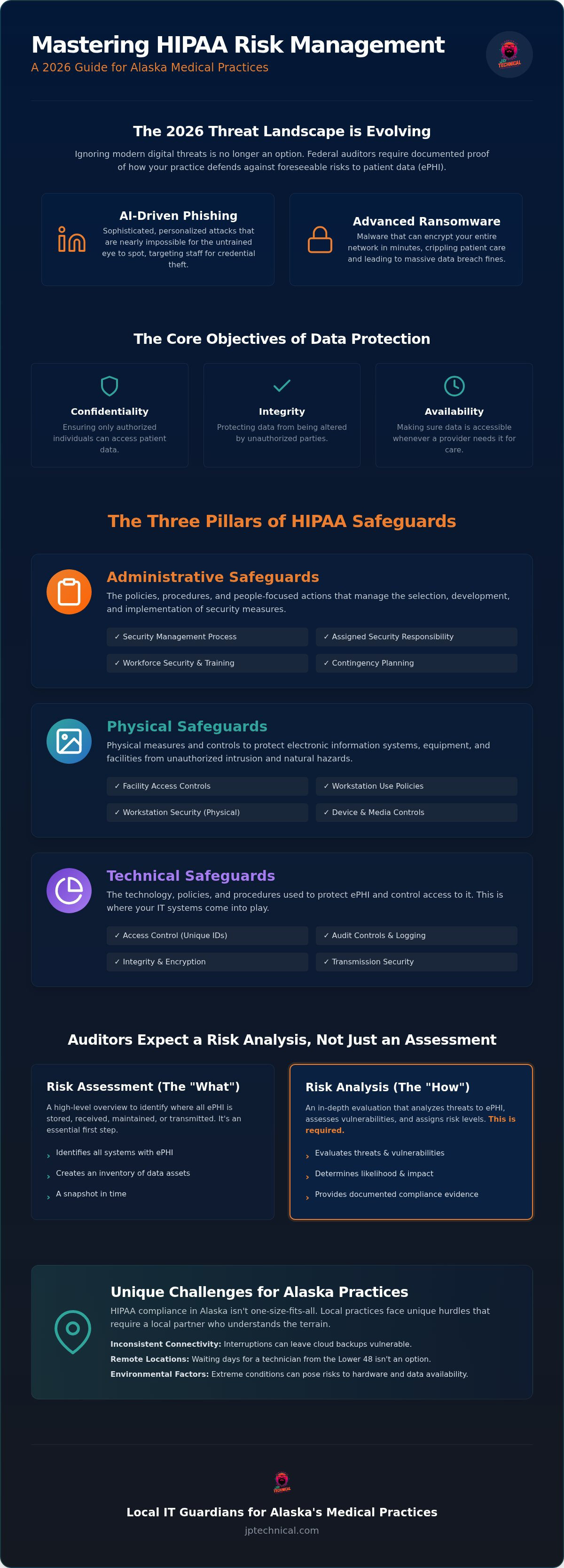
The process of HIPAA compliance risk management is the foundation of a secure medical practice. It’s not a one-time event or a dusty binder on a shelf; it’s a continuous cycle of identifying, assessing, and mitigating threats to electronic Protected Health Information (ePHI). This framework originates from the Health Insurance Portability and Accountability Act (HIPAA), which mandates that providers take proactive steps to safeguard patient data. In 2026, this means moving beyond basic firewalls to address a landscape where hackers use automated tools to find even the smallest crack in your defenses.
The 2026 threat landscape has shifted significantly. We’re seeing AI-driven phishing attacks that are nearly impossible for the untrained eye to spot and sophisticated ransomware that can encrypt an entire network in minutes. These aren’t just “tech problems” anymore. They’re direct threats to your ability to treat patients. The Office for Civil Rights (OCR) has made it clear that ignoring these modern hazards isn’t an option. They enforce standards that require you to document exactly how you’re defending your practice against these evolving risks.
When you look at the HIPAA Security Rule, you’ll find implementation specifications labeled as either “required” or “addressable.” It’s a common misconception that addressable means optional. If a spec is required, you must implement it exactly as stated. If it’s addressable, you have the flexibility to implement an alternative security measure that achieves the same goal, but you must document why that choice was made. Failing to provide this documentation is one of the quickest ways to fail an OCR audit.
The Core Objectives of a Risk Management Program
A solid program focuses on the “CIA triad” of data: confidentiality, integrity, and availability. You must ensure that only authorized people see patient data, that the data isn’t altered by unauthorized parties, and that it’s available whenever a provider needs it for care. To do this, you have to prepare for reasonably anticipated threats. In 2026, a reasonably anticipated threat is defined as any foreseeable event, such as an AI-powered credential theft attempt or a hardware failure caused by extreme environmental conditions, that poses a credible risk to ePHI.
Why Alaska Practices Face Unique Compliance Challenges
Implementing HIPAA compliance risk management in Fairbanks or Kenai looks different than it does in the Lower 48. Alaska medical practices often deal with inconsistent connectivity that can interrupt cloud-based backups, leaving data vulnerable during a sync. If your practice is in a remote area like Wasilla or Palmer, you can’t afford to wait days for a technician to fly in when a server goes down. You need a local guardian who understands these regional hurdles.
Having a “straight-shooter” local expert who knows the Alaska business climate is invaluable. We understand that a clinic in the Kenai Peninsula has different physical security needs than one in downtown Anchorage. By focusing on HIPAA compliance services that prioritize local accountability, you can reduce the anxiety of data breaches and keep your focus on what matters most: your patients.
The Three Pillars of HIPAA Safeguards: Administrative, Physical, and Technical
Effective HIPAA compliance risk management depends on a strategy known as “defense in depth.” This approach doesn’t rely on a single password or a locked door to protect your practice. Instead, it layers your defenses across three distinct categories to ensure that if one layer is breached, others remain standing. According to the AMA’s guide to the Security Rule, these safeguards are designed to be flexible but mandatory. If you neglect even one pillar, your entire compliance posture collapses. We advocate for a state of “proactive vigilance.” This means you’re constantly monitoring these layers rather than waiting for an audit to find a hole in your system.
Physical Safeguards: Beyond the Computer Screen
Many providers focus so heavily on software that they ignore the hardware sitting right in front of them. Physical safeguards are about controlling who can touch your machines. In a high-traffic Anchorage clinic, this starts at the front desk and extends to the back office. You must ask: who has access to your server room? If you don’t have electronic physical access controls, you can’t verify who entered that space or when. Security is a team effort.
Professional security camera systems also play a vital role in documenting authorized access. They provide a visual audit trail that proves only authorized personnel were near sensitive workstations. In clinics across Fairbanks or Wasilla, workstation security is equally critical. A computer left logged in at a nursing station is a major physical vulnerability. We recommend implementing privacy screens and automatic log-offs to mitigate these risks. Documenting these steps isn’t just about catching intruders. It’s about proving to the OCR that you’ve taken every reasonable step to secure your environment.
Technical and Administrative Safeguards
Technical safeguards act as your digital immune system. This includes full-disk encryption and Endpoint Detection and Response (EDR) to stop malware in its tracks. Secure remote access is also vital for Alaska providers who might need to check records from a satellite office or while traveling. If your software isn’t updated, you’re essentially leaving your digital front door unlocked. Proactive patch management ensures your systems stay ahead of the latest vulnerabilities.
Administrative safeguards are the “people” part of the equation. This involves conducting a regular risk analysis and ensuring you have signed Business Associate Agreements (BAAs) with every vendor who touches your data. You must also ensure your staff knows exactly what to do if they suspect a breach. This requires regular training sessions that go beyond a simple annual video. It’s about building a culture of security within your practice. If you’re unsure where your practice stands, a free IT assessment can help identify gaps in your three pillars before they become liabilities.
HIPAA Risk Assessment vs. Risk Analysis: Clearing the Confusion
Many practice managers use the terms “assessment” and “analysis” as if they’re the same thing. While they’re closely related, they serve different purposes during an audit. A risk assessment is the “What.” It’s the process of identifying specific vulnerabilities in your environment, such as a back door that doesn’t lock properly or a server that hasn’t been patched in six months. Think of it as a thorough inventory of every potential weak point in your practice. Integrating these findings into a broader strategy for HIPAA compliance risk management is what moves you from simply finding problems to actually solving them.
The risk analysis is the “So What.” This step takes the vulnerabilities you found and evaluates the likelihood of a threat occurring and the impact it would have on your patient data. It’s the difference between knowing a window is unlocked and understanding that the window leads directly to your server room. A successful 2026 HIPAA risk analysis results in a prioritized list of vulnerabilities with specific, documented mitigation strategies for each.
When to Conduct Each Process
While an annual review is the standard, certain “trigger events” require you to perform a fresh analysis immediately. If you’re moving offices in Anchorage or Wasilla, your physical safeguards have changed, and your previous documentation is no longer valid. Similarly, implementing new medical software or switching to a cloud-based EHR necessitates a new look at your technical safeguards. Relying on generic online templates is a dangerous shortcut. These templates don’t reflect the actual layout of your Fairbanks clinic or the specific way your staff handles records, which makes them essentially useless during a federal investigation.
Evaluating Likelihood and Impact
We use a structured scoring system to help you understand your risk profile. Every vulnerability is categorized into Low, Medium, and High risk tiers based on two factors: how likely it is to be exploited and how much damage it would cause. For example, an unencrypted laptop used for remote work is a “High Impact” risk. If that device is lost or stolen, the breach is immediate and often requires public notification. These high-priority items require immediate remediation to protect your reputation and your bottom line.
At JP Technical, we help Alaska practices prioritize these findings so you don’t feel like you have to fix everything at once. We look at your specific operational needs and help you manage your budget effectively by tackling the most dangerous gaps first. By focusing on a clear roadmap, we turn a complex regulatory requirement into a steady, manageable process that provides genuine peace of mind. If you’re ready to see where your practice stands, you can review our HIPAA compliance services to start building your defense.
How to Build a HIPAA Risk Management Plan for Your Practice
Building a HIPAA compliance risk management plan is a methodical journey that moves from initial discovery to long-term maintenance. You can’t just fix things as they break; you need a structured roadmap that addresses every corner of your operations. It’s vital to remember that in the eyes of the Office for Civil Rights (OCR), a plan only exists if it’s thoroughly documented. Without a written record of your decisions and actions, you lack a legal defense during an audit. This is where HIPAA Compliant IT services in Anchorage serve as a critical support pillar. A local partner provides the on-site physical audits that distant vendors simply can’t perform.
Step 1: Inventory Your ePHI and Assets
You have to start by identifying every single device that touches patient data. This includes obvious hardware like servers and workstations, but it also covers tablets used for patient intake and even smart cameras in your hallways. Once you have an inventory, you must map your data flow. Where does patient information go when it leaves your office? If it’s being sent to a billing company or stored in a cloud backup, those paths must be secured. Here’s a straight-shooter tip: if you don’t know an asset exists, you can’t protect it. Accountability starts with visibility.
Step 2: Identify and Prioritize Vulnerabilities
The next phase involves running a Cyber Security Audit to find network weak spots. we look for unpatched software, weak encryption, and open ports that act as invitations for hackers. However, digital checks aren’t enough. You must also inspect your physical environment. Are your server racks locked? Are your security cameras functional and recording? We also look at workforce habits. In a Fairbanks or Wasilla office, for example, we often find passwords written on sticky notes or staff sharing login credentials. These human errors are just as dangerous as a technical bug.
Step 3: Implement Controls and Document Everything
Once vulnerabilities are identified, you must apply the necessary controls. This includes technical patches, physical locks, and clear administrative policies. Documentation remains your best defense. You need to record what you found, what you did about it, and why you chose that specific solution. We recommend a schedule of “steady reliability” to keep your practice safe. This involves monthly security reviews and quarterly updates to your risk analysis. Consistency builds trust and ensures you’re never caught off guard. Schedule your free IT assessment today
Securing Your Alaska Medical Practice with JP Technical
Managing HIPAA compliance risk management shouldn’t feel like a burden you carry alone. At JP Technical, we act as the local guardian for medical practices throughout the state. We handle the technical heavy lifting so you can focus on providing quality care to your patients. Since our founding in 1996, we’ve built a reputation for steady reliability and protective vigilance. We don’t just offer digital solutions; we provide a physical presence that national vendors cannot match. Our team remains calm under pressure, serving as a stable partner for the long term.
We specialize in the synergy between managed IT services and physical surveillance. This unique combination ensures that your data is protected both on the server and in the office. If a security gap is identified, we don’t just send a report. We show up on-site to install the necessary access controls or security cameras. This comprehensive approach eliminates the confusion of managing multiple vendors and creates a unified defense for your practice.
Our Local Approach to HIPAA Compliance
We believe that proximity matters. Our team provides dedicated on-site support in Anchorage, Wasilla, Kenai, Palmer, and Fairbanks. This local accountability means we understand the specific environmental and connectivity hurdles Alaska providers face. We don’t believe in one-size-fits-all solutions. Instead, we develop customized risk management plans tailored to the specific size and workflow of your clinic. If your practice operates out of multiple satellite offices, we ensure your security standards are consistent across every location.
Communication is the cornerstone of our partnership. We pride ourselves on being straight-shooters who speak plain English. You won’t have to decode “IT-speak” to understand your compliance status. We provide clear update on your security posture and explain the practical impact of every technical decision. This transparency builds the trust necessary for a successful partnership.
Next Steps: Get Your Professional Assessment
The first step toward a more secure practice is understanding your current vulnerabilities. We encourage you to start with a Free IT Assessment. This initial discovery process allows us to identify immediate risks and provide a clear roadmap for remediation. We also offer transparent pricing so you can plan your compliance budget with confidence. You won’t find hidden fees or high-pressure sales tactics here; we value honesty and predictable costs.
Choosing JP Technical means choosing peace of mind. We act as your seasoned guide through the complexities of federal regulations. You don’t have to face the OCR alone. With a reliable local partner by your side, you can reduce the anxiety of data breaches and ensure your practice remains audit-ready for 2026 and beyond.
Protecting Your Practice for the Years Ahead
HIPAA is a living process that requires constant attention. You’ve learned that true security involves layering your defenses across administrative, technical, and physical pillars. By distinguishing between assessment and analysis, you can prioritize the vulnerabilities that pose the greatest threat to your patient data. Mastering HIPAA compliance risk management is about more than just avoiding a fine; it’s about honoring the trust your community places in your care.
Since 1996, we’ve served as a dedicated ally for Alaska healthcare providers. We specialize in the unique intersection of cybersecurity and physical access controls. Whether you’re in Anchorage or the Mat-Su Valley, our team provides the local on-site support needed to handle threats quietly in the background. You don’t have to navigate these regulatory hurdles alone. Schedule your free HIPAA IT assessment with JP Technical today Take the first step toward a predictable, secure future for your clinic. We’re here to help you build a roadmap that provides lasting peace of mind.
Frequently Asked Questions
What is the most common HIPAA risk identified in small practices?
The most frequent risk is the use of unencrypted portable devices like laptops or USB drives. If these items are lost or stolen, it triggers an immediate breach notification requirement. Small practices also frequently struggle with insider threats, which are often just well-meaning employees who haven’t received proper training on phishing or password security. Addressing these gaps is a foundational part of HIPAA compliance risk management for any local clinic.
How often is a HIPAA risk analysis required by law?
Federal regulations require you to conduct a risk analysis as needed to ensure your safeguards remain effective. In practice, the OCR expects an annual review or a new analysis whenever you implement major changes, such as moving offices or adopting a new EHR system. Regular updates prove to auditors that your security posture is proactive rather than reactive. Staying on a consistent yearly schedule is the best way to maintain steady reliability.
Can I perform a HIPAA risk assessment myself using the HHS tool?
You can use the HHS Security Risk Assessment (SRA) tool, but it’s important to understand its limitations. The tool is designed to help you identify vulnerabilities, but it doesn’t automatically fix them or provide the deep analysis required by auditors. Many Alaska providers find the tool’s technical questions confusing. A self-assessment is a good starting point, but most practices need a professional partner to translate those findings into a documented, actionable plan.
Do small medical practices in Alaska really get audited for HIPAA?
Yes, Alaska practices of all sizes are subject to audits and investigations. The OCR doesn’t only target large hospital systems; they also investigate small clinics following patient complaints or reported data breaches. In cities like Fairbanks or Anchorage, a single lost laptop can trigger a federal inquiry. Being small doesn’t grant immunity. Having a documented plan is your only defense when an auditor asks to see your compliance records.
What is the penalty for not having a HIPAA risk management plan?
Penalties for non-compliance are tiered based on the level of negligence. If you don’t have a HIPAA compliance risk management plan, fines can reach tens of thousands of dollars per violation. Beyond the financial impact, the OCR often imposes a multi-year corrective action plan that requires federal monitoring of your daily operations. This oversight is often more disruptive and costly to a small practice than the initial fine itself.
Does HIPAA compliance cover physical security cameras and door locks?
Yes, physical security is a mandatory pillar of the HIPAA Security Rule. You must implement safeguards that limit physical access to electronic information systems and the facilities where they’re housed. This includes using professional security cameras to monitor sensitive areas and electronic door locks to control access to server rooms. Documenting these physical controls is just as important as your digital firewall when proving you’ve taken every reasonable precaution to protect data.
What is a Business Associate Agreement (BAA) and why do I need one?
A Business Associate Agreement is a legal contract between a healthcare provider and a vendor that handles patient data. You need a signed BAA with every partner, including your IT provider, billing company, or cloud storage vendor. This document ensures that the vendor agrees to follow HIPAA standards and accepts liability for protecting your ePHI. Without these agreements, you are legally responsible for any mistakes or breaches caused by your third-party partners.
How does JP Technical help Anchorage businesses with HIPAA audits?
We provide the local, on-site support that national IT firms can’t offer to Anchorage businesses. Our team assists by performing thorough physical and technical audits, identifying gaps, and documenting every remediation step. If you’re ever audited, we stand by you with the records and technical proof needed to satisfy federal requirements. We act as your local guardian, handling the technical heavy lifting so you can remain calm under pressure during an investigation.
 Article by
Colter Hobbs