Alaska IT Infrastructure: 2026 Resilient Business Guide
Imagine a mid-winter morning where your Fairbanks office loses its connection just as a critical shipment needs processing, and the nearest technician is a flight away. It’s a common frustration for local leaders who deal with the reality of remote latency and the high cost of trying to maintain an expert in-house team. You already know that technology in the Last Frontier isn’t just about hardware; it’s about survival and staying ahead of shifting regulations like the 2026 insurance data security requirements.
You shouldn’t have to lose sleep over HIPAA compliance or the threat of a data breach during your busiest season. This guide outlines how professional IT infrastructure management Alaska businesses trust can transform your technology from a source of anxiety into a silent, reliable partner. We’ll show you how to secure a digital perimeter that protects your assets and ensures zero downtime when it matters most. By the end of this article, you’ll have a clear roadmap to predictable costs and a resilient foundation that handles the technical heavy lifting while you focus on growth.
Key Takeaways
Learn how to harden your network against Alaska’s unique environmental challenges, including power fluctuations and remote connectivity hurdles.
Discover why effective IT infrastructure management Alaska depends on an “Integrated Perimeter” that pairs digital cybersecurity with physical surveillance.
Identify the hidden costs of the “single point of failure” in-house staffing model and how a managed team provides more predictable operational stability.
Gain a clear, step-by-step audit process to identify vulnerabilities and implement essential protections like MFA and automated patch management.
Understand the critical role of HIPAA-compliant frameworks in protecting your professional practice from evolving data security threats in 2026.
Table of Contents
What is IT Infrastructure Management in the Alaskan Context?
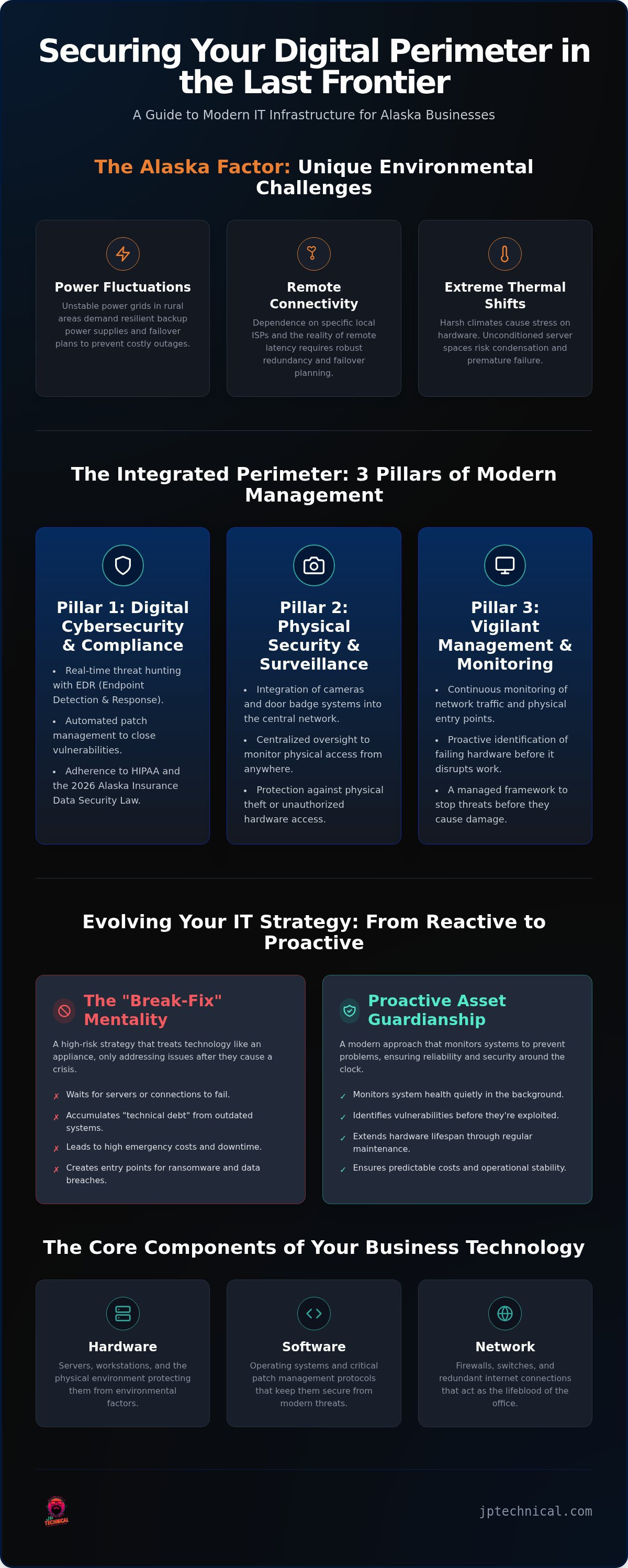
When we talk about IT infrastructure, we aren’t just discussing cables and computers; we are describing the foundational systems that allow your business to exist. In its simplest form, this includes the combined components of your hardware, software, networks, and the physical facilities that house them. For a business in Anchorage or Fairbanks, these elements must work in perfect harmony to withstand the specific environmental and regulatory pressures of 2026.
Effective IT infrastructure management Alaska requires a shift from the old “break-fix” mentality. Instead of waiting for a server to fail, we practice proactive asset guardianship. This means we monitor the health of your systems quietly in the background, identifying a failing hard drive or a security vulnerability before it disrupts your workday. In our climate, technology faces the “Alaska Factor.” This includes everything from unstable power grids in rural areas to extreme thermal shifts that can cause condensation in unconditioned server spaces. If your infrastructure isn’t designed with these local realities in mind, it’s only a matter of time before the environment creates a costly outage.
Choosing local expertise over a national, remote-only provider is a strategic decision. A technician in a lower-48 call center can’t physically inspect your backup power supplies or understand the nuances of local ISP redundancy. Since 1996, we’ve focused on being a reliable neighbor. We know that when the wind picks up in the Mat-Su Valley, your connectivity needs a resilient failover plan that actually works.
The Core Components of Your Business Tech
Your infrastructure is built on three essential pillars. First is the Hardware, which consists of your servers, workstations, and the physical environment protecting them. Second is the Software layer, including your operating systems and the critical patch management protocols that keep them secure. Finally, your Network acts as the lifeblood of the office. This encompasses your firewalls, switches, and the redundant internet connections that keep you online when a primary link fails.
Why ‘Setting and Forgetting’ is a High-Risk Strategy
If you treat your technology like a home appliance that only needs attention when it breaks, you’re accumulating technical debt. Outdated firmware and unmanaged systems are the primary entry points for modern ransomware. Proactive maintenance doesn’t just prevent attacks; it extends the lifespan of your hardware. In harsh climates, a server that’s regularly cleaned and monitored for thermal stress will outlast a neglected one by years. Vigilance today prevents the emergency expenses of tomorrow.
The 3 Pillars of Modern Infrastructure Management
Robust IT infrastructure management Alaska businesses rely on stands on three distinct pillars. We call this the Integrated Perimeter. It’s a strategy where your digital defenses and physical security protocols work as a single unit. If your server room is locked behind a smart door but your network is open to ransomware, you aren’t protected. Likewise, a secure firewall won’t stop someone from walking off with a physical drive. Vigilant Management is the continuous monitoring of both network traffic and physical entry points. This model moves you away from the reactive break-fix cycle and into a managed framework where threats are stopped before they cause damage.
Pillar 1: Digital Cybersecurity & Compliance
Cybersecurity is no longer just about installing a basic antivirus. We implement EDR (Endpoint Detection and Response) to hunt for threats in real time. For healthcare providers and insurance licensees, compliance is a legal necessity. With the Alaska Insurance Data Security Law (SB 134) taking effect on January 1, 2026, the requirements for data security standards and breach reporting have become even stricter. You can find detailed support through JP Technical HIPAA services to ensure your practice meets these evolving standards without the stress of manual tracking.
Pillar 2: Physical Security & Surveillance
Physical security is an often overlooked component of IT. Your cameras, door badge systems, and keyless entry hardware all live on your central network. If these systems aren’t managed correctly, they create vulnerabilities. Integrating these tools into your infrastructure allows for centralized oversight. You gain the ability to monitor office access from anywhere, ensuring that only authorized personnel reach your sensitive hardware. Explore how we handle JP Technical Physical Security to see the difference a unified approach makes.
Pillar 3: Continuity & Disaster Recovery
In Alaska, environmental risks are real. Power grid fluctuations and natural events can take a business offline in seconds. True business continuity is different from a simple file backup. It’s about having a system that allows you to keep working even if your primary hardware is destroyed. We design these systems to survive the local challenges we face every day. For a deeper look at protecting your operations, read our guide on Managed IT Services in Anchorage: The 2026 Guide to Business Continuity.
If you’re unsure where your current defenses stand, a free IT assessment can help identify the gaps in your perimeter before they become liabilities.
In-House vs. Managed IT: A Comparison for Alaska Businesses
Hiring an in-house IT manager in Anchorage often seems like the most direct way to control your technology. However, the 2026 labor market presents a difficult challenge. There is a documented shortage of high-level technical talent in Alaska, which drives up compensation expectations and makes retention a constant struggle. When you rely on a single individual for IT infrastructure management Alaska businesses often find themselves vulnerable to the “Single Point of Failure” risk. If that person leaves or takes a vacation, they take the keys to your digital kingdom with them. This creates a gap in your defenses that a local guardian team can prevent.
Managed IT shifts this burden from a single employee to a specialized team. This model provides continuous monitoring that no individual can realistically sustain alone. We act as a dedicated ally, ensuring your systems remain operational while you sleep. Because we are based in Anchorage and serve Wasilla, Kenai, and Fairbanks, you get the benefit of neighborly accountability. You know exactly where we are if a problem arises. We’ve been part of this community since 1996, and we understand the urgency of showing up when things get difficult.
The Financial Reality of IT Staffing in 2026
The true cost of an in-house manager goes far beyond their base salary. In Anchorage, a qualified IT lead can easily command a six-figure salary. When you add payroll taxes, health insurance, and the thousands of dollars required for annual certifications, the budget becomes significant. Managed services replace these variable, high-cost expenses with a predictable monthly fee. This stability allows for much easier cash flow management. You can review our JP Technical Pricing frameworks to see how this compares to your current staffing projections.
Depth of Expertise: One Person vs. a Specialized Team
Technology has become too complex for one person to master every discipline. Your business needs an expert in cybersecurity to handle EDR, a specialist in physical access for your surveillance systems, and someone who understands the intricacies of HIPAA compliance. Finding all these skills in one hire is nearly impossible. A managed provider brings a “bench” of specialists to every problem. If a complex network issue occurs, we have a technician who has seen it before. If a physical security sensor fails, we have a specialist ready to assist. This collective mastery provides a level of peace of mind that a solo hire simply cannot match. We handle the technical threats quietly in the background, allowing you to focus on your actual work.
Step-by-Step: Building Your Infrastructure Management Plan
A resilient plan for IT infrastructure management Alaska companies can trust begins with clarity. You can’t defend assets you haven’t identified. We start by moving past the day-to-day “fires” to build a structured framework that anticipates trouble. This process ensures your technology supports your business goals rather than dictating them. By following a methodical approach, you move from a state of constant technical anxiety to one of predictable stability.
Step 1: The Infrastructure Audit
We begin by documenting every device, software license, and physical entry point in your facility. This isn’t just a list; it’s a map of your risk. We specifically look for “End of Life” (EOL) hardware. These are devices no longer supported by the manufacturer with security updates. If you’re running a server from 2018, it’s a standing invitation for modern ransomware. Identifying these weak links early allows for a planned, budget-friendly replacement rather than an emergency purchase after a failure. We also verify that your current facilities have the proper thermal controls and power surge protection needed for our climate. Schedule your free IT assessment
Step 2: Hardening the Network & Physical Entry
Once we know what you have, we harden it. This involves upgrading firewalls and implementing managed software updates to close known security gaps. In Alaska, physical security is just as critical as digital defense. We integrate security cameras with remote viewing capabilities so you can monitor your Anchorage or Wasilla office from anywhere. If a sensor detects unauthorized motion at 2:00 AM, you should know instantly. For a deeper look at hardware choices, see our Commercial Security Camera Installation in Anchorage: The 2026 Business Buying Guide.
Step 3: Continuous Monitoring & Review
The final step is establishing a non-negotiable routine. We set up automated alerts for hardware failures and unauthorized access attempts. This allows us to handle threats quietly in the background. Patch & Update Management is the heartbeat of this phase. We don’t wait for a convenient time to secure your systems; we do it systematically. Quarterly business reviews then ensure your technology stays aligned with your growth. If you plan to expand to Kenai or Fairbanks next year, your infrastructure needs to be ready for it today.
Finally, we develop a response plan for local disruptions. If a primary ISP line fails or a power surge hits during a storm, your backup systems must trigger without human intervention. We test these failovers regularly so they work when the stakes are highest. This proactive care is what separates a thriving business from one that’s sidelined by a preventable outage.
Why JP Technical is Alaska’s Trusted IT Guardian
Since 1996, our team has acted as the quiet force behind some of the region’s most resilient operations. We’ve spent 30 years refining a model for IT infrastructure management Alaska businesses can depend on, regardless of the environmental or regulatory forecast. We don’t just see ourselves as a service provider; we are a local guardian. This means we take responsibility for your uptime and security as if it were our own. Our approach is built on a no-nonsense work ethic that values human connection over the “black hole” of automated ticketing systems. When you call us, you speak to a seasoned professional who understands the urgency of your situation.
Our unique value lies in the integration of digital and physical protection. Most firms only look at your screen, but we look at your entire perimeter. If your server is secure but your back door isn’t monitored, your business remains at risk. We bridge that gap by combining Managed IT Services with advanced physical surveillance and access control expertise. This comprehensive oversight ensures that your assets are protected from both cyber threats and physical breaches, providing a level of continuity that fragmented vendors simply cannot match.
Local Roots, Professional Standards
Being based in Anchorage is a strategic choice that allows us to provide rapid response and on-site support when it’s needed most. We serve a broad footprint, including Wasilla, Kenai, Palmer, and Fairbanks. This local presence is vital because Alaska has infrastructure challenges that a technician in a lower-48 call center will never truly grasp. Our “Straight-Shooter” promise means you’ll always get honest advice. If a piece of equipment doesn’t need replacing, we’ll tell you. We prioritize your long-term stability over short-term sales, acting as a guide through the complex tech landscape of 2026.
A Comprehensive Safety Net for Your Business
Consolidating your technology needs under one roof eliminates the finger-pointing that often occurs between different vendors. With JP Technical, you have a single point of contact for your IT, HIPAA compliance, and physical security. This methodical management rhythm creates a predictable environment where costs are controlled and surprises are minimized. You gain the peace of mind that comes from knowing a dedicated ally is watching your back. For a closer look at how we protect local firms from evolving digital threats, explore our guide on Managed Cybersecurity in Anchorage: A 2026 Guide for Local Business Defense. We handle the technical threats quietly in the background so you can stay focused on your mission.
Securing Your Alaskan Business for 2026 and Beyond
Establishing a resilient business foundation in the Last Frontier requires a strategy that goes beyond simple tech support. You need an integrated approach that pairs digital cybersecurity with physical surveillance to protect every entry point of your operation. By shifting from a reactive mindset to a proactive managed model, you ensure your systems withstand local environmental pressures and stay online when it matters most.
Professional IT infrastructure management Alaska businesses trust is built on local accountability and technical mastery. Since 1996, our local Anchorage-based support team has served as a reliable guardian for the community. Whether you need HIPAA compliance specialists to secure patient data or experts to harden your physical perimeter, we provide the steady vigilance required to protect your bottom line.
You deserve a partner who values human connection and honest, straight-shooter advice. We’re ready to help you build a predictable foundation that handles threats quietly in the background. Secure Your Business with a Free IT & Security Assessment We look forward to ensuring your technology remains a silent, powerful partner in your long-term success.
Frequently Asked Questions
What does IT infrastructure management actually include for a small business?
Infrastructure management covers the health and security of your servers, workstations, software updates, and network connectivity. For an Alaskan small business, this also includes backup power systems and environmental monitoring for server rooms. We handle the technical heavy lifting like EDR deployment and patch management. This ensures your foundation is stable enough to support daily operations without constant manual intervention from your staff.
Why should I hire a local Alaska IT company instead of a national provider?
A local provider understands the unique challenges of the region, such as specific ISP redundancy needs and the impact of extreme weather on hardware. If your server fails in Anchorage, a local team can be on-site immediately to resolve the issue. National call centers lack this physical presence and local accountability. We’ve served the Anchorage and Wasilla communities since 1996, offering neighborly support that remote-only vendors cannot match.
How often should my business undergo an IT infrastructure audit?
You should conduct a comprehensive audit at least once a year or whenever you plan significant growth. These reviews identify “End of Life” hardware and security vulnerabilities before they become liabilities. Regular audits are essential for maintaining the IT infrastructure management Alaska businesses need to stay ahead of 2026 regulatory changes. This proactive cadence ensures your technology remains aligned with your operational goals and budget.
Is physical security like cameras really part of IT infrastructure?
Modern surveillance and access control systems live on your business network. If these physical tools aren’t managed as part of your IT stack, they can create security holes or network congestion. Integrating cameras and door badge systems into your infrastructure allows for centralized monitoring and remote management. This unified approach protects your physical office and your digital data under a single, cohesive security perimeter designed for total vigilance.
Can managed IT services help my Alaska practice stay HIPAA compliant?
Managed services provide the technical safeguards required by HIPAA, such as encrypted backups and audit logs. We implement frameworks that track who accesses patient data and ensure all software is patched against known threats. With the 2026 Alaska Insurance Data Security Law in effect, having a specialist handle these compliance hurdles is vital. It lowers your risk of breaches and ensures you meet annual certification requirements through methodical documentation.
What happens to my infrastructure during an internet or power outage in Anchorage?
A resilient plan includes uninterruptible power supplies (UPS) and redundant internet connections to prevent downtime. If a primary line fails, your system should automatically switch to a secondary ISP or backup power source. We design these failovers to trigger without human intervention. This ensures your critical business applications stay online and your data remains protected even when the local grid or connectivity is disrupted during a storm.
How much does professional IT infrastructure management cost in Alaska?
Costs are typically structured as a predictable monthly fee based on the number of users or devices in your office. While pricing varies depending on the complexity of your network and security needs, managed services often cost less than a single full-time hire. This model replaces unpredictable emergency repair bills with a stable budget. It allows you to invest in growth rather than reacting to expensive technological failures.
Do I need an IT infrastructure manager if I use cloud-based software?
Even if your software is in the cloud, you still rely on local hardware, firewalls, and internet connections to access it. A manager ensures your local network is fast enough to handle cloud traffic and that your endpoints are secure from ransomware. Cloud software doesn’t manage your office’s physical security or local backup power. You still need professional oversight to maintain a secure and high-performing business environment for your team.
 Article by
Colter Hobbs