Medical Office IT Support in Alaska: The 2026 Guide to Compliance and Reliability
Imagine a winter storm in the Mat-Su Valley knocks out your connection just as your clinic’s schedule is full, and your IT provider is stuck in a call center thousands of miles away. In the rugged landscape of the Last Frontier, a digital glitch can feel as isolating as a blizzard. Finding reliable medical office IT support Alaska clinics can actually count on means looking for a team that understands both the terrain and the technical stakes.
You already know that a single hour of downtime doesn’t just hurt your bottom line; it compromises patient trust and disrupts essential care. The anxiety of a potential HIPAA violation or a failed audit is a heavy burden to carry while you’re trying to focus on medicine. It’s a pressure that every local provider feels as regulations become more complex and cybersecurity threats grow more sophisticated.
This guide will show you how to secure your practice against modern threats, maintain strict HIPAA compliance, and ensure your systems stay upright. We’ll explore the February 16, 2026, compliance deadline for 42 CFR Part 2 and show you how a unified approach to digital and physical security provides the peace of mind you need to serve your community.
Key Takeaways
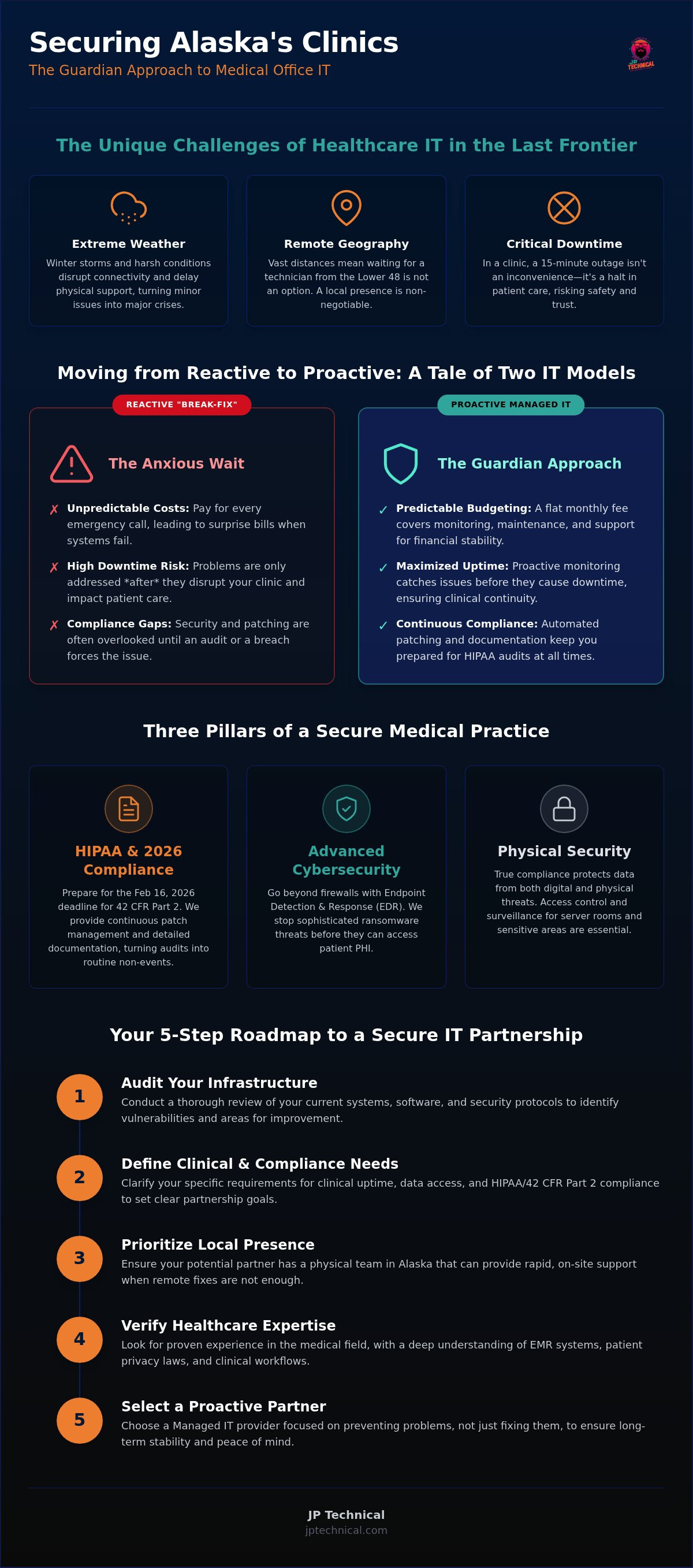
Effective medical office IT support Alaska clinics rely on must prioritize resilience to handle remote logistics and extreme weather without losing patient data.
You’ll learn why moving from a reactive “break-fix” model to managed IT creates predictable costs and prevents the high price of clinical downtime.
Discover how to align with 2026 HIPAA standards by implementing proactive EDR and automated patch management to stop ransomware before it starts.
Securing your practice requires more than just digital firewalls. We explain how physical access control and surveillance protect your facility and your compliance status.
Use our 5-step roadmap to audit your current infrastructure and find a local partner who can actually reach your site when things go wrong.
Table of Contents
Why Specialized Medical IT Support is Critical for Alaska Practices
Medical IT support isn’t just a subcategory of general technical services; it’s a specialized branch designed around the non-negotiable requirements of patient privacy and system availability. While a standard office might treat a network glitch as a minor inconvenience, a medical practice views it as a total halt in patient care. This is why medical office IT support Alaska providers must act as a “Guardian,” managing both the digital infrastructure and the physical security risks that could compromise a facility. A general IT firm might know how to fix a laptop, but they often lack the specific expertise needed to navigate the intersection of technology and healthcare regulations.
The High Stakes of Clinical Downtime
When a system fails in a clinical setting, data integrity and patient safety are immediately at risk. If a provider cannot access a patient’s history or current medications because the server is unresponsive, the quality of care drops instantly. In a retail setting, a 15-minute outage might delay a few sales. In a patient room, that same 15 minutes can lead to missed diagnoses, delayed treatments, and a complete breakdown of clinical workflow. Local support is essential here because it eliminates the lag time associated with shipping parts or waiting for a technician to fly in from the Lower 48. We define clinical uptime as the baseline for modern patient care, where technology remains invisible and reliable so the focus stays on the person in the exam room.
Navigating Alaskas Logistical Challenges
Operating a clinic in Kenai, Fairbanks, or Wasilla presents hurdles that providers in other states simply don’t face. Harsh weather and remote geography can turn a minor hardware failure into a multi-day crisis if your IT partner doesn’t have a local presence. Reliable HIPAA compliance services and technical support require a team that understands how to maintain internet stability when the wind picks up or the power fluctuates. By partnering with an Anchorage-based provider, you ensure that someone can be on-site quickly when remote troubleshooting isn’t enough.
Proactive monitoring allows us to catch these issues before they affect your morning rush, keeping your practice resilient in the face of the “Last Frontier” factor. This local vigilance is a core part of following the Health Insurance Portability and Accountability Act (HIPAA) while maintaining operational continuity. A true guardian approach doesn’t stop at the firewall. It includes physical security and surveillance to protect server rooms and sensitive areas. If your IT partner doesn’t understand the physical layout and logistical reality of medical office IT support Alaska, they can’t fully protect your data or your patients.
Ensuring HIPAA Compliance and Data Security in 2026
The healthcare landscape in 2026 presents new challenges for practice managers. With the February 16, 2026, compliance deadline for 42 CFR Part 2 alignment with HIPAA, your data handling must be more precise than ever. Healthcare ransomware has evolved, specifically targeting the high-value patient files stored in small to mid-sized clinics. If your security strategy relies on a “set it and forget it” approach, you’re carrying a significant liability. Effective medical office IT support Alaska depends on a proactive architecture that protects information from the server room all the way to the tablets used by your clinical staff.
The HIPAA Audit Trail: Documentation and Patching
Compliance is a continuous process of verification rather than a one-time setup. Patch and update management is a core requirement under the HIPAA Security Rule standards. An unpatched system is an open door for exploits that could lead to a massive data breach. We use automated reporting to track every security check and software update. This level of detail transforms the dreaded HIPAA audit into a routine non-event for your practice. You can explore our dedicated HIPAA compliance services to see how we manage these technical hurdles behind the scenes.
Cybersecurity Beyond the Firewall
Modern security requires more than just a strong perimeter. Endpoint Detection and Response (EDR) is now essential for protecting patient PHI. Unlike traditional antivirus that only recognizes known threats, EDR monitors system behavior to catch suspicious activity in real time. This is vital in a clinical environment where staff move between various workstations and mobile devices throughout the day.
Technology alone isn’t enough to secure a practice. Your employees are your first line of defense against phishing and social engineering. Regular training helps your team recognize threats that often bypass digital filters. To round out this protective shield, a robust Backup and Disaster Recovery plan ensures your data remains retrievable even after a local disaster. If you’re unsure if your current setup meets these 2026 standards, you can request a free IT assessment to identify any critical security gaps. We build these systems to work quietly in the background so you can focus entirely on patient care.
Managed IT vs. Break-Fix: Which Fits Your Alaska Practice?
Deciding how to fund your medical office IT support Alaska is more than a financial choice; it’s a strategic one. Many practices start with a “break-fix” model, calling a technician only when a server dies or the internet cuts out. This approach seems cost-effective on the surface, but it creates a fundamental conflict of interest. A break-fix provider only earns money when your practice is struggling. In contrast, a managed service model aligns our goals with yours. We succeed when your systems are stable, secure, and fully operational.
The return on investment for managed services becomes clear when you consider the cost of a single HIPAA breach or a day of lost appointments. With the 2026 compliance deadlines approaching, the risk of “fixing it later” is simply too high for a modern clinic. A monthly partnership ensures that your practice remains a fortress, both digitally and physically. Following official physical security guidance is much easier when you have a partner who monitors your access points as diligently as your firewall.
Predictable IT Budgeting for Medical Offices
Unexpected repair bills can wreck a clinic’s monthly cash flow. Managed services provide a flat-rate structure that covers everything from remote support to emergency disaster recovery. When you look at IT pricing considerations, it’s important to weigh the monthly fee against the hidden costs of downtime. If a provider is down for four hours, the lost revenue often exceeds the cost of a full month of proactive support. Flat-rate budgeting allows you to manage your growth without fearing the financial impact of a sudden hardware failure.
Proactive Maintenance: The “Silent Guardian” Effect
Most of our critical work happens while your office is empty. We perform security scans, install software patches, and verify backups during the “night shift” to ensure your team arrives to a perfectly functioning network. This proactive care extends the life cycle of your hardware by preventing software bloat and identifying early signs of component failure before they cause a crash. The best medical office IT support Alaska clinics can have is the kind they never have to call because the problems were solved before they could disrupt the morning clinic rush.
Beyond the Screen: Physical Security for Medical Facilities
Firewalls and EDR protect your data from invisible threats, but HIPAA compliance also demands rigorous physical safeguards. A data breach doesn’t always happen over the wire; it can occur if an unauthorized person walks into your server room or accesses a workstation. Comprehensive medical office IT support Alaska must account for the four walls of your clinic. Managing digital and physical risks under one roof simplifies your operations and ensures no gaps exist between your network security and your office doors. This unified approach provides the “Guardian” protection necessary for modern healthcare.
Physical Access Control and Patient Privacy
Traditional metal keys are a liability in a modern medical environment. They’re easily copied, lost, and offer zero tracking. Replacing them with electronic badge systems allows you to control exactly who enters sensitive areas like labs, records rooms, or drug cabinets. These physical security solutions create a digital audit trail, which is a core component of HIPAA physical safeguard compliance. If an employee leaves the practice, you can deactivate their access instantly without the expense of re-keying the entire building. This proactive control protects both your patient PHI and your physical assets while maintaining a strict chain of custody for controlled substances.
Surveillance Systems for Liability Protection
Strategic camera placement is about more than just catching intruders. It’s about protecting your staff from workplace safety issues and your practice from fraudulent liability claims. High-definition cameras at clinic entries and waiting areas provide a clear record of events. For practice owners in Wasilla or Fairbanks, remote monitoring capabilities allow you to check on your facility from anywhere at any time. We ensure your surveillance system is integrated with your local network safely. This prevents the cameras themselves from becoming a security vulnerability while ensuring the footage is backed up and retrievable when you need it most.
Having a single partner for both IT and physical security means you have one number to call and one team that understands the full scope of your practice’s safety. It eliminates the frustration that often happens between different vendors when a system fails. If you want to see how your current physical safeguards measure up against 2026 standards, you can schedule a free IT assessment today. We’ll help you build a secure environment that protects your patients, your staff, and your reputation through diligent, localized care. This integrated strategy is the most reliable way to ensure your practice stays compliant and operational in the unique Alaska business environment.
Selecting Your Alaska IT Partner: A 5-Step Roadmap
Choosing the right partner for medical office IT support Alaska is a decision that impacts your practice’s safety and daily workflow. You need a local guardian who understands the specific hurdles of the Last Frontier, from unpredictable weather to remote logistics. This roadmap helps you move from reactive repairs to a stable, long-term partnership that prioritizes clinical uptime.
Step 1: Audit your current status. Determine the age of your hardware and your current compliance standing. If your server is over five years old, it’s a liability that could lead to an expensive failure.
Step 2: Verify local response times. Remote support is a standard tool, but it’s not a complete solution. If a critical switch fails in Wasilla or the Mat-Su Valley, you need a technician who can physically show up at your door.
Step 3: Evaluate medical software experience. General IT knowledge isn’t enough for a clinic. Your provider must understand how your EHR platforms interact with HIPAA requirements and local network configurations.
Step 4: Check for a full security stack. Ensure the provider offers a unified approach. You should have one partner managing your EDR, backups, and physical security.
Step 5: Start with a professional assessment. A thorough audit identifies the vulnerabilities that “break-fix” technicians often overlook.
Questions to Ask a Potential IT Provider
Straightforward questions help you separate seasoned professionals from distant call centers. Ask if they sign a HIPAA Business Associate Agreement (BAA) as a standard part of their contract. Inquire about their average on-site response time for an office in Palmer or Kenai. Finally, ask if they can manage your network and your security cameras under one roof. Having a single point of contact for all security needs simplifies your management and ensures there are no gaps in your protection.
Starting with a Free IT Assessment
A professional IT and security audit provides a clear view of your practice’s operational health. During this process, we examine your network logs, backup integrity, and physical access points to find hidden risks before they become emergencies. This proactive step is the most reliable way to ensure you’re ready for the 2026 compliance standards. It gives you a roadmap for long-term stability and the peace of mind that comes from knowing your systems are guarded. If you’re ready to secure your practice, you can Schedule your Free IT Assessment with JP Technical today.
Securing Your Practice for 2026 and Beyond
Ensuring your clinic stays operational in Alaska’s unique environment requires more than just basic technical help. It demands a guardian who integrates digital compliance with physical office security. We have explored how the transition toward proactive managed services and strict HIPAA adherence protects your patient care environment from both downtime and data breaches. When your technology is stable, you can focus entirely on your patients.
Since 1996, JP Technical has served as a reliable local partner for practices across Anchorage and the Mat-Su Valley. We specialize in providing the comprehensive medical office IT support Alaska providers need to meet 2026 standards with confidence. By merging HIPAA-compliant digital architecture with physical access control, we ensure your facility remains protected from every angle. Our team acts as a straight-shooter, providing the technical mastery needed to handle threats quietly in the background.
Don’t wait for a system failure or a failed compliance audit to reveal the hidden gaps in your security. You can take a proactive step toward total peace of mind right now. Secure Your Practice with a Free IT Assessment and let’s build a resilient future for your clinic together. Your patients rely on your expertise; you can rely on ours to keep your technology steady and secure.
Frequently Asked Questions
Is HIPAA compliance the same as cybersecurity?
No, cybersecurity is just one component of a broader HIPAA strategy. While cybersecurity focuses on technical defenses like firewalls and EDR, HIPAA compliance includes administrative and physical safeguards. You must follow specific legal protocols and documentation requirements to meet the Security Rule standards. A secure network is a great start, but compliance requires a holistic approach to patient privacy.
Does JP Technical support medical practices outside of Anchorage?
Yes, we provide medical office IT support Alaska clinics rely on across Anchorage, Wasilla, and the Mat-Su Valley. We understand the logistical hurdles of the Kenai Peninsula and surrounding areas. Our team balances remote troubleshooting with the ability to provide on-site support when hardware failures require a physical presence at your facility.
What is the response time for emergency IT issues in a medical office?
We prioritize clinical emergencies because we know that downtime stops patient care. Our managed IT model uses proactive monitoring to resolve 90% of issues before they cause a disruption. If an emergency does occur, our local team responds quickly to get your exam rooms back online. We focus on steady reliability so you don’t have to wait on a distant call center.
Can you help us transition to a new Electronic Health Record (EHR) system?
We provide the essential infrastructure support needed for a successful EHR migration. Our team works with your software vendor to ensure your network, servers, and workstations meet the necessary performance specifications. This collaboration prevents the common technical bottlenecks that often delay new system rollouts. We make sure your hardware stays compliant throughout the entire transition.
Do we need to buy our own hardware, or does JP Technical provide it?
We act as your consultant to help you select and procure the most reliable business-grade hardware. While we are a service provider rather than a retail store, we ensure the equipment you choose fits your medical office IT support Alaska requirements. This approach ensures your hardware is fully compatible with your security stack and your clinical software from day one.
How does physical access control help with HIPAA compliance?
Physical access control fulfills the HIPAA requirement to limit access to systems that house patient data. By using electronic badge systems, you replace unsecure keys with a trackable digital record. This creates an audit trail of who accessed your server room or records storage. It’s a definitive way to prove you are protecting PHI from unauthorized physical entry.
What happens to our patient data if there is an earthquake or power outage?
Your data remains safe and retrievable through our Backup and Disaster Recovery services. We use encrypted, off-site backups that are unaffected by local environmental disasters. If a power outage or earthquake damages your local hardware, we can restore your systems to new equipment quickly. This resilience ensures your practice can resume care as soon as it’s safe to open your doors.
 Article by
Colter Hobbs