Arctic IT vs. Alaska Computer Support: Which is Right for Your Small Business?
Hiring a massive IT firm in the state might actually be the riskiest move for a growing Alaskan company. While a large vendor offers scale, it often comes at the cost of the personal, neighborly service that keeps a small office running smoothly. You’ve likely felt the frustration of waiting for a callback during a crisis or struggling to understand how vague cybersecurity rules apply to your specific team. When evaluating IT support for small business operations, it’s essential to look beyond the allure of a major brand and focus on who will actually show up when things get difficult.
At JP Technical, we understand that you need more than just a help desk; you need a reliable guardian for your data. This article provides a side-by-side comparison of different IT providers in Alaska to help you choose the right scale, security, and compliance for your unique needs. We will explore how different providers manage predictable monthly spending and bulletproof cybersecurity. By the end, you’ll have the clarity needed to select a partner who offers both technical mastery and the local accountability you deserve.
Key Takeaways
Understand why your company size determines the quality of your support and how to avoid being overlooked by large vendors.
Discover the core differences between Arctic IT vs Alaska Computer Support for small business goals to decide between enterprise scale and boutique service.
Learn to evaluate IT partners based on their ability to manage complex HIPAA requirements and physical security alongside standard technical support.
Identify the specific benefits of working with a “middle ground” provider that offers high-level technical mastery without sacrificing personal accountability.
Gain a clear framework for stabilizing your monthly IT spending while ensuring your cybersecurity remains proactive and vigilant.
Table of Contents
The Managed IT Landscape in Alaska: Why the Choice Matters
Alaska’s geography creates a specific set of challenges for business technology. In Anchorage or Fairbanks, a server failure isn’t just an IT ticket; it’s a potential shutdown if replacement parts are stuck in a snowstorm. This environment is why Managed services have become the standard for companies that can’t afford downtime. When weighing Arctic IT vs Alaska Computer Support for small business needs, you’re choosing more than a vendor. You’re choosing a partner to navigate the “Alaska tax” on hardware shipping and the reality of remote logistics.
The landscape has shifted dramatically. It’s no longer enough to have someone who simply fixes computers. Modern operations require specialized knowledge in cybersecurity and compliance. If your business handles patient data, you need HIPAA compliance services that are baked into your daily workflow. The choice between a massive enterprise firm and a boutique specialist often comes down to where you fall on their priority list. Small businesses often feel like a small fish in a big pond when working with massive vendors. Conversely, a tiny shop might lack the depth to handle complex security threats.
The Role of an MSP in 2026
By 2026, the old model of calling when something breaks has been replaced by continuous vigilance. Modern providers use automated patch management and remote monitoring to catch issues before your staff even notices a glitch. This proactive approach is vital in Alaska. Getting a replacement part can take days instead of hours due to shipping delays. A true partner understands these logistical hurdles and keeps critical spares on hand to ensure continuity. They treat 24/7 monitoring as a requirement, not a luxury, to protect your uptime and data integrity.
Evaluating Local Accountability
Accountability looks different when your IT provider lives in your time zone. A national firm might offer a local office, but the decision-makers are often thousands of miles away. A 100% Alaska-owned business understands how a major earthquake or an extreme freeze affects your operations. Local knowledge affects everything from disaster recovery planning to physical security implementation. We define a “Local MSP” as a partner who can be on-site within an hour in Anchorage or Wasilla. This speed is essential for maintaining business continuity when remote support isn’t enough.
Arctic IT: The Enterprise Powerhouse for Scale
Arctic IT stands as the heavyweight in the Alaskan technology market. With a workforce ranging from 51 to 200 employees, they offer a level of resources that few other local providers can match. As a member of the Doyon, Limited family of companies, they carry significant influence in government contracting and tribal organization support. They aren’t just a local operation; their reach extends to Plano, Texas, allowing them to manage massive, multi-state deployments for large corporations and federal entities. This scale makes them a formidable ally for organizations with complex, high-volume needs.
This scale is a double-edged sword for the average business owner. While they have the bench strength to handle 500-user rollouts, a 10-person office might find their standardized approach a bit overwhelming. When evaluating Arctic IT vs Alaska Computer Support for small business operations, it’s clear that Arctic IT is built for the enterprise. You’re paying for a massive infrastructure that ensures stability for giants, but it might feel like overkill for a local storefront. Small clients can sometimes experience “small fish” syndrome, where their tickets carry less weight than a high-priority government contract.
Specialization in Microsoft Cloud
Their identity is deeply tied to their status as a Microsoft Solutions Partner. They possess deep expertise in Dynamics 365, Power Platform, and complex Azure migrations. These tools are incredibly powerful for organizations with 100 or more seats that need intricate ERP solutions or custom database management. Their high-level vendor relationships mean they can resolve enterprise-level licensing or technical hurdles quickly. If your business depends on a complex, nationwide Microsoft ecosystem, their certifications provide a high degree of confidence and technical mastery.
The Enterprise Service Model
Managing hundreds of clients across different time zones requires rigid standardization. Arctic IT relies on structured support tiers and strictly defined processes to maintain efficiency. This model works well for large entities with internal IT departments that just need high-level escalation help. However, for a small business without its own tech staff, this can lead to a lack of personalized attention. You might speak to a different technician every time you call, losing that “neighborly” feel. If you’re wondering if your current setup is truly optimized for your specific size and risk, a free IT assessment can help you identify where you stand. Their pricing typically aligns with these larger budgets, reflecting the cost of maintaining a 50-person technical team and elite certifications.
Alaska Computer Support: The Boutique Local Specialist
Alaska Computer Support offers the polar opposite experience of an enterprise powerhouse. With a small team of 2 to 10 employees, they lean heavily into a boutique service model. This provider focuses on small and medium-sized businesses across Anchorage and Wasilla. For many local startups, the appeal lies in the personal connection. You aren’t just another account number in a database. Instead, you likely know your technician by name and can reach them without navigating multiple layers of corporate management.
When deciding between Arctic IT vs Alaska Computer Support for small business needs, the choice often hinges on the level of intimacy you require. If your team values having a familiar face walk through the door, a smaller local shop provides that reassurance. They excel at the fundamentals: keeping desktops running, managing basic local networks, and providing reactive support when a printer goes offline. This agility is a significant asset for businesses that don’t have complex regulatory burdens or high-risk data profiles.
The SMB-First Mentality
A boutique provider operates with a sense of neighborly urgency. They understand that for a small Anchorage shop, a single downed workstation can halt half of the day’s productivity. Their service model is built around day-to-day desktop support and straightforward networking. This approach resonates with owners who want a “straight-shooter” partner rather than a distant consultant. They offer a stable presence for companies that need reliable, no-nonsense IT maintenance without the overhead of enterprise-level contracts.
Scale and Depth Challenges
The limitations of a smaller team become apparent during simultaneous emergencies. If two clients experience a server failure at the same time, a 2 to 10 person team can quickly become overwhelmed. This bandwidth constraint often extends to more specialized areas. Maintaining deep, up-to-date expertise in complex fields like HIPAA compliance services or physical security requires significant resources and dedicated specialists.
A boutique specialist may struggle to provide the 24/7 proactive monitoring or the rigorous auditing required for high-risk industries. Strategic roadmapping also takes a backseat when a small team is constantly in reactive mode. While they are excellent for basic continuity, they might lack the technical depth needed for a total IT strategy that includes advanced cybersecurity and long-term infrastructure planning.
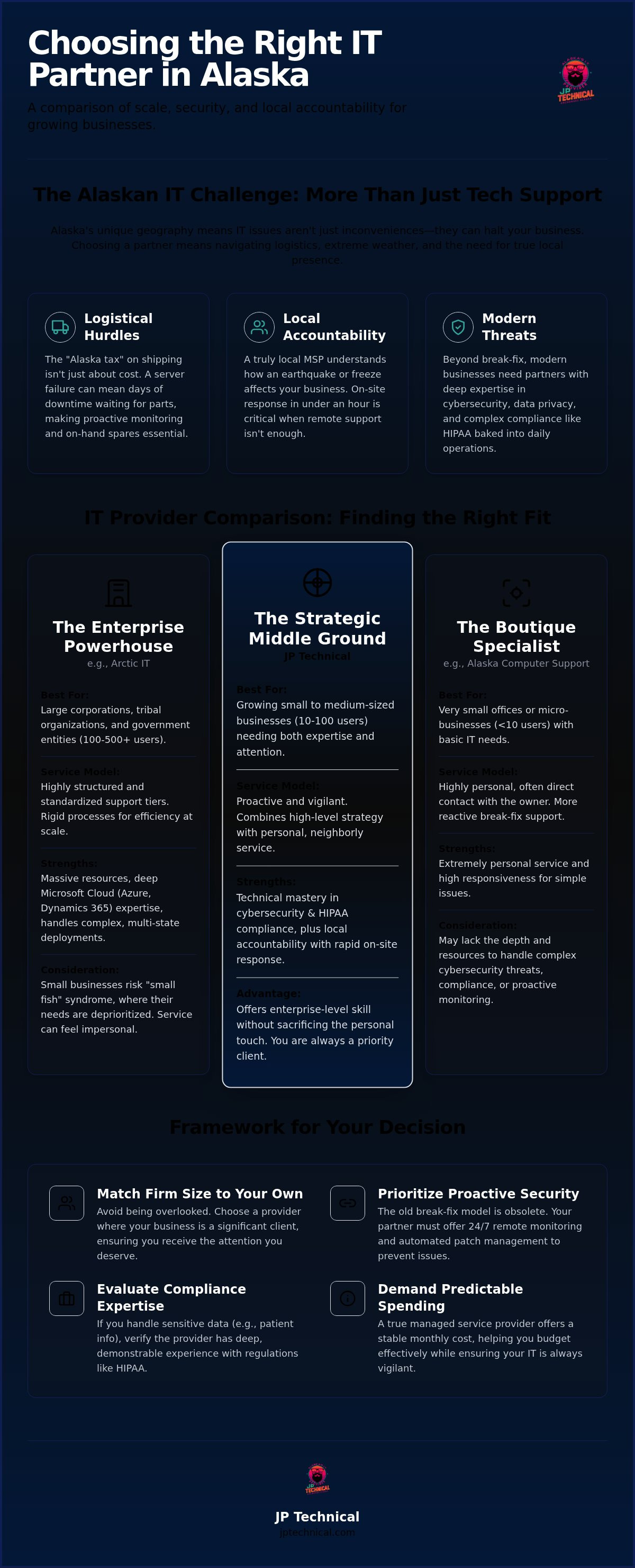
Comparison Matrix: Scale, Security, and Compliance
Choosing between Arctic IT vs Alaska Computer Support for small business success depends on your specific risk profile and operational scale. A large enterprise firm typically operates with a tiered support system. You start with Level 1 help desk staff and move up the chain for complex issues. In contrast, a boutique firm usually provides direct access to a lead technician. While the big firm offers massive resources, the smaller shop offers familiarity. The right choice for your Anchorage office depends on whether you prioritize a deep bench of specialists or a single point of contact who knows your history.
The “Security Stack” is another major differentiator. Enterprise providers often include advanced Endpoint Detection and Response (EDR) and 24/7 threat hunting in their base packages. Boutique shops might stick to standard antivirus and firewalls, which can leave gaps in a modern threat environment. If you’re facing a rigorous SOC2 or complex regulatory audit, a larger firm has the documentation and dedicated compliance officers to get you through it. Smaller shops often lack the dedicated personnel to manage the hundreds of pages of evidence required for these certifications.
The Cost of “Too Big” vs. “Too Small”
Hidden costs often lurk in enterprise contracts. Many large vendors require minimum seat counts, which means a 10-person office might pay for 25 seats just to get in the door. Conversely, there’s a real risk of outgrowing a boutique provider. If your business adds a second location or starts handling sensitive data, a 2-person IT shop may not have the bandwidth to scale with you. Enterprise firms often target response times based on contract tiers, while boutique shops aim for immediate availability but can easily become overextended during peak hours. If you’re unsure which model fits your current budget, reviewing predictable monthly IT spending options can provide much-needed clarity.
Specialized Needs: HIPAA and Physical Security
Healthcare providers in Alaska need more than just “computer repair” to stay operational. They require a partner who understands the intersection of digital data and physical access. Many IT providers ignore the importance of security cameras and door badges in a total security strategy. If your facility handles patient records, you need HIPAA compliance services that are proactive rather than reactive. A true local guardian looks at the whole picture, ensuring that your physical access controls are as secure as your network firewall. To see how your current security measures stack up against modern requirements, we recommend a free IT assessment to identify potential vulnerabilities before they become liabilities.
The Strategic Middle Ground: Why JP Technical Fits Small Business
JP Technical occupies the space where enterprise-level technical mastery meets the personalized care of a local shop. Since 1996, we’ve provided Alaskan businesses with a reliable alternative to the “big vs. small” dilemma. When you evaluate Arctic IT vs Alaska Computer Support for small business needs, you’re often choosing between a massive corporation and a tiny team. We offer a third path. We combine 30 years of deep experience with a “straight-shooter” approach that prioritizes your uptime above all else. This means no-nonsense communication and a commitment to showing up when things get difficult.
Our specialization in medical and dental IT makes us a preferred partner for clinics across the state. We don’t just provide “computer repair.” We build secure environments that protect patient data and meet federal requirements. This level of technical sophistication is usually reserved for enterprise clients, but we’ve scaled it specifically for the 10-to-50 person office. By focusing on this strategic middle ground, we ensure you never feel like a small fish in a big pond, yet you never lack the technical depth required for modern security.
Protecting the Perimeter: Beyond the Screen
Security isn’t just about firewalls and passwords. If an unauthorized person enters your server room, your digital defenses won’t matter. We integrate security camera systems and physical access controls directly into your IT infrastructure. This unified approach ensures that your network and your front door are managed by the same vigilant team. Local businesses in Wasilla and Kenai trust our “neighborly guardian” model because they know we handle both physical and digital threats with the same technical precision. If a camera goes down or a server glitches, you only have one number to call.
Ready for Your Next Step?
Transitioning from an “emergency-only” IT model to a managed partnership provides the stability your business needs to grow. It’s the difference between waiting for a crash and preventing one. If you’re ready to see how your current technology stacks up, a free IT assessment is the best way to find your gaps. For a deeper look at the local landscape, read our Managed IT Services in Anchorage: The 2026 Guide. We’re here to help you stabilize your IT spending and protect your operations for the long term.
Secure Your Alaskan Business with the Right Partnership
Choosing between Arctic IT vs Alaska Computer Support for small business goals requires a clear look at your daily operations and long-term risks. While massive firms offer scale and tiny shops offer familiarity, your business deserves a partner who provides both technical mastery and local accountability. You need a team that understands why HIPAA compliance and physical security must work together to protect your reputation and your data.
Since 1996, we’ve served as the local guardian for companies that value steady reliability and proactive care. Our Anchorage-based support team combines specialized expertise with a “no-nonsense” work ethic that prioritizes your uptime. We’re ready to help you move past reactive repairs and into a stable, predictable partnership that lowers your anxiety regarding complex technical hurdles.
Get a Free IT Assessment for Your Alaska Business to identify your security gaps and stabilize your technology today. Let’s build a more resilient future for your team.
Frequently Asked Questions
Is Arctic IT too big for a 5-person office in Anchorage?
Arctic IT is primarily structured for enterprise-scale operations, which often makes them a mismatch for a 5-person office. Their service model relies on standardized processes designed for hundreds of users. Small teams may find it difficult to meet minimum seat requirements or get the personalized, neighborly attention that a smaller local provider offers.
Does Alaska Computer Support offer HIPAA compliance services?
Alaska Computer Support focuses on general IT for small businesses but may lack the specialized depth required for rigorous HIPAA auditing. Managing healthcare data requires more than basic security; it involves continuous regulatory documentation and specific technical safeguards. If your practice handles sensitive patient records, you need a partner with a dedicated focus on these legal requirements.
How much does managed IT services cost in Alaska for a small business?
Managed IT costs in Alaska are typically structured as a predictable monthly fee based on your total number of users and specific security needs. When evaluating Arctic IT vs Alaska Computer Support for small business goals, you’ll find that pricing scales with the level of compliance and proactive monitoring required. Most providers customize their plans to ensure you aren’t paying for enterprise-level features you don’t use.
Can JP Technical handle both my IT and my security cameras?
Yes, we specialize in merging digital and physical security into one cohesive strategy. We manage your network servers alongside your security camera systems and physical access controls. This integrated approach ensures that your front door is just as secure as your network firewall, giving you a single point of accountability for your entire facility.
What is the difference between an MSP and a computer repair shop?
A computer repair shop follows a reactive “break-fix” model where they only help after a failure occurs. An MSP acts as a proactive guardian, using 24/7 monitoring to prevent problems before they disrupt your productivity. Managed services include continuous cybersecurity, backup management, and routine updates to ensure long-term business continuity.
Do I need a local IT company if my employees work remotely in Wasilla?
Local support is still essential for remote teams because hardware eventually fails and requires hands-on maintenance. A local partner understands Alaskan logistics and can provide on-site help or hardware replacements much faster than a national firm. Being in the same time zone also ensures that your remote staff gets support when they actually need it.
How long does it take to switch IT providers in Alaska?
A smooth transition typically takes between 30 and 60 days to complete properly. This timeframe allows your new partner to conduct a thorough audit, document your existing systems, and install new security tools without interrupting your daily operations. A methodical handoff is the best way to ensure that no critical data or security patches are missed during the move.
 Article by
Colter Hobbs