Managed IT Providers in Alaska: A Local Guide for 2026
If your current IT support is three time zones away, they’re effectively invisible when your server fails on a sub-zero Tuesday. You deserve a partner who can reach your office without needing a flight plan. We understand that technology in the Last Frontier doesn’t behave like it does in the Lower 48. Between the logistical hurdles of remote sites and the constant pressure of HIPAA audits, you need more than a basic help desk. You need a partner who treats your connectivity as a lifeline rather than a convenience.
Finding the right managed IT providers Alaska businesses can depend on requires looking past simple technical support. You need a guardian who integrates digital defense with physical security to keep your doors open and your data safe. This guide will show you how to choose an IT partner that offers seamless HIPAA compliance and proactive care. We’ll explore the essential criteria for 2026 to ensure your business remains resilient, secure, and locally supported through every technical and regulatory challenge.
Key Takeaways
Understand why a partner with a physical presence in the state is essential for maintaining reliable connectivity across remote Alaskan locations.
Learn how the top managed IT providers Alaska offers integrate cybersecurity with physical surveillance to create a unified shield for your business.
Discover the specific criteria for evaluating HIPAA compliance expertise to ensure your medical practice stays audit-ready and secure.
Use our professional checklist to verify a provider’s local roots, technical certifications, and ability to provide on-site support when it matters most.
Identify the long-term benefits of a “neighborly” partnership that prioritizes human connection and steady reliability over automated service queues.
Table of Contents
The Landscape of Managed IT Providers in Alaska
Operating a business in Alaska requires a different level of resilience than anywhere else in the country. While companies in the Lower 48 might worry about minor software glitches, Alaskan business owners deal with extreme weather, isolated infrastructure, and the logistical reality of being thousands of miles from major tech hubs. These environmental factors turn routine technical issues into significant operational risks. A Managed Service Provider (MSP) serves as the bridge between these local challenges and the high-level reliability your team needs to stay productive. If your technology isn’t built to withstand the specific pressures of the North, your business continuity is always at risk.
The industry is moving away from the old “break-fix” model, where you only call a technician after something stops working. That reactive approach is dangerous in a state where parts can take days to arrive and specialized help is scarce. Modern managed IT providers Alaska businesses rely on act as proactive guardians. This shift means your systems are monitored, patched, and secured before a failure occurs. It’s about predictable performance rather than emergency repairs. By prioritizing vigilance and routine maintenance, you can focus on your daily operations while your IT partner handles the technical background noise.
Logistics and Local Accountability
In our region, physical distance is a major factor in response times. National, remote-only providers often struggle because they don’t have boots on the ground when a hardware failure requires an on-site visit. If your office is in Anchorage, Wasilla, or Kenai, you need a partner who can physically access your server room during a crisis. Local knowledge of our utility grids and telecommunications infrastructure allows for faster troubleshooting and more accurate disaster recovery planning. Accountability is higher when your IT expert is a neighbor who understands the local business community and the unique quirks of our regional network.
The 2026 Tech Outlook for the Last Frontier
As we move into 2026, the threats facing Alaskan industries are becoming more sophisticated. Cybersecurity is no longer just about software; it requires an integrated approach that includes physical security and surveillance to protect the hardware that keeps your data flowing. Remote work across vast distances has increased the demand for cloud-hybrid solutions that remain stable even when local connectivity fluctuates. The “local guardian” approach in 2026 is defined by a commitment to proactive, integrated protection that secures both your digital assets and your physical workplace through constant, localized vigilance.
Essential Services Every Alaskan MSP Should Provide
Choosing between managed IT providers Alaska offers requires more than just looking at a price sheet. You need a partner who understands that your digital infrastructure is inseparable from your physical location. A comprehensive service package should act as a shield, protecting your business from both invisible cyber threats and tangible local risks. This involves a blend of advanced software defense, regulatory expertise, and on-site hardware management.
Proactive Patch Management: Closing security gaps before they’re exploited.
Endpoint Detection and Response (EDR): Monitoring for suspicious behavior in real-time.
Backup and Disaster Recovery: Ensuring data survives local power surges or seismic events.
Cybersecurity and HIPAA Compliance
For Anchorage medical practices, IT support isn’t just about speed; it’s about staying on the right side of federal law. HIPAA audits can be stressful, but a specialized provider makes the process predictable and manageable. By implementing essential cybersecurity services, your team can focus on patient care while the technical details remain secure. Managed firewalls and EDR prevent the kind of downtime that halts clinical operations. You can rely on JP Technical’s HIPAA services to ensure your practice meets every regulatory requirement without the guesswork.
Bridging Digital and Physical Security
Many business owners overlook the fact that a server room is only as secure as the door protecting it. If an unauthorized person gains physical access to your hardware, even the best firewall can’t stop them. This is why the best managed IT providers Alaska has to offer integrate physical security solutions like access control and surveillance into their service model. Using a single partner for both your network and your cameras eliminates communication gaps between vendors. It creates a unified defense strategy where your digital and physical perimeters are monitored by the same team of experts.
Environmental risks like earthquakes and extreme cold also demand a specialized approach to backup and disaster recovery. Your data shouldn’t just exist in the cloud; it needs a local redundancy that can be accessed even when the wider internet is unstable. If you’re unsure whether your current setup can handle Alaska’s unique challenges, you might benefit from a free IT assessment to identify any hidden vulnerabilities in your workflow.
Local vs. National IT Providers: Which Is Right for You?
Choosing between managed IT providers Alaska offers often comes down to a choice between scale and relationship. National IT firms frequently promise lower monthly rates by centralizing their support in out-of-state call centers. While this model works for basic software troubleshooting, it often falls short when your business faces a complex hardware failure or a localized network outage. A local partner provides a level of accountability that a distant vendor simply can’t match. When your server room is down, a voice on the phone in a different time zone is a poor substitute for a technician who can be at your door in an hour.
The “neighborly” advantage is particularly strong in the Anchorage business community. Trust is built on shared experiences and local roots. If you partner with a local guardian, you’re working with someone who understands the specific regulations and community standards that govern Alaskan commerce. These providers don’t just fix computers; they invest back into the local economy and build long-term partnerships based on mutual success. You aren’t just a ticket number in a global queue. You’re a neighbor whose business continuity matters to the person answering the phone.
The Trust Factor in Alaska
Alaskan business owners tend to value a “straight-shooter” personality. You need an expert who gives you the facts without hiding behind technical jargon or high-pressure sales tactics. A local MSP understands the regional infrastructure and the unique quirks of our utility grids. This specialized knowledge allows them to provide more accurate advice on everything from disaster recovery to FTC cybersecurity guidance. They know what works in our climate and what doesn’t, saving you the frustration of trial-and-error solutions designed for the Lower 48.
Hidden Costs of National Call Centers
Remote-only support often looks cost-effective on paper, but it frequently leads to expensive on-site emergencies. If a national provider can’t solve a problem remotely, you’re often left to find a local contractor at a premium rate to handle the physical repair. The time spent explaining our geography to a technician who doesn’t know the difference between Kenai and Ketchikan is time your business isn’t making money. These delays add up. A proactive local partnership eliminates this friction by providing steady, predictable care that keeps your systems running smoothly. If you’re looking for transparent value, reviewing managed IT pricing for local services often reveals a much lower total cost of ownership over time.
Ultimately, the peace of mind that comes from a local guardian is irreplaceable. You deserve a partner who possesses the technical mastery to handle threats quietly in the background but remains approachable enough to act as a guide. This balance of professional authority and localized care ensures your business stays resilient through any challenge 2026 brings.
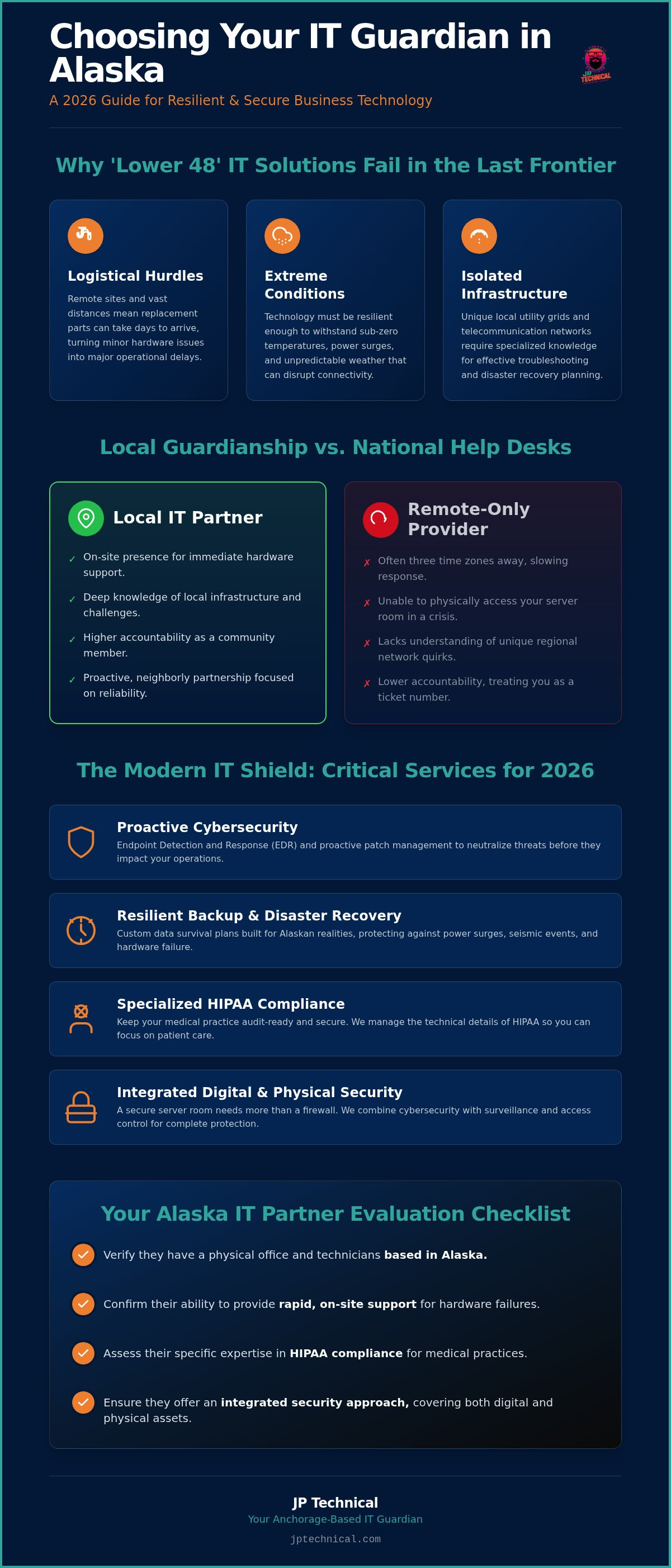
How to Evaluate an Alaska IT Partner: A Selection Checklist
Selecting a long-term partner requires more than a handshake and a quote. If you’re interviewing managed IT providers Alaska has available, you need a way to filter out the high-volume vendors from the dedicated partners. A structured evaluation ensures you don’t end up with a service that looks good on paper but fails when an actual crisis hits. Your goal is to find a guardian who understands your infrastructure as well as you do.
Start by verifying their physical presence. A provider claiming to serve the Mat-Su Valley from a desk in Seattle isn’t going to help when your network switch fails during a storm. You need boots on the ground in Anchorage or the surrounding communities. Check for industry-specific certifications like HIPAA or CJIS. If a provider can’t explain their specific protocols for these regulations, they aren’t equipped to protect your business from audit risks.
Transparency is another non-negotiable factor. If a service agreement is filled with vague qualifiers and hidden fees, you’ll eventually face “bill shock.” A reliable partner provides clear pricing and defined response times. They should focus on proactive maintenance, handling patches and updates quietly in the background so your team never sees the threat in the first place.
Questions to Ask During the Interview
“How do you handle physical security alongside network security?” A true local guardian protects both your data and the hardware it sits on.
“What is your typical response time for an on-site emergency in Palmer or Fairbanks?” Local logistics matter, and you need a partner who understands the drive time.
“Can you provide a free IT assessment before we sign?” You deserve to know exactly where your vulnerabilities lie before committing to a contract.
Red Flags to Avoid
Avoid providers who treat security as an afterthought. If they don’t lead with a clear disaster recovery and business continuity plan, your data is at risk. Be wary of any firm that resists providing a comprehensive assessment of your current infrastructure. This lack of transparency usually signals a “one-size-fits-all” approach that won’t account for Alaska’s unique technical hurdles. If they don’t prioritize security as their primary focus, they aren’t the right fit for a modern business.
Before you make a final decision, ensure your potential partner is willing to sit down and walk through your specific needs. If you want to see how your current systems measure up against 2026 standards, you can request a free IT assessment to get a clear picture of your security posture.
JP Technical: Your Anchorage-Based IT Guardian
JP Technical stands as a seasoned specialist among managed IT providers Alaska businesses have relied on for decades. Since 1996, we have operated with a no-nonsense work ethic that prioritizes steady reliability over flashy marketing. We understand that your business doesn’t just exist in a digital cloud; it operates in a physical space with unique regional challenges. Our approach combines high-level technical sophistication with the grounded perspective of a neighbor who knows exactly what it takes to keep an office running in the North.
We provide integrated solutions that bridge the gap between your network and your physical workplace. While many vendors only look at your screen, we look at your entire perimeter. This includes everything from HIPAA compliance services for medical practices to physical access controls for your server room. By managing both your digital and physical security, we eliminate the gaps that often lead to data breaches or operational downtime. It is a level of protective vigilance that only a local partner with deep roots can provide.
Why Local Roots Matter Since 1996
Our history in Anchorage is built on being there when things get difficult. When a massive earthquake rattles the infrastructure or a winter storm knocks out local power, we are already on the move. We don’t wait for a ticket to clear a global queue. Our local team provides the steady reliability you need to maintain business continuity through any crisis. For a deeper look at how we support our community, you can read our guide on Managed IT Services in Anchorage to see how we help businesses stay resilient.
Ready for a Proactive Partnership?
Choosing a managed IT partner is about more than just fixing computers. It’s about securing your future. We invite you to experience a partnership that feels like a dedicated ally rather than a distant vendor. We’ll help you secure your digital assets and your physical premises with a strategy tailored to your specific workflow. You can check out our transparent pricing to see how our services fit your budget without any hidden fees or surprises.
Don’t wait for a security breach or a system failure to realize your IT support is insufficient. A proactive strategy is the only way to ensure your data stays safe and your operations remain uninterrupted. If you’re ready to lower your anxiety and gain true peace of mind, it’s time to work with a local guardian. You can start today by requesting a free IT assessment to identify exactly where your business needs the most protection.
Securing Your Alaskan Business for 2026 and Beyond
Success in the Last Frontier depends on a foundation of steady reliability. As the technical and regulatory landscape evolves, the distance between your business and your support team becomes a critical factor in your resilience. By choosing a partner who integrates digital defense with physical oversight, you ensure that your operations remain predictable even during local infrastructure failures. The right choice among managed IT providers Alaska offers is one that acts as a vigilant guardian, protecting your data and your premises with equal precision.
Since 1996, JP Technical has provided this level of proactive care to Anchorage and the surrounding communities. We specialize in HIPAA-compliant medical IT and the seamless integration of physical security systems to keep your business audit-ready and safe. You don’t have to navigate these complexities alone. Take the first step toward a more secure future and secure your business with a free IT assessment from JP Technical today. We look forward to showing you the peace of mind that comes from a truly local partnership.
Frequently Asked Questions
What is the average response time for managed IT providers in Alaska?
Response times depend on your specific service level agreement and your physical proximity to the technician. Most local providers resolve software issues remotely within minutes but prioritize on-site emergencies for critical hardware failures. In major hubs like Anchorage or Wasilla, you can typically expect a technician at your door within a few hours for high-priority situations.
Do managed IT providers in Anchorage also handle physical security cameras?
Some specialized firms offer integrated solutions that include both network management and physical surveillance. This “one-stop-shop” approach ensures your cameras and access control systems are secured on a professionally managed network. Combining these services prevents communication gaps between vendors and creates a more cohesive defense strategy for your office.
How much do managed IT services typically cost for a small business in Alaska?
Pricing is generally structured as a predictable monthly fee based on the number of users and the complexity of your network. Most managed IT providers Alaska businesses trust offer tiered service plans that scale as your company grows. This model helps you avoid the high costs of emergency repairs by focusing on proactive maintenance and long-term stability.
Can a national IT company provide HIPAA-compliant services in Alaska?
National firms can provide compliant software, but they often struggle with the physical requirements of Alaskan compliance. Effective HIPAA management requires an understanding of local workflows and the ability to perform on-site security audits of your hardware. A local partner offers the accountability needed to ensure your physical data storage meets federal standards.
What happens if my business in Fairbanks has an IT emergency and my provider is in Anchorage?
Most technical issues are resolved instantly through secure remote support tools that allow technicians to troubleshoot your systems from afar. If a hardware failure requires an on-site visit, a provider with a regional presence will coordinate travel or utilize trusted local partners. Having a partner who understands the logistics of the Interior is essential for minimizing your downtime.
Is it better to have separate providers for IT and physical access control?
Consolidating these services under a single partner is usually more efficient and secure. When your IT provider also manages your physical access control, they can ensure your server room is protected both digitally and physically. This unified strategy eliminates finger-pointing between different vendors and ensures your entire perimeter is monitored by one expert team.
What industries in Alaska benefit most from managed IT services?
Healthcare practices, legal firms, and professional service providers benefit most due to their strict data security and regulatory needs. Any business that operates across multiple remote locations or handles sensitive client information requires the steady reliability of an MSP. This support is vital for maintaining productivity despite the unique environmental challenges of the North.
How does an MSP help with business continuity during an Alaskan earthquake?
An MSP protects your business by ensuring your data is backed up to secure, redundant locations outside the immediate impact zone. If an earthquake damages your local hardware, your provider can quickly restore your operations using cloud-hybrid solutions. This proactive planning ensures your team can resume work as soon as power and connectivity are restored.
 Article by
Colter Hobbs