Endpoint Detection and Response in Alaska: The 2026 Business Guide
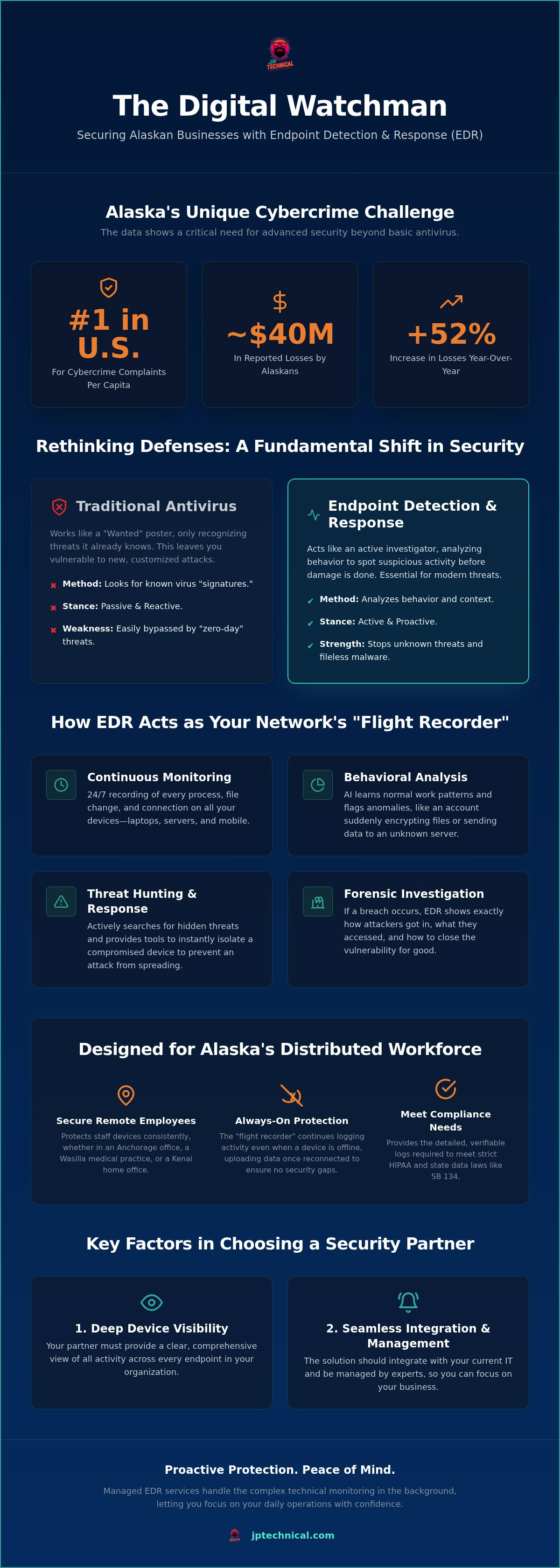
Did you know that Alaska leads the nation in cybercrime complaints per capita, with over 914 reports for every 100,000 residents? In 2025 alone, Alaskans reported nearly $40 million in losses due to cybercrime, which is a 52 percent increase from the previous year. It’s a sobering reality for local business owners who feel the weight of rising ransomware attacks and the pressure of meeting new SB 134 compliance deadlines. You likely already have an antivirus program, but you probably suspect it isn’t enough to stop modern, silent threats. Adopting professional endpoint detection and response Alaska services is the most effective way to close that gap and protect your livelihood.
We understand that managing security for remote employees in Kenai or maintaining HIPAA compliance in a Wasilla medical practice can feel overwhelming. This guide will show you how EDR technology acts as a digital watchman, catching the sophisticated attacks that traditional software misses. You’ll learn how to choose a security partner who understands our local landscape and how to ensure your business stays compliant with state and federal data laws. We’ll break down the technical noise so you can focus on running your business with peace of mind.
Key Takeaways
Learn how EDR provides a “flight recorder” for your network, monitoring devices to catch sophisticated threats that traditional antivirus software misses.
Understand why professional endpoint detection and response Alaska services are vital for securing remote employees and maintaining HIPAA compliance from Fairbanks to Palmer.
Discover how behavioral analysis can stop a ransomware attack in its tracks by spotting suspicious activity before your files are encrypted.
Identify the two most important factors when choosing a security partner: deep device visibility and seamless integration with your current IT infrastructure.
Gain confidence in your security posture by learning how managed EDR services handle technical monitoring in the background so you can focus on your daily operations.
Table of Contents
Why EDR is Crucial for Alaska’s Regulatory and Remote Landscape
Proactive Protection with JP Technical’s Managed EDR Services
What is Endpoint Detection and Response (EDR)?
In the simplest terms, an “endpoint” is any device that connects to your business network. This includes the laptops your team uses in Anchorage, the servers in your office, and the mobile devices your remote staff carries in Wasilla or Kenai. Endpoint detection and response (EDR) is a security technology that continuously monitors these devices to identify threats that managed to sneak past your initial defenses.
EDR is the digital equivalent of a 24/7 security guard for every device in your company. Its core mission goes beyond just blocking a virus; it’s designed to detect, investigate, and respond to sophisticated activities that look like normal business but are actually malicious. For a business owner, this means you aren’t just hoping your software catches a threat. You have a system in place that actively hunts for trouble and provides a clear path to fix it.
How EDR Differs from Traditional Antivirus
Traditional antivirus software works like a collection of “Wanted” posters. It looks for known digital signatures of viruses that have been seen before. If a threat isn’t on the list, the antivirus might let it right through the front door. This is why relying only on antivirus in 2026 is like locking your front door but leaving every window in the building wide open. It leaves you vulnerable to new, customized attacks that haven’t been “posted” yet.
EDR takes a different approach by focusing on behavior. Instead of looking for a known face, it looks for the “shady person” lurking in the digital lobby. If a program suddenly starts trying to encrypt files or send data to an unknown location, EDR flags it immediately. This behavioral analysis is critical for stopping zero-day attacks that don’t have a signature yet. It turns your security from a passive gatekeeper into an active investigator.
The Digital Watchman for Alaska Networks
Operating a business in Alaska presents unique logistical challenges, especially when your workforce is spread across vast distances. Maintaining a consistent endpoint detection and response Alaska strategy ensures that your security isn’t dependent on a single office network. Whether an employee is working from a home office in Palmer or a job site in Fairbanks, the security travels with the device itself.
One of the most valuable features of EDR is its ability to record data even when a device is offline. If a laptop is disconnected from the internet while traveling through a remote area, the EDR agent continues to log activity. Once the device reconnects, that data is uploaded, ensuring no gaps in your security history. This “flight recorder” capability is essential for businesses that must meet strict HIPAA compliance services requirements. It provides the transparency needed to prove your data remained safe, regardless of where the device was located. This continuous monitoring creates a foundation for proactive defense, moving your business from a reactive state to one of prepared vigilance.
How EDR Protects Your Business from Modern Threats
Modern cyber threats don’t just knock on the front door; they look for unpatched vulnerabilities and use stolen credentials to walk right in. To stop these intruders, your security needs to be proactive. Modern endpoint detection and response Alaska solutions act as a “flight recorder” for your network. They document every process, file change, and connection made by your devices. This continuous data collection allows for forensic investigation. If a breach occurs, you don’t have to guess what happened. You can see exactly how the threat entered and what it touched, which helps you close those gaps for good.
Continuous Monitoring and Behavioral Analysis
Traditional security relies on knowing what a virus looks like. EDR relies on knowing what your business looks like. Through “behavioral baselining,” the system learns the normal work patterns of your team. If an account that usually only accesses spreadsheets suddenly starts trying to download the entire database, the system flags it as an anomaly. This is how EDR identifies “fileless malware,” which lives in a computer’s memory and leaves no traditional file for a scan to find. By using AI to process millions of events, the technology can find the one true threat in a sea of normal activity. This high-level approach is similar to the methods used for securing federal networks against cyber threats, bringing enterprise-grade vigilance to your local office.
Rapid Incident Response and Remediation
When a threat is detected, every second counts. EDR provides “One-Click” isolation. This allows you to cut off an infected laptop from the rest of the network instantly. If a remote worker’s device is compromised, you can isolate it before the infection spreads to your Anchorage office server. It’s a definitive solution that stops the “east-west” movement of malware across your business. This prevents a localized problem from turning into a company-wide disaster.
Some advanced systems even offer rollback capabilities. If a ransomware strain manages to encrypt a few files before being caught, the system can undo those changes, restoring the files to their previous state. This level of protection is a cornerstone of a thorough Cyber Security Audit Anchorage. It ensures that a single mistake by an employee doesn’t lead to a total business shutdown. If you are unsure where your current defenses stand, a free IT assessment can help identify where EDR would best serve your team.
Why EDR is Crucial for Alaska’s Regulatory and Remote Landscape
Alaska’s vast geography is one of our greatest strengths, but it creates unique vulnerabilities for business networks. When your team is spread from Fairbanks to Palmer, the traditional “perimeter” of your office disappears. This decentralization makes endpoint detection and response Alaska a necessity rather than a luxury. In 2025, Alaskans reported nearly $40 million in losses due to cybercrime. This represents a 52 percent increase from the previous year. Most of these losses stemmed from investment fraud and business email compromise, which accounted for $7 million in reported damages. For local professional services like legal firms and accounting offices, a single data breach can result in devastating financial and reputational damage.
Beyond the immediate threat of theft, regulatory pressure is mounting. The Alaska Senate Bill 134 (SB 134) established strict deadlines for insurance data security. As of January 1, 2026, most licensees must meet rigorous risk assessment and information security program requirements. Many cyber insurance underwriters now refuse to renew policies unless EDR is in place. They view it as a baseline control for risk management. Citing EDR digital security for SMBs is now standard practice because it provides the proactive monitoring that insurers demand to mitigate their own liability.
Supporting HIPAA Compliance in Anchorage Medical Practices
Medical practices in Anchorage are prime targets for cybercriminals because patient data is highly valuable on the dark web. EDR technology helps you maintain HIPAA compliance services by providing the detailed audit logs required by federal law. If a security event occurs, you have a documented record of every action taken on your devices. This transparency is vital for proving you’ve met your “proactive monitoring” obligations and avoiding the heavy fines associated with data negligence.
Securing the Remote Workforce Across the Last Frontier
Managing “Shadow IT” is a significant hurdle when employees work from home in remote locations like Kenai. Without a robust endpoint detection and response Alaska solution, you can’t be sure if a home laptop has the same protection as a desktop in your main office. EDR secures the VPN and remote access points your team uses daily. It ensures that every endpoint, regardless of its physical location, stays under the watchful eye of your security team. This uniform protection is the only way to manage a truly decentralized Alaska workforce while keeping your data predictable and safe.
Choosing the Right EDR Solution for Your Local Business
Selecting an endpoint detection and response Alaska solution is a decision that impacts your daily operations and your long-term security. You shouldn’t settle for a generic tool that only offers surface-level data. First, evaluate the level of visibility the software provides. It must be able to see every active process on the device to be effective. If the tool can’t see hidden background tasks, it can’t protect you from sophisticated fileless malware that lives in the computer’s memory.
Second, check for integration. Your security tools should talk to each other. An EDR solution that integrates with your existing firewall and backup systems creates a unified defense. This ensures that if a threat is detected at the endpoint, your firewall can adjust its rules automatically to prevent further spread. It also ensures your backups remain untainted by the detected threat.
Third, decide who will manage the alerts. EDR generates a lot of data. If your internal team isn’t prepared to analyze these logs 24/7, you’ll likely face “alert fatigue.” This is when important warnings are missed because there are too many minor notifications. Finally, look for local accountability. If a critical alert triggers at 2 AM on a Tuesday, you need to know exactly who is responding. A local partner provides a level of dedication and neighborhood roots that a distant software vendor simply can’t match.
Key Features to Prioritize in 2026
In 2026, security shouldn’t come at the cost of productivity. Look for a solution with low system impact. Modern EDR agents are designed to run quietly in the background without slowing down your team’s computers. Additionally, prioritize offline protection. In remote Alaska, internet connections can be unpredictable. You need a system that continues to monitor and log activity even when a device is disconnected. This works alongside Managed Firewall Services Alaska to create a layered defense that covers both your network perimeter and individual devices.
Managed EDR vs. Do-It-Yourself
Many business owners try to manage their own EDR to save on costs, but this often leads to gaps in coverage. Professional endpoint detection and response Alaska is most effective when backed by a Security Operations Center (SOC). A SOC is a team of experts who watch your network around the clock. They filter out the “noise” and only contact you when a real threat requires action. This proactive care lowers your anxiety and ensures that technical hurdles don’t interrupt your growth.
Outsourcing to a local Alaska MSP provides a better cost-benefit ratio than hiring an in-house security team. You get enterprise-grade protection and 24/7 vigilance without the overhead of additional staff. If you’re ready to see how these tools fit your specific needs, start with a free IT assessment to map out your path to better security.
Proactive Protection with JP Technical’s Managed EDR Services
A sophisticated security tool is only as effective as the team operating it. While many vendors sell you a software license and leave you to manage the alerts, our approach is different. We believe that endpoint detection and response Alaska is a service that requires active, human vigilance. We manage the technical “noise” and the complex configurations so you can focus on running your business. If a threat is detected, you won’t get a confusing automated email; you’ll get a definitive resolution from a local expert who understands your network.
Our managed services integrate seamlessly with our broader offerings, such as HIPAA compliance services and proactive patch management. This creates a unified security posture where your endpoints, your network, and your regulatory requirements are all handled under one roof. This level of integration ensures that there are no gaps in your defense. It provides the peace of mind that comes from knowing a local guardian is watching your back around the clock. You don’t have to worry about technical hurdles or surprise audits because we’ve already prepared for them.
Local Expertise Meets Global Security Standards
JP Technical leverages world-class EDR tools and combines them with a neighborly Anchorage touch. We don’t believe in one-size-fits-all solutions. Instead, we provide direct support from technicians who know your community and the specific logistical challenges of the Last Frontier. Whether your team is based in Anchorage, Wasilla, or Kenai, you receive the same high-level sophistication and no-nonsense work ethic. Since our founding in 1996, we’ve remained a mark of long-term reliability for Alaska businesses, showing up when things get difficult and staying until the job is done.
Get Started with a Free IT Assessment
The transition from basic antivirus to a managed endpoint detection and response Alaska solution is simpler than most business owners expect. We start by identifying the specific gaps in your current endpoint security. This assessment helps us understand your device count, your remote work habits, and your compliance needs. Our goal is to make your security predictable and your daily operations stable. We handle the deployment and monitoring, ensuring your team stays productive without being slowed down by heavy software.
If you’re ready to move beyond reactive security and embrace a proactive defense, we’re here to help. Our team will guide you through every step of the process, ensuring your business stays protected against the evolving threats of 2026. Schedule your free IT assessment with JP Technical today to see how we can secure your future.
Secure Your Alaska Business for the Future
Modern threats require more than just basic antivirus software. We’ve seen that EDR provides the visibility and behavioral analysis needed to stop ransomware before it causes lasting damage. Whether you are managing a remote team in Kenai or a medical practice in Anchorage, having a robust endpoint detection and response Alaska strategy is the only way to meet 2026 compliance standards and insurance requirements. It turns your security from a passive gatekeeper into a proactive investigator.
You don’t have to manage these technical hurdles alone. Since 1996, JP Technical has served as a local guardian for businesses across the state. Our Anchorage-based proactive support team specializes in HIPAA-compliant cybersecurity, ensuring your data stays safe and your operations remain predictable. We handle the vigilance so you can focus on growth. It’s time to trade digital anxiety for the peace of mind that comes with professional, local care.
Secure your business endpoints with a free IT assessment today. Let’s work together to build a stable and secure future for your business.
Frequently Asked Questions
Is EDR just a fancy name for antivirus?
No, EDR is a more advanced evolution of security. Traditional antivirus looks for known files and signatures of old threats. EDR monitors the behavior of your devices in real time. It acts like a security guard who watches for suspicious movements rather than just a lock on the front door that only stops people with a specific key.
Do I need EDR if my business is very small?
Yes, small businesses are frequently targeted because they often lack robust defenses. In a state like Alaska, where cybercrime reports are high per capita, even a small office is at risk. Professional endpoint detection and response Alaska services ensure that a single compromised laptop doesn’t lead to a total financial loss for your company.
How much does EDR impact my computer’s performance?
The impact is negligible on modern business hardware. These security agents are designed to be extremely lightweight and run quietly in the background. Your team can continue their daily work in programs like Excel or specialized medical software without noticing any lag or system slowdown. If your hardware meets 2026 standards, performance remains smooth.
Can EDR help my Alaska business with HIPAA compliance?
EDR is a critical tool for meeting HIPAA requirements. It provides the detailed audit logs and proactive monitoring that federal regulators demand. If a security event occurs, the system provides a clear record of what happened to the data. This transparency is essential for proving you’ve taken the necessary steps to protect patient privacy.
What happens when EDR detects a threat on a remote employee’s laptop?
The system can automatically isolate that device from your network. This prevents a threat on a laptop in Kenai or Wasilla from moving “east-west” to your Anchorage servers. Once the device is isolated, our team investigates the threat and clears it before allowing the device to reconnect to your business data.
Is EDR included in JP Technical’s managed IT services?
We include managed EDR as a foundational part of our cybersecurity suite. We don’t just install the software and walk away. Our team manages the alerts and handles the response for you. This partnership approach ensures that your security stays up to date without adding extra work to your daily schedule.
Does EDR protect against ransomware specifically?
EDR is one of the most effective defenses against ransomware. It identifies the specific behavior of file encryption as it begins. By stopping the process in seconds, it prevents the malware from locking your entire database. Some of our systems can even roll back unauthorized changes to restore your files to their original state.
How long does it take to install EDR across my Anchorage office?
Deployment is typically very fast and can be completed in a single afternoon. We use remote management tools to push the software to all your endpoints simultaneously. This process doesn’t require any downtime for your employees. Your team can stay productive while we strengthen your endpoint detection and response Alaska posture in the background.
 Article by
Colter Hobbs