Door Badge Systems in Anchorage: A 2026 Guide for Business Security
You realize on a Sunday evening that a terminated employee still has a physical key to your warehouse, and suddenly, your peace of mind disappears. Managing physical security shouldn’t feel like a constant game of tracking down metal keys or worrying about unauthorized duplicates. If you’re tired of the risks associated with staff turnover or lost hardware, it’s time to consider how door badge systems Anchorage businesses use can simplify your daily operations.
Most local owners agree that juggling keys across multiple locations like Wasilla or Fairbanks is a logistical headache that eventually leads to a security gap. This 2026 guide provides a clear path to a more reliable, keyless solution. You’ll learn exactly how modern badge systems work, why they outperform traditional locks, and how to choose a setup that fits your specific business needs. We’ll also look at how these systems integrate with your existing IT infrastructure to ensure your physical and digital security work together as a single, protective shield.
Key Takeaways
Discover why replacing physical keys with digital credentials eliminates the risk of unauthorized duplicates and simplifies staff turnover management.
Learn how to select hardware specifically rated for sub-zero temperatures to ensure your exterior access points remain reliable during Alaska winters.
Understand the process of identifying high-security zones, such as server rooms and HR files, to maintain compliance and operational safety.
Explore how modern door badge systems Anchorage offices use can be integrated into a secure, managed VLAN to bridge the gap between physical and IT security.
Gain insights into choosing between mullion readers and keypad combos to balance office aesthetics with multi-factor authentication requirements.
Table of Contents
What is a Door Badge System and Why Does Your Business Need One?
Implementing Your Badge System with a Local Managed IT Partner
What is a Door Badge System and Why Does Your Business Need One?
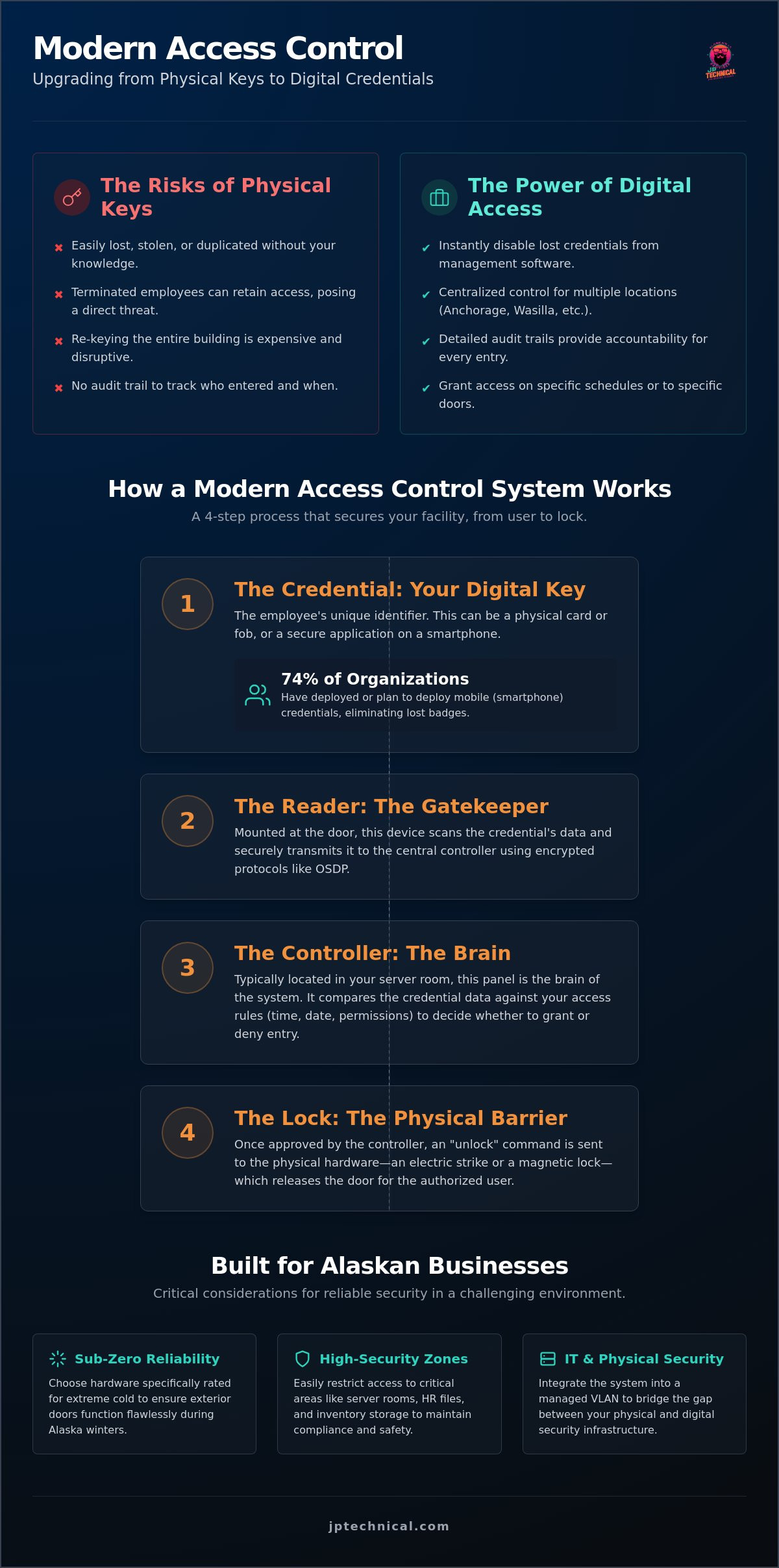
A door badge system is a specialized access control system that replaces traditional metal keys with digital credentials. Instead of a physical lock and key, your team uses encrypted cards, fobs, or smartphone apps to enter secured areas. For many local owners, the primary driver for adopting door badge systems Anchorage specialists provide is the inherent liability of the traditional key. Keys are easily lost, stolen, or duplicated at any hardware store without your knowledge. When an employee leaves on bad terms, a physical key in their pocket represents a direct threat to your property and your sensitive data.
Think of your badge system as a physical firewall. Just as a digital firewall monitors and blocks unauthorized traffic on your network, a badge system provides a controlled perimeter for your office or warehouse. This is especially critical for Anchorage medical clinics handling sensitive patient records or Fairbanks logistics hubs managing high-value inventory. You’re protecting the building, but you’re also protecting the information stored inside. By implementing a modern physical security solution, you establish a proactive defense that ensures your business remains stable and predictable.
The Shift from Physical Keys to Digital Access
Re-keying a commercial building is a significant expense that often isn’t budgeted for until an emergency happens. Every time a key goes missing, you face the cost of a locksmith and the time spent distributing new sets to every staff member. Digital access removes this burden. If a badge is lost, you simply disable it in the management software. The change is instantaneous. These systems also provide detailed audit trails. You can see exactly which door was accessed at 3:00 AM, providing a level of accountability that a standard deadbolt cannot match.
Benefits of Keyless Entry for Local Teams
Managing security becomes much simpler when you have multiple offices in Wasilla or Palmer. Instead of carrying a heavy ring of keys for every location, a single badge can be programmed to grant access across all your sites. This centralized control reduces the anxiety managers feel about unauthorized entry after hours. To maximize protection, these systems often work alongside security camera installation Anchorage services. This integration allows for visual verification; you can match a badge swipe event with a video clip to ensure the person using the card is actually the authorized employee.
How Modern Access Control Components Work Together
Reliability in security comes from how well your hardware communicates. A door badge system is more than just a piece of plastic; it is a chain of components that must work in perfect harmony to protect your facility. When you invest in door badge systems Anchorage businesses rely on, you are installing four distinct layers of technology: the credential, the reader, the controller, and the locking hardware. If one of these parts fails or is outdated, the entire perimeter is compromised.
The Credential: This is the digital key carried by the employee. It holds a unique signature that identifies the user to the system.
The Reader: Mounted at the entry point, this device scans the credential and transmits that data to the control panel.
The Controller: Often called the “brain,” this panel lives in your server room. It evaluates the data against your rules to determine if access should be granted.
The Locking Mechanism: This is the physical hardware, such as an electric strike or magnetic lock, that releases the door latch once the controller sends the “unlock” command.
Credentials: Cards, Fobs, or Smartphones?
The type of credential you choose depends on your daily workflow. RFID proximity cards remain the industry standard because they are cost-effective and easy to issue. For industrial sites or field workers in Palmer or Kenai, rugged key fobs are often a better choice because they withstand harsh handling. However, the most significant trend in 2026 is the move toward mobile access. According to data from securitytoday.com, 74% of organizations have already deployed or are planning to deploy mobile credentials. This allows employees to use encrypted smartphone apps to unlock doors, which eliminates the problem of forgotten or lost physical badges.
Readers and Controllers: The Hardworking Hardware
The connection between your reader and controller is a frequent target for sophisticated tampering. To prevent this, we prioritize the use of OSDP (Open Supervised Device Protocol). This protocol ensures the communication between the door and the controller is fully encrypted, making it much harder for someone to “sniff” the wiring and spoof an authorized badge swipe. You also need to decide between a cloud-based or an on-premise controller. Cloud systems offer the convenience of remote management from any device, while on-premise systems provide total local control over your data.
Choosing the right balance of hardware requires a clear understanding of your building’s layout and your long-term security goals. If you are unsure which components fit your current network, a free IT assessment can help identify the best path forward for your specific location.
Choosing the Right Hardware for Your Anchorage Office
Selecting the right hardware for your facility is about more than just aesthetics; it is about ensuring long-term durability in a demanding environment. When evaluating door badge systems Anchorage businesses must prioritize hardware that can withstand both high-traffic use and our specific climate challenges. The components you choose today will determine how much maintenance you face over the next decade. A “straight-shooter” approach to hardware selection means looking past the sleekest designs to find the most resilient technology for your specific entry points.
In Alaska, weather-rated housing is a non-negotiable requirement for any exterior door. Standard readers often fail when temperatures drop well below zero, as internal components can become brittle or succumb to moisture from condensation. We recommend hardware with an IP65 or higher rating to ensure your team isn’t locked out during a winter storm. For public-facing entrances or high-traffic areas, vandal-resistant designs provide an extra layer of protection against tampering, ensuring your perimeter remains secure even when your office is empty.
Reader Styles and Placement
The physical layout of your door frame usually dictates the style of reader you need. Mullion readers are narrow and designed to fit perfectly on the slim metal frames of glass storefront doors. If you have more wall space, single gang readers offer a standard “light-switch” footprint that is familiar to most users. For parking garages or gated entries in Palmer, long-range readers allow employees to scan their credentials without rolling down their windows. Regardless of the style, we always ensure mounting heights comply with ADA standards, typically placing the reader between 34 and 48 inches from the floor for universal accessibility.
Locking Hardware: Strikes vs. Maglocks
Your locking mechanism is the final piece of the security puzzle. Electric strikes are the most common choice because they allow the existing door latch to remain functional, providing a familiar feel for your staff. Magnetic locks, or maglocks, use a powerful electromagnetic field to hold the door shut and are ideal for all-glass entries where traditional strikes cannot be installed.
You must also choose between fail-safe and fail-secure configurations. Fail-safe hardware unlocks automatically if the power goes out, which is essential for life safety and emergency egress. Fail-secure hardware stays locked during a power outage, which is often preferred for high-security areas like server rooms to protect assets until power is restored. Balancing these requirements ensures your building is safe for people and secure for your business.
Planning for Compliance and Alaska Environmental Factors
Planning for compliance and environmental resilience is the stage where many businesses overlook critical details. A door badge system must do more than just unlock a door; it must satisfy regulatory requirements and survive the unique stressors of the North. If you don’t account for local power instability or sub-zero temperatures, your security investment will eventually leave you vulnerable. A systematic approach ensures that your setup remains a reliable asset rather than a maintenance burden.
Identify high-security zones: Map out areas like server rooms, HR files, and medicine storage that require restricted access levels.
Select sub-zero hardware: Ensure exterior readers are rated for the extreme cold often found in Anchorage and Fairbanks.
Integrate battery backups: Local power fluctuations can reset controllers; dedicated backups ensure your doors remain functional during a brownout.
Verify fire codes: Every electronic lock must allow for immediate emergency egress per the latest Anchorage building standards.
Audit for standards: Use the system logging features to maintain the records required for HIPAA or internal security compliance.
HIPAA Compliance for Anchorage Medical Practices
Restricting physical access to Protected Health Information (PHI) is a core requirement of federal law. If an unauthorized person enters your records room or pharmacy storage, you face significant legal liability. The door badge systems Anchorage medical offices utilize provide the digital logs necessary to prove your security protocols during a HIPAA audit. By pairing access control with managed IT services Anchorage businesses trust, you create a unified defense that protects both your physical files and your digital network from a single point of management.
Alaska-Proofing Your Access Control
National vendors often sell hardware that isn’t built for our climate. Cheap plastic readers often crack or fail when temperatures drop during an Anchorage winter. Beyond the cold, you must manage ice buildup on magnetic locks and electric strikes, which can prevent doors from latching correctly. Planning an access control installation Anchorage requires local technicians who understand these terrain-specific hurdles. We ensure that every component is positioned and protected to remain functional through the darkest and coldest months of the year.
If you’re ready to ensure your facility meets these rigorous standards and can withstand the local environment, schedule a free IT assessment to review your current security posture.
Implementing Your Badge System with a Local Managed IT Partner
Installing a door badge system is only half the battle; the other half is ensuring that system remains secure and functional on your company network. Modern access control devices are essentially specialized computers connected to your internet. If they aren’t managed correctly, they can become a weak point in your digital perimeter. Choosing a partner that understands both the physical hardware and the underlying IT infrastructure is the only way to ensure your building stays locked and your data stays private.
A professional implementation involves more than just mounting a reader. We prioritize several technical layers to protect your business:
Secure VLAN Segmentation: Your door system should live on its own virtual local area network (VLAN). This prevents a compromised badge reader from giving a hacker access to your financial records or client data.
Single Point of Accountability: When your IT provider and security installer are the same team, you don’t have to deal with finger-pointing during a technical glitch. We handle everything from the wiring to the software configuration.
Proactive Firmware Management: Like any computer, badge controllers require regular updates. We manage these patches to close security vulnerabilities before they can be exploited.
Scalable Architecture: Whether you are adding a new office in Wasilla or expanding your Fairbanks warehouse, your system should grow with you without requiring a complete overhaul.
The Advantage of IT-Integrated Security
Integrated security prevents your door badge systems Anchorage setup from becoming a “backdoor” for cyber threats. Many standalone security companies install hardware but leave the network configuration to chance. We take a different approach by treating physical access as a core component of your IT strategy. This allows you to manage employee permissions from your desktop or smartphone, giving you total control over your facility regardless of where you are. This level of “neighborly vigilance” means we are watching the technical details in the background so you can focus on running your business.
Next Steps for Your Anchorage Business
Securing your facility is a long-term commitment that requires a partner who shows up when things get difficult. If you’re ready to move away from the risks of physical keys, the first step is a thorough review of your current environment. We provide a “straight-shooter” perspective on what you actually need to protect your assets without selling you unnecessary bells and whistles.
You can start by requesting a free IT and security assessment to identify gaps in your current setup. From there, we can review physical security options tailored specifically to your building’s layout and your industry’s compliance needs. Whether you need to secure a single door or a multi-site operation, we provide the technical mastery and local accountability you expect from a long-term partner.
Secure Your Perimeter for the Long Term
Transitioning from traditional keys to modern digital access control is a definitive step toward protecting your business’s future. By choosing the right hardware and planning for the unique environmental challenges of the North, you ensure your facility remains secure and accessible even in the harshest conditions. It’s clear that the most effective door badge systems Anchorage businesses use today are those integrated deeply with their IT infrastructure to prevent digital vulnerabilities. This unified approach provides the stability and predictability you need to grow without constant security concerns.
JP Technical has provided local support and neighborly vigilance to the community since 1996. We specialize in HIPAA compliance and the seamless integration of physical security with managed IT services. If you want no-nonsense, straight-shooter advice on how to protect your assets, we’re ready to help you navigate the process. Taking control of your building’s security shouldn’t be a source of anxiety; it should be a source of confidence and long-term peace of mind.
Secure your office today with a Free IT & Security Assessment from JP Technical and start building a more resilient, keyless environment for your team.
Frequently Asked Questions
How much does a door badge system cost to install in Anchorage?
The total cost for installation depends on the number of doors, the complexity of the wiring, and the specific hardware you choose. Factors such as whether you opt for basic proximity cards or advanced mobile credentials will influence the initial investment. Local labor rates and the shipping of specialized hardware to Alaska also play a role in the final quote.
We provide a clear, straight-shooter estimate after evaluating your building’s layout and security requirements. This ensures you only pay for the components necessary to protect your specific facility without hidden fees or unnecessary add-ons.
What happens to the door locks if the power goes out?
Your doors will react based on whether they are configured as fail-safe or fail-secure. Fail-safe hardware unlocks automatically during a power loss to ensure everyone can exit safely during an emergency. Fail-secure hardware remains locked to protect sensitive areas like server rooms until power is restored.
To prevent unauthorized access or lockouts during local power fluctuations, we integrate dedicated battery backups into the controller. These backups keep your system operational for several hours, providing continuity until the grid stabilizes or a generator takes over.
Can I use my smartphone as a door badge?
Yes, modern door badge systems Anchorage businesses use can be configured to support encrypted smartphone credentials. This technology allows employees to unlock doors with a tap or a gesture within a secure app, removing the need for physical plastic cards.
According to industry data from 2026, 74% of organizations are now deploying mobile credentials for their enhanced security and convenience. This setup is particularly useful for teams that frequently lose physical fobs or for managers who need to grant temporary access to contractors remotely.
Are door badge systems more secure than traditional keys?
Digital badge systems are significantly more secure because they eliminate the risk of unauthorized key duplication. If an employee loses their badge or leaves the company, you can revoke their access instantly in the software. You don’t have to worry about a master key floating around the community or the high cost of re-keying every lock.
These systems also create a detailed audit trail. You get a permanent record of every entry attempt, including the time, location, and identity of the person. This level of accountability is impossible to achieve with a standard metal key and deadbolt.
Do I need a special server to run a badge system?
You don’t necessarily need a dedicated on-site server to manage your access control. Many businesses now choose cloud-based controllers that allow for remote management through a secure web portal. This reduces your upfront hardware costs and simplifies the maintenance process for your IT team.
If your business requires total local data control for compliance reasons, we can install an on-premise controller. Both options provide a stable and predictable way to manage permissions without requiring a complex IT overhaul.
How long does it take to install access control in a small office?
A standard installation for a small office with two or three doors typically takes one to two business days. The timeline depends on how easily we can run low-voltage wiring to each entry point and the type of locking hardware being installed.
We work methodically to minimize disruptions to your daily operations. By coordinating the physical installation with your network configuration, we ensure the transition to your new keyless system is smooth and organized.
Can I integrate my badge system with my security cameras?
Yes, integrating your badge system with your surveillance cameras is a highly effective way to verify entry events. When a badge is swiped, the system can automatically bookmark the corresponding video clip. This allows you to confirm that the person using the badge is the authorized owner.
This integration provides a unified security posture. It bridges the gap between physical access and visual monitoring, giving you a comprehensive view of who is entering your building and when.
Is it possible to manage access for multiple locations from one app?
Centralized management allows you to control access for offices in Anchorage, Wasilla, or Fairbanks from a single interface. You can add or remove users across all locations simultaneously, which is a major advantage for growing Alaska firms.
This “single pane of glass” approach reduces administrative headaches. It ensures that your security policies are applied consistently across your entire organization, regardless of how many miles sit between your branch offices.
 Article by
Colter Hobbs