Healthcare Data Security in Alaska: The 2026 Comprehensive Compliance Checklist
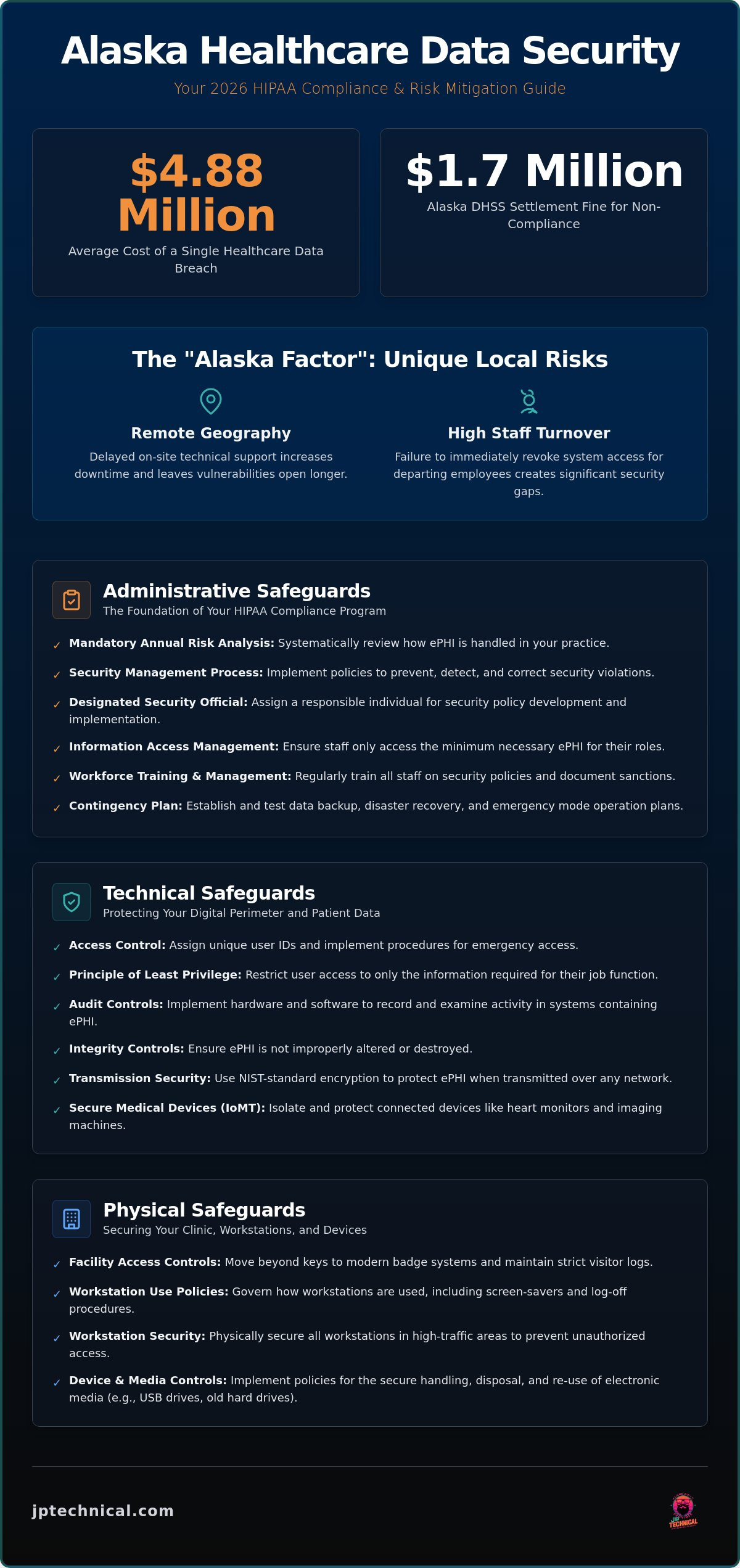
Could your Alaska medical practice survive a $4.88 million bill for a single data breach? It’s a sobering question, but with the average cost of a breach reaching that record high, the financial stakes for healthcare data security Alaska have never been more critical. You already know that protecting patient privacy is more than a legal obligation; it’s a foundation of trust in our local communities. Whether you’re operating in Anchorage or a remote clinic in the Interior, the fear of a massive fine like the $1.7 million DHSS settlement is a constant pressure that’s hard to ignore.
We understand that keeping up with 2026 cybersecurity standards feels like a moving target when you have limited local staff. That’s why we’ve built this guide to give you back your peace of mind. You’ll get a clear, actionable roadmap to navigate the new SB 134 risk assessment requirements and the annual certification deadlines starting in February 2026. This checklist simplifies HIPAA compliance and technical safeguards into manageable steps, ensuring your practice remains a secure haven for the Alaskans who depend on you.
Key Takeaways
Identify the unique risks that Alaska’s remote geography and high staff turnover pose to your practice’s data integrity.
Master the mandatory annual Risk Analysis process to ensure your administrative safeguards fully comply with federal HIPAA requirements.
Secure your digital perimeter using NIST-standard encryption and the principle of least privilege for all patient records.
Protect your physical clinic space by moving beyond traditional keys to modern badge systems and securing high-traffic workstations.
Learn how a localized approach to healthcare data security Alaska reduces your risk of data breaches through proactive, integrated vigilance.
Table of Contents
Why Healthcare Data Security in Alaska Requires a Local Focus
Administrative Safeguards Checklist: The Foundation of HIPAA
Technical Safeguards Checklist: Protecting the Digital Perimeter
Implementing Your Healthcare Security Strategy with JP Technical
Why Healthcare Data Security in Alaska Requires a Local Focus
Securing patient information in the 49th state involves more than just installing a firewall. At its core, healthcare data security Alaska is defined by the Health Insurance Portability and Accountability Act (HIPAA) and the HITECH Act. These federal mandates require medical practices to protect the confidentiality, integrity, and availability of electronic protected health information (ePHI). While the rules are national, the application is deeply local. Alaska clinics face a unique set of geographic and operational hurdles that national providers often overlook.
The “Alaska Factor” creates specific vulnerabilities. Many of our medical facilities operate in remote areas where reliable technical support is hours or even days away. High workforce turnover in the local healthcare sector adds another layer of risk. When a staff member leaves a practice in Wasilla or Fairbanks, failing to immediately revoke their system access creates a massive security gap. Without a neighborly, watchful eye on your network, these small administrative oversights can lead to significant data exposure.
We only have to look at the $1.7 million Alaska Department of Health and Social Services (DHSS) settlement to see the consequences of gaps in oversight. This landmark case wasn’t just about a lost USB drive; it was about a systemic failure to implement sufficient policies and procedures. It taught us that “good enough” isn’t a strategy. As we move through 2026, the industry has shifted away from reactive “break-fix” IT. You can no longer afford to wait for a system failure to address your vulnerabilities. Proactive HIPAA Compliance Services are now the standard for protecting both your patients and your practice.
The High Cost of Non-Compliance in the Last Frontier
HIPAA enforcement has become more aggressive, with fines tiered based on the level of negligence. For a small practice, even a “Tier 1” violation can result in thousands of dollars in penalties per record. In the DHSS case, the lack of documented risk assessments was the primary driver of the massive settlement. Beyond the financial hit, the reputational damage in tight-knit Alaska communities is often permanent. When news of a breach spreads in a town where everyone knows their neighbor, patient trust evaporates quickly.
The 2026 Threat Landscape for Alaska Medical Providers
Ransomware remains a dominant threat, with attackers increasingly targeting rural healthcare facilities that they perceive as “soft targets” with limited IT staff. Additionally, the rise of the Internet of Medical Things (IoMT), such as connected heart monitors and imaging machines, has expanded the digital perimeter of local networks. For Alaska medical providers in 2026, ePHI security is defined as the rigorous, documented protection of patient data through an integrated framework of administrative, technical, and physical safeguards.
Administrative Safeguards Checklist: The Foundation of HIPAA
Administrative safeguards act as the management framework for your entire compliance program. While firewalls and passwords are vital, they only work if your team follows a structured set of rules. For Alaska medical practices, this means moving beyond generic templates and creating living documents that reflect how your specific clinic operates. These policies are the “brain” of your healthcare data security Alaska strategy, ensuring that every staff member knows their role in protecting patient privacy.
The HIPAA Security Rule identifies the annual Risk Analysis as the single most important administrative requirement. This isn’t a “one and done” task. It’s a systematic review of every way ePHI enters, moves through, and leaves your practice. In 2025, the OCR reported a record 772 large healthcare data breaches nationally. Many of these incidents stemmed from unaddressed vulnerabilities that a proper risk analysis would have caught before an attacker could exploit them.
Mastering the Annual Risk Assessment
To master this process, start by mapping your data flow. Do you use mobile tablets for patient intake? Is your backup data stored offsite in a way that survives an Alaska earthquake or a prolonged power surge? Once you identify where ePHI lives, evaluate the likelihood of threats like ransomware or unauthorized access. If you aren’t sure where to begin, you can schedule a free IT assessment to jumpstart your 2026 compliance planning and identify hidden gaps in your network.
Documentation is your best defense during an audit. Your policies should clearly define who has access to specific files and how that access is revoked when an employee leaves. This is especially important in Alaska, where high staff turnover can lead to “ghost accounts” that remain active long after a person has moved on. Additionally, ensure you have signed Business Associate Agreements (BAAs) for every vendor. If a third party has potential access to your ePHI, they must be legally bound to protect it as strictly as you do.
Workforce Training and Incident Response
Your staff is your first line of defense. Effective training focuses on practical scenarios, like spotting a phishing email that looks like a request from a local pharmacy. Cultivating a “no-blame” culture is essential. If an employee clicks a suspicious link, they should feel comfortable reporting it immediately. Rapid reporting is often the difference between a minor incident and a full-scale breach. For a deeper look at policy management, our HIPAA Audit Preparation for Healthcare guide provides specific advice for local office managers.
Technical Safeguards Checklist: Protecting the Digital Perimeter
Technical safeguards are the digital armor protecting your practice. If administrative safeguards are the “how,” technical safeguards are the “what.” In the context of healthcare data security Alaska, these tools must be robust enough to handle modern ransomware while remaining accessible for your daily clinical operations. You don’t need to be a global enterprise to implement enterprise-grade security. You simply need a structured approach that prioritizes your most vulnerable entry points.
Implementing the principle of least privilege (PoLP) is a critical first step. This means each staff member only has access to the specific patient records required for their job. If a nurse doesn’t need to see billing data, those permissions should be restricted. This limits the “blast radius” if a single account is compromised. We combine this with EDR & Antivirus solutions that go beyond traditional software. Traditional antivirus waits for a known threat to appear. Modern Endpoint Detection and Response (EDR) monitors behavior. It can stop an unknown ransomware attack in its tracks before it encrypts your database.
Network isolation is another essential layer. Your guest Wi-Fi should never touch the network used for your Electronic Health Records (EHR) or billing systems. If a patient connects a compromised phone to your guest network, a properly isolated system ensures that threat cannot jump to your clinical data. This protective vigilance keeps your core operations running smoothly even if an external device brings a threat into your waiting room.
Encryption and Integrity Controls
Relying on a “set it and forget it” approach to encryption is a dangerous myth in 2026. Encryption must cover data at rest on your local servers and data in transit through emails or portals. Integrity controls ensure that ePHI isn’t accidentally altered or maliciously destroyed. To maintain a secure perimeter, follow this baseline checklist:
Use NIST-validated encryption for all mobile devices and laptops.
Implement secure, encrypted patient portals for all digital communications.
Disable auto-forwarding on staff email accounts to prevent accidental data leaks.
Verify that your Backup & Disaster Recovery systems also use high-level encryption.
Audit Controls and Monitoring
HIPAA requires you to know exactly who accessed a patient record and when they did it. Audit logs provide this transparency. We set up automated alerting to flag suspicious activity, such as a login attempt from outside of Alaska during non-business hours. This level of technical vigilance is a core part of our Managed IT Services. You shouldn’t have to monitor your network in the middle of the night. A local guardian handles the technical heavy lifting, providing the safety and continuity your practice deserves.
Physical Security Checklist: Securing the Clinic Premises
Data security isn’t just about lines of code; it’s about the physical walls and locks surrounding your patient information. If a visitor can wander into your server room or walk away with an unencrypted tablet, your digital defenses are already bypassed. For comprehensive healthcare data security Alaska, your physical office must be as secure as your network. This “forgotten” leg of the HIPAA stool is often where the most preventable breaches occur.
Workstation security is your next line of defense. In a busy clinic, it’s easy for a screen to be left active while a clinician steps away. We recommend implementing automatic logouts and privacy screens to prevent “drive-by” data theft in waiting rooms or shared spaces. Additionally, surveillance cameras should monitor sensitive areas like server closets and file storage rooms. This creates a visual deterrent and provides a clear record of who was present if an incident occurs. Vigilance in these high-traffic areas ensures that your commitment to privacy is visible to both staff and patients.
Modern Access Control for Alaska Clinics
Traditional keys are a liability in a modern medical practice. When a staff member leaves a clinic in Anchorage or Fairbanks, the cost and hassle of re-keying the entire facility often lead to dangerous delays. Moving to digital badge systems allows you to revoke access instantly with a few clicks. You can learn more about physical security and access control systems that integrate directly with your compliance efforts. These systems don’t just lock doors; they create a digital audit log of every entry and exit, providing a complete compliance trail that satisfies HIPAA requirements.
Device and Media Controls
A common scenario in healthcare breaches involves a laptop or external drive stolen from a vehicle. This “technician’s vehicle” lesson is a reminder that data is most vulnerable when it’s on the move. Clinicians using tablets or phones must be managed through a Mobile Device Management (MDM) system. This allows your IT partner to remotely wipe a device if it’s lost or stolen. Unencrypted mobile devices act as portable, unsecured gateways to your entire patient database, making them one of the highest risk factors for a reportable HIPAA breach. Finally, ensure that old hardware is properly sanitized. Simply deleting files isn’t enough; legacy patient data must be destroyed using certified hardware disposal methods.
Securing your physical premises is a vital step in protecting your practice’s future. If you want to ensure your clinic meets these 2026 standards, you can schedule a free security assessment to evaluate your current physical and digital safeguards.
Implementing Your Healthcare Security Strategy with JP Technical
Building a robust defense for your practice is a complex task that requires more than just checking boxes. As we’ve discussed, healthcare data security Alaska relies on a three-legged stool of administrative, technical, and physical safeguards. Managing these moving parts while providing patient care can easily overwhelm a local office manager. This is where a local partner becomes an essential ally. Unlike national, “faceless” providers who treat every clinic like a ticket in a queue, we understand the specific operational rhythms of Alaska medical practices.
Our “Guardian” approach integrates your IT infrastructure, HIPAA compliance requirements, and physical security into a single, cohesive strategy. This eliminates the gaps that often occur when multiple vendors handle different parts of your security. When your door badge system, your server encryption, and your staff training are all managed under one roof, you gain a level of predictability and safety that fragmented systems can’t provide. We help you move beyond “compliance-only” thinking to foster a true culture of patient data privacy that builds lasting trust in your community.
The JP Technical Difference
We’ve maintained deep roots in Anchorage, Wasilla, and the surrounding regions since 1996. This local experience means we’ve seen the unique challenges Alaska healthcare providers face, from connectivity issues in remote clinics to the high staff turnover mentioned earlier. You can review our HIPAA compliant service offerings to see exactly how we tailor our technical mastery to protect your specific practice. We provide personalized support that values human connection, ensuring you’re never left waiting for a distant technician when you need immediate assistance.
Your Security Roadmap
Securing your practice doesn’t happen overnight, but it can be achieved through a steady, methodical process. We recommend a 30-day plan to shore up your healthcare data security Alaska posture. This roadmap starts with a comprehensive assessment to identify your current vulnerabilities. From there, we move to remediation, where we fix high-priority gaps in your encryption or physical access controls. Finally, we establish a maintenance routine of proactive monitoring and patch management to keep your practice ahead of evolving threats.
Budgeting for these protections is a vital part of your long-term stability. You can view our Managed IT Pricing for Alaska Businesses to understand how we structure our services to provide maximum value and peace of mind. Taking the first step is simple and provides the clarity you need to move forward with confidence. Contact us today to secure your Alaska medical practice and ensure your patient data remains protected by a local expert who stands by you when things get difficult.
Protecting Your Practice’s Future in Alaska
Securing patient data in 2026 requires more than a passive approach. You’ve seen how administrative, technical, and physical safeguards must work together to create a true shield for your clinic. By prioritizing annual risk assessments and implementing modern access controls, you protect your practice from the record-breaking breach costs seen across the nation. This integrated strategy is the only way to ensure healthcare data security Alaska medical providers can rely on for long-term stability.
You don’t have to manage these complex regulatory hurdles alone. JP Technical has been serving Alaska since 1996 as specialized HIPAA compliance experts. From our Anchorage-based headquarters, we provide the localized support and protective vigilance your clinic needs to stay ahead of evolving threats. We’re ready to act as your seasoned guardian, handling the technical details so you can focus on your patients.
Secure Your Patients and Your Practice—Schedule a Free IT Assessment Today
Your commitment to privacy today builds a stronger, more trusted medical practice for all Alaskans tomorrow.
Frequently Asked Questions
Is HIPAA compliance different for small clinics in Alaska compared to large hospitals?
HIPAA standards apply equally to all covered entities, regardless of their size. While a large hospital system has more complex infrastructure, a small clinic in Wasilla must implement the same core administrative, technical, and physical safeguards. The federal government expects your small practice to maintain a level of healthcare data security Alaska that is appropriate for your specific operations and risk level.
Does healthcare data security in Alaska require data to be stored locally in the state?
No federal or state law mandates that patient data must physically reside within Alaska’s borders. You can use cloud providers or data centers located in the lower 48 as long as they are HIPAA-compliant and have a signed Business Associate Agreement (BAA). However, you must ensure your data remains accessible and protected according to the standards set by the Alaska Personal Information Protection Act (APIPA).
What are the most common causes of healthcare data breaches in Alaska?
Phishing attacks and stolen unencrypted devices remain the top threats to local practices. In our remote environment, unauthorized access due to unrevoked credentials for former employees is also a significant risk. These “ghost accounts” create easy entry points for attackers if your administrative policies don’t include a strict offboarding process for staff who have left the practice.
Can my Alaska practice be fined even if no patient data was actually stolen?
Yes, the Office for Civil Rights (OCR) can issue substantial fines for “willful neglect” even if a breach hasn’t occurred. If an audit reveals that you haven’t conducted a mandatory risk analysis or lack documented security policies, you are in violation of the HIPAA Security Rule. Regulatory penalties are often driven by the absence of proper safeguards rather than the theft of data itself.
How often should an Alaska medical practice conduct a HIPAA risk analysis?
You should conduct a comprehensive risk analysis at least once a year. It’s also necessary to perform a new assessment whenever you make significant changes to your network, such as installing a new EHR system or opening a satellite clinic. Regular reviews ensure your healthcare data security Alaska strategy evolves alongside new cybersecurity threats and regional regulatory updates like Alaska’s SB 134.
What is the role of physical access control in healthcare data security?
Physical access control prevents unauthorized individuals from reaching your servers, workstations, or paper records. This includes using badge entry systems, locking server closets, and installing privacy screens in high-traffic waiting areas. If a visitor can walk into a back office and access an unlocked computer, your digital encryption won’t matter; physical security acts as your practice’s first line of defense.
Is cloud storage HIPAA-compliant for Alaska healthcare providers in 2026?
Cloud storage is compliant as long as the provider signs a Business Associate Agreement and uses NIST-standard encryption. In 2026, many providers also require multi-factor authentication and detailed access logs to meet modern standards. If your cloud vendor refuses to sign a BAA or cannot provide an audit trail of data access, they are not a suitable partner for a medical practice.
How does JP Technical help with HIPAA audit preparation?
We provide the technical documentation and evidence of vigilance that auditors require. This includes current risk assessments, logs of network activity, and proof of regular patch management. If you face an audit, we stand by you as a local partner to explain the safeguards we’ve implemented, helping you demonstrate a consistent and proactive commitment to patient privacy and regulatory compliance.
 Article by
Colter Hobbs