The 2026 Guide to Business Continuity Planning in Alaska: A Local Resilience Template
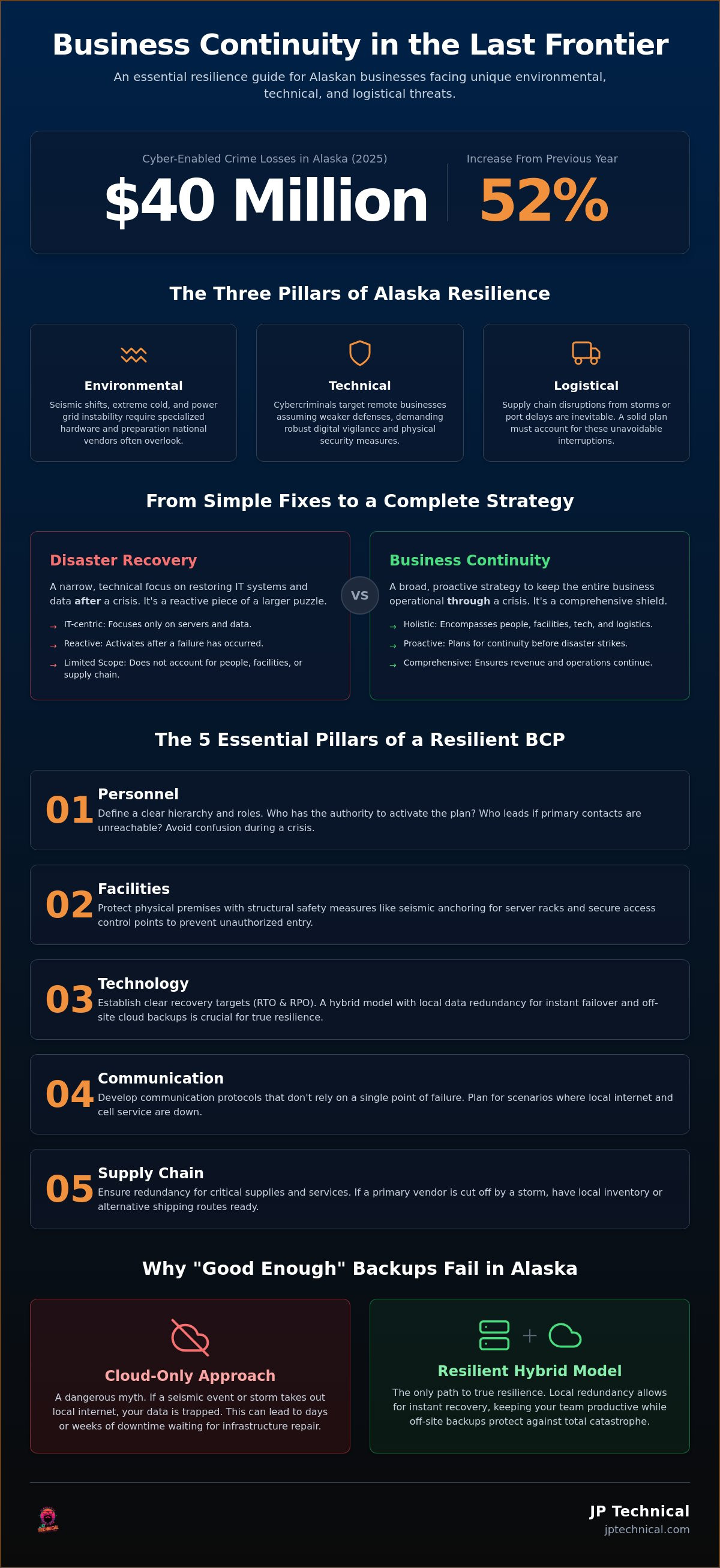
In 2025, Alaskans reported nearly $40 million in losses from cyber-enabled crimes. That 52% increase from the previous year proves that a simple data backup is no longer enough to keep your doors open when disaster strikes. You already know that running a business in the Last Frontier requires a specific kind of grit. Whether you are operating out of Kenai or Fairbanks, the fear of prolonged downtime during a winter storm or a sudden seismic event is a constant reality. It’s difficult to find reliable support when local IT resources feel out of reach, leaving you to wonder if your team and your data are truly protected.
This guide offers a comprehensive framework for business continuity planning Alaska business owners can implement today. We have built a local resilience template to help you defend against earthquakes, extreme weather, and the rising tide of cyber threats. You’ll learn how to move beyond basic backups to a full continuity strategy that prioritizes employee safety and operational stability. We will provide a clear, step-by-step path to ensure your business stays functional and your downtime remains minimal. This approach gives you the peace of mind to focus on growth in 2026 while we help you prepare for the unexpected.
Key Takeaways
Learn why effective business continuity planning Alaska requires a shift from simple technical backups to a comprehensive strategy for maintaining daily operations.
Identify the five essential pillars of resilience, including how to define emergency roles for personnel and protect physical facility access points.
Discover specific mitigation tactics for Alaska’s environment, such as seismic anchoring for server racks and protecting external hardware from extreme cold.
Follow a step-by-step guide to testing your readiness through Business Impact Analysis and leadership tabletop exercises.
Understand the value of partnering with a local technical guardian who provides proactive monitoring and understands the unique logistical challenges of the North.
Table of Contents
What is Business Continuity Planning in the Alaska Context?
In the Lower 48, a disaster might mean a temporary detour for a supply truck. In our state, it can mean complete isolation. Business Continuity Planning is a proactive strategy designed to ensure your essential functions continue even when the unthinkable happens. It’s the difference between closing your doors for a month and staying open for your community. While many people use the terms interchangeably, there is a distinct line between disaster recovery and business continuity. Disaster recovery is a technical focus on restoring IT systems and data after a crash. Business continuity planning Alaska businesses need is much broader; it’s about the people, the physical premises, and the operational flow that keeps your revenue moving. Business continuity planning serves as a comprehensive shield for both digital and physical assets, ensuring that your organization remains operational through every layer of a crisis.
The Three Pillars of Alaska Resilience
Alaska presents risks that national vendors often overlook because they don’t understand our geography. To build a plan that actually works, you have to address three specific areas of vulnerability.
Environmental: We don’t just deal with rain or wind. We manage seismic shifts that can sever fiber lines and extreme cold that can seize backup generators. Power grid instability in remote areas like the Kenai Peninsula requires hardware that can handle frequent surges and dips.
Technical: Cybercriminals often target northern businesses because they assume remote locations mean weaker defenses. With cyber-enabled crime losses in Alaska reaching nearly $40 million in 2025, your plan must include active physical security and digital vigilance.
Logistical: When a storm hits, the supply chain stops. If your business depends on specialized parts or workforce members who must travel from Anchorage to Fairbanks, your BCP must account for these inevitable delays.
Why “Good Enough” Backups Fail in Anchorage
Many business owners believe that pushing data to the cloud is a “set it and forget it” solution. This is a dangerous myth. If a major seismic event or storm takes out local internet infrastructure, your cloud data is effectively trapped until the lines are repaired. Relying solely on the cloud can result in days of downtime while you wait for bandwidth to stabilize.
True resilience requires a hybrid approach. You need local data redundancy for immediate recovery and off-site backups for total site catastrophes. If your recovery time objective is measured in minutes rather than days, a simple backup isn’t enough. You need a system that allows you to failover to local hardware instantly, keeping your team productive while the world outside is in chaos. We focus on building these stable, long-term partnerships to ensure your data stays where it belongs: accessible and safe.
The 5 Essential Pillars of Your BCP Template
A resilient business isn’t built on luck. It’s built on a structured framework that accounts for every moving part of your organization. When we discuss business continuity planning Alaska professionals need, we look at five core pillars. These categories ensure that whether you’re facing a cyberattack or a massive storm, you have a pre-verified path to follow. It’s about being prepared before the pressure mounts.
First, your personnel need a clear hierarchy. You can’t afford confusion during a crisis. Define who holds the authority to activate the BCP and who manages specific departments if the primary lead is unreachable. Second, your facilities must be protected. This includes everything from structural safety to access control. Third, your technology needs specific recovery targets. Fourth, you must establish communication protocols that don’t rely on a single internet connection. Finally, your supply chain needs redundancy. If the Port of Alaska faces a delay, you need local inventory or alternative shipping routes to stay afloat.
Setting Your Recovery Objectives (RTO & RPO)
In the world of IT, two metrics dictate your survival: Recovery Time Objective (RTO) and Recovery Point Objective (RPO). RTO is the maximum amount of time your business can be offline before the damage becomes irreversible. RPO is a measure of data loss; it determines how far back your backups go. To set these, you must calculate the true cost of downtime. It’s a simple equation that brings a lot of clarity.
Add your hourly lost revenue to your hourly labor costs. If that number is $5,000, a four-hour outage costs you $20,000. For an Alaska medical practice, an RTO might be one hour because patient care depends on immediate record access. A retail shop in Fairbanks might accept a four-hour RTO but requires a very short RPO to ensure every transaction is captured. Understanding these numbers helps you prioritize where to spend your budget for the best protection.
Physical Security and Access Control
Resilience isn’t just digital. Your facility must remain secure even when the power grid fails. Traditional locks and legacy systems often fail during prolonged outages, leaving your assets vulnerable. Modern Physical Security Solutions integrate battery backups and local processing to ensure your doors stay locked and your cameras keep recording when the lights go out.
When you combine surveillance with remote monitoring, you gain a “guardian” perspective on your property. You can verify the safety of your site from a smartphone, even if you’re stuck at home during a blizzard. This proactive vigilance is essential for protecting your equipment and your team. If you aren’t sure where your current plan stands, a free IT assessment can identify the gaps in your physical and digital defenses.
Addressing Alaska-Specific Environmental Risks
Generic plans from the Lower 48 don’t account for a 7.1 magnitude quake or a month of sub-zero temperatures. Effective business continuity planning Alaska depends on recognizing that our environment is our greatest operational threat. If your strategy doesn’t address physical hardware safety alongside data security, it’s incomplete. We prioritize a ground-up approach where physical stability is the foundation for digital uptime.
Power grid instability is a constant factor in our state. Sudden surges or dips can fry sensitive motherboards even if the power doesn’t fully go out. You need high-grade Uninterruptible Power Supply (UPS) systems and robust surge protection for every critical node. Additionally, your plan must account for regional isolation. With landslides increasing by 295% in recent decades, a single event can shut down the Seward Highway or other vital arteries. If your Anchorage HQ becomes unreachable, your teams in Wasilla or Kenai must have secure remote access to keep the business moving. This ensures that a physical blockage doesn’t lead to a total operational standstill.
Seismic Safety for IT Infrastructure
In a seismic event, an unanchored server rack becomes a major liability. It can sever vital connections or sustain terminal physical damage in seconds. Physical anchoring is as vital as digital encryption in Alaska. We recommend securing racks directly to the building’s structural frame to prevent tipping. To further reduce risk, consider a cloud-first strategy for your most critical applications. By moving heavy on-premise infrastructure to secure, off-site data centers, you minimize the amount of physical hardware that could fail during a tremor.
The “Last Frontier” Supply Chain Buffer
Shipping to Alaska is notoriously slow, especially during winter months or post-disaster recovery. You can’t wait three weeks for a replacement firewall to arrive from a warehouse in the Lower 48. Maintaining a local buffer of critical hardware is essential for rapid recovery. We suggest keeping “crash kits” that include essential networking equipment and pre-configured laptops for key staff.
Strategic local partnerships are your best defense against shipping bottlenecks. By working with a technical ally who maintains emergency inventory in Anchorage or Fairbanks, you ensure you aren’t at the mercy of a delayed cargo flight. This proactive care keeps your operations moving while others are stuck waiting for a delivery. It’s about having the right parts on the right side of the border when they matter most.
A Step-by-Step Guide to Testing Your Continuity Plan
A plan on paper is just a starting point. It doesn’t guarantee your doors will stay open when a real crisis hits. Effective business continuity planning Alaska requires rigorous testing to bridge the gap between theory and reality. You must begin with a Business Impact Analysis (BIA). This process identifies which parts of your operation are most vulnerable to downtime and which functions must be restored first. Once you know your weak spots, you can build a testing schedule that ensures your defenses are ready for the next seismic event or cyberattack. Testing should be a regular part of your operational rhythm, not a one-time event.
The Tabletop Exercise: A Low-Stress Simulation
You don’t need a full system shutdown to test your readiness. A tabletop exercise is a 60-minute “what if” session with your leadership team. Present a specific scenario, such as a major fiber line cut or a ransomware lockout. Ask your staff how they would communicate and which tasks take priority. This exercise often reveals hidden communication gaps before a real emergency occurs. If your team realizes they don’t have secondary contact numbers for key vendors, you can fix that now. Focus on documenting lessons learned rather than placing blame. These insights allow you to refine your protocols in a calm environment where the stakes are low.
Technical Failover Testing
Theory must eventually meet technical reality. You need to perform a live failover test for your data backups to verify they are functional. It’s common for businesses to discover that their backups don’t actually restore in the timeframe they expected. Testing remote login speeds is also essential for a fully distributed team. If your staff in Kenai can’t access files quickly during an Anchorage outage, your productivity will stall. For organizations with strict data requirements, our HIPAA Compliance Services ensure your testing meets all regulatory standards for 2026, including mandatory encryption and multi-factor authentication.
The Alaska business landscape changes rapidly. New regulations, such as the 2026 HIPAA Security Rule updates and SB 134 insurance requirements, mean your plan can’t sit on a shelf. We recommend reviewing and updating your BCP quarterly rather than annually. This frequent cadence keeps your team sharp and your technology current. If you haven’t tested your systems in the last 90 days, your business is at risk. You can take the first step toward true resilience by scheduling a free IT assessment to evaluate your current readiness.
Partnering with a Local Guardian for Long-Term Stability
National vendors often view our state as a logistical hurdle or a remote dot on a map. They don’t understand how a single storm in the Mat-Su Valley can ripple through an entire week of operations. Choosing a partner for business continuity planning Alaska requires more than technical skill; it requires local accountability. We live and work in the same communities you do, which means we understand the specific environmental and logistical pressures your business faces every day. This neighborly approach ensures that your continuity strategy isn’t just a generic template, but a plan built for the reality of the North.
At JP Technical, we act as a seasoned guardian for your organization. We integrate physical security and surveillance with robust IT continuity to create a unified defense. By combining Managed IT Services with proactive Backup and Disaster Recovery, we handle the technical threats quietly in the background. This allows you to focus on your core business while we maintain a state of protective vigilance over your data and your facility. We value human connection and direct communication, ensuring you always have a “straight-shooter” to call when things get difficult.
The Benefits of Local Vigilance
When a crisis occurs, every minute counts. A national vendor might put you in a support queue, but a local partner provides faster on-site response times for businesses in Anchorage, Wasilla, and Kenai. This proximity is vital for hardware replacements and physical security adjustments that can’t be handled over a remote connection. Our approach is grounded in honesty and transparency. We offer a clear perspective on your technical needs without the high-pressure jargon often found in the industry. If you’re ready to identify the gaps in your current strategy, a free IT assessment is the most effective way to start the planning process.
Predictable Costs for Unpredictable Events
Disasters are unpredictable, but your IT budget shouldn’t be. Many business owners fall into the “break-fix” trap, where they only pay for support when something fails. This leads to massive, unexpected expenses during a crisis when you can least afford them. Managed services turn these emergency spikes into predictable monthly operational costs. This shift allows you to plan for the long term with confidence.
By investing in proactive maintenance and 24/7 monitoring, you prevent small issues from becoming operational catastrophes. Our service models are designed for transparency and stability, ensuring you know exactly what you’re paying for. You can view our pricing structure to see how we help businesses move from reactive panic to steady, long-term resilience. True peace of mind comes from knowing that your technical guardian is always on watch, protecting your employees and your data regardless of the weather outside.
Securing Your Business Against the Unexpected
Resilience in the North isn’t a one-time project. It’s an ongoing commitment to your employees and your community. By focusing on the five essential pillars and addressing our specific environmental risks, you move beyond simple backups. You create a strategy that ensures your doors stay open through seismic shifts and sub-zero temperatures. Regular testing and a hybrid approach to data redundancy are the only ways to guarantee your recovery objectives are met.
Effective business continuity planning Alaska requires a partner who understands our specific landscape. JP Technical has been serving Alaska since 1996, providing localized support from our Anchorage-based team. We are specialists in HIPAA-compliant managed IT and physical security, offering the protective vigilance you need to stay operational. Secure your future with a Free IT Assessment from JP Technical today. You don’t have to face these challenges alone. We’re here to help you build a stable, long-term foundation for your business.
Frequently Asked Questions
Is business continuity planning different from disaster recovery?
Yes, disaster recovery is a technical subset that focuses on restoring IT systems and data after a crash. The business continuity planning Alaska organizations require is a broader strategy that ensures the entire operation, including staff roles and physical facility access, remains functional during a crisis. While disaster recovery gets your servers back online, business continuity keeps your revenue moving while the repairs happen.
How often should an Alaska business update its BCP?
You should review your strategy quarterly to account for the rapid changes in our local regulatory and technical environment. Annual reviews are often too slow to capture new employee hires, hardware upgrades, or the 2026 HIPAA Security Rule updates. A quarterly cadence ensures your team remains familiar with emergency protocols and that your contact lists for local vendors stay current.
What are the biggest risks to business continuity in Anchorage?
Seismic activity and cybercrime are the most immediate threats to local stability. Beyond the 7.1 earthquake reality, Anchorage businesses face significant logistical risks if the Port of Alaska or major highways experience delays. With cyber-enabled crime losses rising by 52% in 2025, your plan must prioritize digital vigilance alongside physical structural safety to ensure total resilience.
Does HIPAA require a business continuity plan for medical practices?
Yes, HIPAA mandates a contingency plan to ensure patient data remains accessible during an emergency. The 2026 updates have shifted several safeguards from “addressable” to “required,” meaning your practice must have documented procedures for data backup and emergency mode operations. Failing to have a tested plan can result in significant compliance penalties and compromised patient care.
Can a small business afford professional business continuity planning?
Professional planning is highly scalable and prevents the catastrophic costs associated with prolonged downtime. By partnering with a technical guardian for managed services, you turn unpredictable emergency expenses into a stable monthly operational cost. This allows you to access enterprise-level Backup and Disaster Recovery tools without the need for a massive upfront capital investment.
What is the first step in creating a BCP for my Alaska office?
The first step is conducting a Business Impact Analysis (BIA) to identify your most critical operational functions. This process helps you understand which departments must be restored first and how much downtime your budget can actually survive. Once you have these recovery objectives defined, you can build a technical framework that supports those specific business needs.
How do I ensure my employees can work remotely during a storm?
You must implement secure remote access tools and multi-factor authentication (MFA) before the weather forces your team home. Ensuring your staff has pre-configured hardware and access to cloud-based applications allows them to stay productive even if the Anchorage HQ is inaccessible. Regular testing of these remote connections is essential to prevent login bottlenecks during a real event.
What happens to my physical security cameras if the power goes out?
Modern surveillance systems remain active during power failures if they are integrated with high-grade UPS systems and local storage. Resilient physical security setups use cameras that record directly to internal memory when the connection to the central server is lost. This protective vigilance ensures your facility remains monitored and your assets stay safe until the local grid is stabilized.
 Article by
Colter Hobbs