HIPAA Audit Preparation for Healthcare: The 2026 Manager’s Guide
With the average cost of a healthcare data breach reaching $10.93 million in 2025, the margin for error in your compliance strategy has effectively disappeared. You likely feel the weight of overwhelming regulatory jargon and the persistent fear of massive fines for accidental non-compliance. It’s common to feel uncertain about whether your current IT vendors are actually upholding their end of the bargain. HIPAA audit preparation for healthcare shouldn’t feel like a guessing game, especially with the 2026 Security Rule overhaul eliminating the flexibility of addressable safeguards.
We know you’re looking for a steady hand to guide you through these shifts. This guide provides a clear, step-by-step framework tailored for healthcare administrators to master these new complexities. You’ll gain the confidence that your patient data is truly secure and protected by a culture of vigilance. We’ll walk through a definitive preparation checklist, explain mandatory technical requirements for encryption and MFA, and show you how a reliable local partner can handle the technical burden for you.
Key Takeaways
Navigate the 2026 HIPAA Security Rule overhaul with a focus on Alaska’s specific risks like remote connectivity and local staffing.
Implement a step-by-step framework for HIPAA audit preparation for healthcare to ensure your practice is ready for the OCR’s increased enforcement.
Conduct a comprehensive security risk analysis to map ePHI flow and identify vulnerabilities before they lead to a breach.
Deploy non-negotiable technical safeguards, including multi-factor authentication and encryption, to meet the latest federal requirements.
Understand why a local Anchorage partner is essential for maintaining a culture of vigilance and providing rapid response during an audit.
Table of Contents
Navigating the 2026 HIPAA Audit Landscape in Alaska
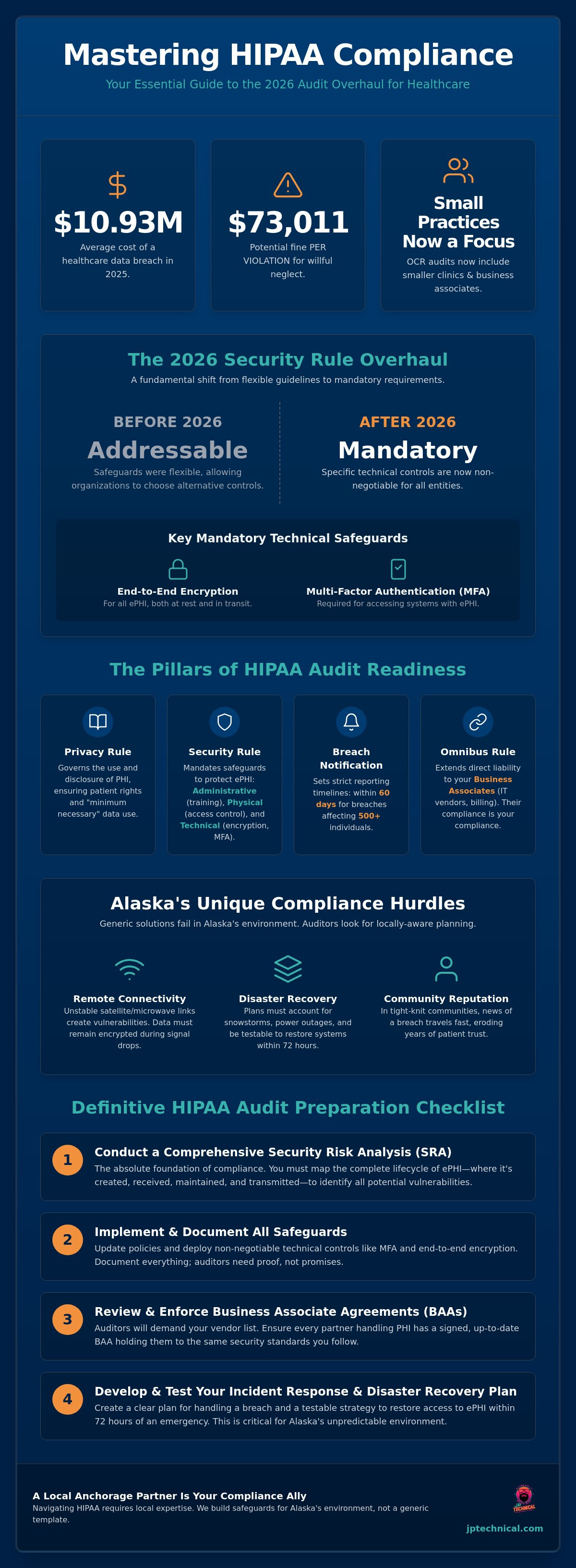
The Office for Civil Rights (OCR) has shifted its strategy. For 2026, the focus has moved beyond massive hospital systems to include small practices and their business associates. If you manage a clinic in Alaska, the 2026 audit cycle priorities center on the updated Security Rule, which now mandates specific technical controls that were previously considered flexible. This change is part of a broader effort to strengthen the Health Insurance Portability and Accountability Act (HIPAA) across the entire healthcare ecosystem.
Our state presents unique hurdles for HIPAA audit preparation for healthcare. Remote access is a necessity here, but it often relies on inconsistent satellite or microwave connectivity. This creates vulnerabilities that auditors look for, specifically regarding how data remains encrypted when signals drop or when staff access records from remote villages. If your connection isn’t stable, your data security shouldn’t be the variable that suffers.
You might face a “desk audit,” where you submit documentation through a secure portal, or a “comprehensive on-site audit.” While desk audits are more common, they often lead to on-site visits if your paperwork shows gaps in your risk analysis. Auditors aren’t just looking for policies on a shelf; they want to see the actual flow of protected health information (PHI) through your network.
The price of failure is high. Beyond the inflation-adjusted fines, which can reach $73,011 per violation for willful neglect, there’s the damage to your reputation. In tight-knit communities from the Mat-Su Valley to the Kenai Peninsula, news of a data breach travels fast. Trust is your most valuable asset, and a single audit failure can erode years of community service.
Why HIPAA Audits are Increasing for Small Practices
The OCR’s Risk Analysis Initiative has made it clear that no entity is too small to be audited. Data breaches often serve as the tripwire that triggers an investigation. The Health Information Technology for Economic and Clinical Health (HITECH) Act requires the Department of Health and Human Services to perform periodic audits of covered entities and business associates to ensure compliance. If you haven’t updated your risk analysis recently, you’re essentially operating in the dark.
The Local Advantage: Compliance from Anchorage to Fairbanks
A distant IT vendor might not understand why a snowstorm in Fairbanks or a power outage in Juneau impacts your data backup strategy. We prioritize local accountability because we’re your neighbors. Under the 2026 rules, you must have a testable disaster recovery plan to restore systems within 72 hours. Working with a Managed IT for Healthcare Anchorage partner ensures that your technical safeguards are built for Alaska’s environment, not just a generic template. We stay vigilant so you can focus on patient care.
The Three Pillars of HIPAA Audit Readiness
To succeed in HIPAA audit preparation for healthcare, you must understand the regulatory structure that auditors use as their scorecard. The HHS HIPAA Audit Program looks for evidence that you’ve implemented specific controls across four key areas. These rules aren’t just legal hurdles; they’re the framework for a secure practice. If you view them as a burden, they’ll always feel overwhelming. If you view them as a roadmap for patient safety, they become manageable.
The Privacy Rule governs how protected health information (PHI) is used and disclosed. It focuses on patient rights, such as the right to access their own medical records and the requirement for “minimum necessary” use of data. The Security Rule is the technical core of your compliance. It requires administrative safeguards like staff training, physical safeguards like locked server rooms, and technical safeguards like encryption and multi-factor authentication (MFA).
The Breach Notification Rule sets strict timelines for reporting data exposures. If a breach affects 500 or more individuals, you must notify the HHS, the media, and the affected parties within 60 days. Finally, the Omnibus Rule expanded these requirements to your Business Associates (BAs). This means your IT vendors, billing companies, and cloud providers are now directly liable for compliance. If your partners aren’t compliant, you aren’t either.
Managing Business Associate Agreements (BAAs)
Auditors will ask for your vendor list almost immediately. A signed Business Associate Agreement (BAA) is a non-negotiable contract that binds your partners to the same security standards you follow. When you vet a vendor, ask for their compliance documentation. If they hesitate to sign your BAA or can’t explain their own security protocols, they aren’t a partner; they’re a liability. We’ve seen practices face significant penalties simply because a vendor lacked a current agreement. A straight-shooter approach is best here: if they won’t sign, they don’t get the contract.
Documentation: The Paper Trail of Compliance
“If it isn’t documented, it didn’t happen.” This is the auditor’s mantra. You must retain all policies, risk assessments, and training logs for at least six years from the date of their creation or the date they were last in effect. We recommend maintaining a centralized “Compliance Binder” that contains your current BAA list, your latest risk analysis, and employee training signatures. This organization shows the auditor that you have a culture of vigilance. If you’re unsure where your current documentation stands, a professional IT assessment can help identify gaps before an auditor arrives.
Step-by-Step Guide to Conducting a HIPAA Risk Assessment
A risk assessment isn’t a one-time hurdle to clear. It’s a continuous process of protective vigilance that defines your practice’s security posture. If you overlook this step, your HIPAA audit preparation for healthcare lacks its most critical foundation. Auditors don’t just want to see that you have a plan; they want to see the logic behind it. They’ll examine how you identified threats and what you did to mitigate them. You must trace every path ePHI takes through your clinic to ensure no door is left unlocked.
The process starts by identifying where ePHI is created, received, maintained, or transmitted. Once you have this data map, you can assess your current security measures. Are they truly effective against modern threats like ransomware or sophisticated phishing? We recommend using the Security Risk Assessment (SRA) Tool provided by the ONC to help quantify these risks. This tool helps you determine the likelihood and impact of potential threats, allowing you to prioritize your efforts. You can’t fix everything at once, so your Risk Management Plan should focus on high-impact vulnerabilities first. Documenting every meeting, decision, and remediation step provides the primary evidence an auditor needs to see that you’re acting in good faith.
Inventorying Your Digital and Physical Assets
Mapping data flow from the front desk to the cloud is essential for a complete assessment. Your inventory must include every device that touches patient data, including mobile devices used for home visits, specialized medical equipment like imaging machines, and remote workstations used for telehealth. If a device isn’t on your list, it isn’t being protected. For a deeper look at keeping these systems running reliably, see our guide on Managed IT Services in Anchorage. We believe in a “no-nonsense” approach to asset management: if it’s on the network, it must be secured.
Common Gaps Found in Alaska Medical Practices
We often see three recurring issues in our local medical community. First, there’s a frequent lack of encryption on portable devices and email. If a laptop is stolen from a vehicle in Anchorage, encryption is the only thing standing between a minor incident and a $10 million breach. Second, we find insufficient employee training records. You might provide the training, but if you don’t have signed logs for every new hire, the OCR considers that training non-existent. Finally, outdated software patches on legacy medical systems are a major risk. These systems are often the weakest link because they’re difficult to update without specialized expertise. Staying on top of these patches is a core part of being a seasoned professional in this field.
Strengthening Technical and Physical Safeguards
Once you’ve identified your vulnerabilities through a risk analysis, you must deploy the actual defenses that keep data safe. In the past, some safeguards were considered “addressable,” giving smaller practices a bit of flexibility. Under the 2026 Security Rule overhaul, that flexibility has largely vanished. HIPAA audit preparation for healthcare now requires a rigid adherence to specific technical and physical standards regardless of your clinic’s size. If an auditor walks through your doors, they’ll check for more than just digital firewalls; they’ll look at the locks on your doors and the cameras in your hallways.
Technical safeguards are your digital frontline. Multi-factor authentication (MFA) is now a non-negotiable requirement for all systems and applications accessing ePHI. Data must be encrypted both at rest and in transit. If a hacker intercepts an email or steals a hard drive, encryption ensures the data remains unreadable. Additionally, you must maintain detailed audit logs. These logs act as a digital paper trail, recording exactly who accessed which patient records and at what time. Without these logs, you cannot prove that access was authorized, which is a major red flag during an OCR investigation.
Access Control and Surveillance in Healthcare
Physical safeguards extend well beyond the server room door. You must secure the entire facility to prevent unauthorized individuals from wandering into areas where PHI is visible on screens or stored in paper files. Implementing Physical Security Solutions like electronic door badge systems allows you to restrict sensitive areas automatically based on staff roles. This creates a record of entry that complements your digital logs. High-definition security cameras offer protective vigilance, documenting that only authorized personnel entered record storage areas. If a physical security breach occurs, these systems provide the definitive evidence needed for your incident report.
Cybersecurity Hygiene for HIPAA Compliance
Maintaining compliance requires constant maintenance, not a one-time setup. Managed patch management is essential to close software vulnerabilities before they can be exploited by modern threats like ransomware. We also implement Endpoint Detection and Response (EDR) as a mandatory technical safeguard. EDR goes beyond traditional antivirus by monitoring for suspicious behavior in real-time and isolating threats instantly. While we often discuss these tools in other contexts, such as Cybersecurity for Law Firms Anchorage, their role in healthcare is strictly defined by federal law. If your technical defenses aren’t proactive, your audit readiness is at risk. To ensure your safeguards meet the 2026 standards, we recommend scheduling a free IT assessment to review your current posture.
Maintaining Perpetual Compliance with a Local Managed IT Partner
The biggest mistake a healthcare manager can make is viewing compliance as a project with a finish line. In the world of HIPAA, “set it and forget it” isn’t just a myth; it’s a dangerous liability. Regulations change, new threats emerge, and staff turnover can quickly create gaps in your security protocols. Effective HIPAA audit preparation for healthcare requires a state of perpetual readiness where your defenses are always active and your documentation is always current. If you wait for an audit notification to start preparing, you’ve already lost the battle.
Working with a local Anchorage partner provides a level of accountability that national vendors simply can’t match. If an auditor walks into your clinic or a server failure threatens your 72-hour data restoration mandate, you don’t want to be stuck in a phone queue with a technician three time zones away. We understand the specific logistical hurdles of operating in Alaska, from connectivity issues in remote clinics to the importance of local reputation. A local partner shows up when things get difficult, ensuring your Backup & Disaster Recovery plans are tested and your systems remain secure.
Managed IT services remove the technical burden from your shoulders, allowing you to focus on patient outcomes rather than patch cycles. We handle the complex requirements of the 2026 Security Rule, including mandatory multi-factor authentication (MFA) and continuous vulnerability management. This partnership transitions your practice from a state of pre-audit anxiety to one of calm, organized readiness. When compliance is baked into your daily operations, an audit becomes a routine check rather than a crisis.
The JP Technical Approach to HIPAA
We believe in protective vigilance that stays ahead of the curve. Our approach involves proactive monitoring of your entire network to catch vulnerabilities before they become breaches. We provide monthly compliance reporting that serves as a continuous audit trail, documenting your adherence to technical safeguards. This neighborly commitment means we treat your practice’s security as if it were our own. To see where your practice stands today, we recommend starting with a Free IT Assessment for Healthcare.
Your Next Steps: A 30-Day Preparation Plan
Don’t let the 2026 requirements catch you off guard. You can significantly improve your posture by following a structured plan over the next month. Focus on these high-impact areas to build a foundation of compliance:
Week 1: Review all current Business Associate Agreements (BAAs) and ensure every vendor with access to PHI has a signed, updated contract on file.
Week 2: Inventory all digital and physical assets, including mobile devices and remote workstations, to ensure they are encrypted and tracked.
Week 3: Verify that multi-factor authentication is active on every system and that your audit logs are correctly capturing access data.
Week 4: Schedule a professional gap analysis to identify hidden vulnerabilities and finalize your Risk Management Plan.
The Office for Civil Rights is increasing its scrutiny of smaller covered entities. Taking these steps now ensures that you can face an inquiry with confidence and documented proof of your efforts. Don’t wait for an OCR letter to arrive before you start your preparation. Reach out to a local expert today to secure your practice’s future.
Build a Culture of Continuous Compliance
The 2026 regulatory shift means your practice must move beyond basic checklists. True HIPAA audit preparation for healthcare is about establishing a culture of protective vigilance that safeguards patient trust every single day. You’ve seen how mandatory encryption, multi-factor authentication, and rigorous physical access controls are no longer optional items. They are the definitive standards for any modern medical facility. Managing these technical and physical hurdles doesn’t have to be a solo effort that distracts you from patient care.
Since 1996, our Anchorage based team has served as a local guardian for Alaska’s healthcare community. As HIPAA compliant Managed IT specialists and physical security experts, we provide the steady reliability you need to stay ahead of federal scrutiny. We handle the technical burden quietly in the background so you can lead your team with confidence. If you’re ready to move from uncertainty to audit readiness, Secure Your Practice with a Free HIPAA IT Assessment. We’ll identify your current gaps and help you build a predictable, secure environment for your staff and patients. Your peace of mind is just one conversation away.
Frequently Asked Questions
How much does a HIPAA audit cost for a small healthcare practice?
The Office for Civil Rights does not charge a fee to conduct a federal audit. However, the internal cost of preparation, including staff time and documentation gathering, can be substantial. If an audit reveals non-compliance, you face civil monetary penalties that range from $145 to over $73,000 per violation depending on the level of neglect. Investing in proactive maintenance is always more cost-effective than paying for a reactive cleanup after an enforcement action.
What are the most common reasons the OCR triggers a HIPAA audit?
Data breaches affecting 500 or more individuals are the most frequent triggers for an investigative audit. Patient complaints regarding access to records or improper disclosures also prompt OCR inquiries. Sometimes, the OCR selects entities for random “desk audits” as part of their periodic compliance review program. Maintaining a culture of vigilance ensures you are ready regardless of what triggers the initial contact.
Can a small medical practice in Alaska be audited if they use paper records?
Yes, the HIPAA Privacy Rule applies to all forms of protected health information, including paper records and oral communications. Even if you don’t use an Electronic Health Record system, you must still implement physical safeguards like locked filing cabinets and shredding protocols. Auditors in Alaska will examine how you secure these physical files against unauthorized access, especially in shared office spaces or remote clinic locations.
How often should a HIPAA risk assessment be updated?
You should update your risk assessment at least once a year to reflect changes in your technology and operations. It’s also mandatory to perform a new assessment whenever you implement significant changes, such as moving to a new office, switching IT vendors, or adding new medical equipment to your network. Regular updates are a core part of HIPAA audit preparation for healthcare, proving to auditors that your security strategy is proactive rather than static.
What happens if we fail a HIPAA audit but haven’t had a data breach?
Failing an audit without a breach still results in significant consequences, including mandatory Corrective Action Plans (CAPs) and civil monetary penalties. The OCR issues fines for “willful neglect” even if no data was actually stolen. You may be required to undergo years of federal monitoring and provide regular compliance reports to the government. This oversight is intrusive and costly, making it essential to address vulnerabilities before an auditor identifies them.
Is cloud storage like Google Drive or Dropbox HIPAA-compliant?
These platforms are only HIPAA-compliant if the provider signs a Business Associate Agreement (BAA) and you configure the security settings correctly. Standard consumer versions of Google Drive or Dropbox do not meet these requirements. You must use their enterprise or healthcare-specific tiers and disable public sharing features. If your cloud provider won’t sign a BAA, you cannot legally use them to store or transmit patient data.
Do I need a HIPAA-compliant IT provider if I am a sole practitioner?
Yes, any vendor that creates, receives, maintains, or transmits ePHI on your behalf is considered a Business Associate. Even as a sole practitioner, you are responsible for ensuring your IT support understands the technical safeguards required by the Security Rule. A specialized partner provides the protective vigilance needed to secure your endpoints and backups. If your IT person doesn’t understand HIPAA, they are a liability to your practice’s legal standing.
What is the “Wall of Shame” and how can my practice stay off it?
The “Wall of Shame” is the unofficial name for the OCR’s public portal that lists every healthcare data breach affecting 500 or more individuals. To stay off this list, you must implement robust technical safeguards like encryption and multi-factor authentication. Consistent HIPAA audit preparation for healthcare is your best defense. By maintaining a testable disaster recovery plan and proactive security patches, you lower the risk of a reportable incident that could damage your local reputation.
 Article by
Colter Hobbs