Cybersecurity for Law Firms in Anchorage: The 2026 Legal Compliance Guide
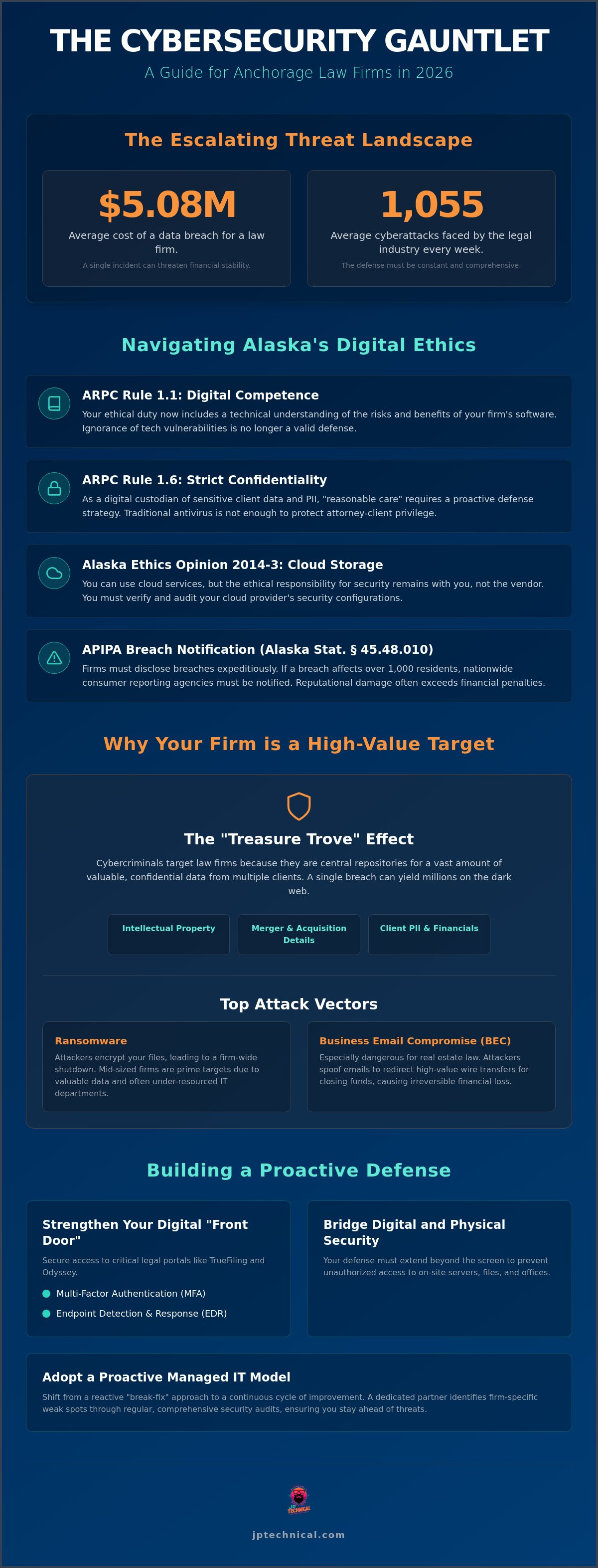
In 2026, the average cost of a data breach for law firms has climbed to $5.08 million. With the legal industry now facing an average of 1,055 attacks every week, implementing robust cybersecurity for law firms Anchorage is no longer just a technical recommendation. It’s a requirement for professional survival. You’ve spent years building your firm’s reputation, yet a single ransomware attack or a lapse in client confidentiality under ARPC Rule 1.6 can put everything at risk in a matter of hours.
Keeping up with the latest Alaska Bar ethical standards while managing remote work and the TrueFiling portal is a heavy burden for any managing partner. We believe your focus should remain on your clients, not on the technical complexities of Alaska Ethics Opinion 2025-1 or APIPA breach notifications. This guide offers a clear roadmap to help you secure your practice and maintain strict compliance. You’ll discover how to build a localized defense strategy that protects your sensitive data and ensures you have a dedicated partner who can walk into your Anchorage office the moment a problem arises.
Key Takeaways
Master the technical requirements of ARPC Rule 1.1 to ensure your firm remains ethically compliant while using modern cloud-based tools.
Discover how to implement specialized cybersecurity for law firms Anchorage that protects your high-value litigation blueprints from evolving ransomware threats.
Strengthen your “front door” by deploying MFA and EDR specifically configured for secure interactions with the TrueFiling and Odyssey portals.
Bridge the gap between digital defense and physical office protection to prevent unauthorized access to your on-site server rooms and physical files.
Shift your operations toward a proactive managed IT model that identifies firm-specific weak spots through regular, comprehensive security audits.
Table of Contents
Navigating Alaska’s Ethical Standards for Digital Competence
Why Anchorage Law Firms are High-Value Targets for Cybercrime
Navigating Alaska’s Ethical Standards for Digital Competence
ARPC Rule 1.1 requires lawyers to provide competent representation. In 2026, this mandate explicitly includes a technical understanding of the risks and benefits of the software you use daily. If your firm relies on digital files, your ethical duty extends to the protection of those systems. Effective cybersecurity for law firms Anchorage starts with acknowledging that ignorance of tech vulnerabilities isn’t a valid defense before the Bar. You’re expected to know how your data is stored and who has access to it at all times.
ARPC Rule 1.6 demands strict confidentiality, which is the cornerstone of the attorney-client privilege. This rule intersects with broader Information Technology Law to create a high standard for data protection. When you handle sensitive litigation blueprints or PII, you’re acting as a digital custodian. Traditional antivirus software is no longer sufficient to meet this standard. In 2026, “reasonable care” implies a proactive defense strategy that can stop modern ransomware before it encrypts your server. If your security is reactive, you’re already behind the curve.
Alaska Ethics Opinion No. 2014-3 permits cloud storage, but it places the burden of security squarely on the attorney. You can’t delegate your ethical responsibilities to a software provider. If a breach occurs because of a weak configuration, the Bar looks to you, not the vendor. You must verify that your cloud environment meets the “Last Frontier” standard of reliability and safety. This involves regular audits and a clear understanding of where your data physically resides.
The Impact of the Alaska Personal Information Protection Act (APIPA)
Alaska Stat. § 45.48.010 sets strict rules for responding to security breaches. Under APIPA, you must disclose a breach to affected residents in the most expeditious time possible. Personal information includes names paired with social security numbers, driver’s licenses, or financial account details. If a breach affects more than 1,000 residents, you’re also required to notify nationwide consumer reporting agencies. The financial penalties are steep, but the damage to your reputation in the Anchorage legal community is often much harder to repair.
Ethics of Third-Party SaaS and Cloud Vendors
Before moving client files to a new platform, you must conduct thorough due diligence. Ensure the provider uses encryption and maintains redundant backups. Your choice of a local partner matters because you need someone who can show up when things get difficult. You hold the ultimate responsibility to ensure that all non-lawyer assistants and external IT contractors act in a manner compatible with your professional obligations. It’s your name on the firm, so it’s your responsibility to oversee the digital gates.
Why Anchorage Law Firms are High-Value Targets for Cybercrime
Cybercriminals view law firms as high-value targets because they act as central repositories for sensitive information. A single firm might hold intellectual property, merger details, and the personally identifiable information (PII) of hundreds of clients. This “treasure trove” effect makes a law firm’s server worth millions on the dark web. In 2026, we’ve seen a sharp rise in ransomware attacks specifically targeting mid-sized firms. These offices often handle complex litigation but lack the massive IT departments found in national corporations. If your defenses aren’t current, you’re essentially leaving the vault door unlocked.
Real estate law firms face a particularly dangerous threat from Business Email Compromise (BEC). Attackers spend weeks monitoring email chains to learn the timing of wire transfers. They then spoof a partner’s email address to redirect closing funds into a fraudulent account. This isn’t just a technical failure. It’s a direct assault on the trust your clients place in you. When a wire transfer disappears, the legal and financial fallout can be permanent. Implementing specialized cybersecurity for law firms Anchorage is the only way to prevent these sophisticated social engineering attacks from succeeding.
The Anatomy of a Law Firm Breach
Most breaches don’t start with a sophisticated hack. They begin with a simple phishing email or unpatched software. A single compromised credential can give an attacker the keys to your entire network. Once inside, they can lock you out of your own files, leading to a total firm-wide shutdown. According to CISA’s Cyber Guidance, small and mid-sized organizations are often the most vulnerable because they underestimate their own risk profile. The ripple effect of such a breach is devastating. You aren’t just dealing with lost data; you’re facing potential malpractice suits and grueling Bar Association inquiries that can last for years.
Alaska-Specific Threat Vectors
Anchorage firms operate in a unique environment. Our community relies on a high degree of trust, which attackers often exploit. They use local names and familiar references to make phishing attempts seem legitimate. There is also a paradox in our geographic isolation. While we are physically distant from global conflict zones, our digital connectivity makes us just as vulnerable as a firm in New York or London. Lawyers working remotely from the Kenai Peninsula or Fairbanks often use home networks that lack enterprise-grade protection. This creates a weak link in your firm’s security perimeter. You can identify these local vulnerabilities by requesting a free IT assessment to ensure your remote access points are fully secured against intrusion.
Essential Technical Safeguards for Alaska’s Legal Portals
TrueFiling and Odyssey are essential tools for any practice operating within the Alaska Court System. However, these portals also represent a significant entry point for potential threats if they aren’t properly secured. Protecting your access to these systems requires a multi-layered approach that begins with Multi-Factor Authentication (MFA). Think of MFA as your firm’s front door. Even if a password is stolen, an attacker cannot gain access without a second form of verification. This single step is one of the most effective ways to improve cybersecurity for law firms Anchorage and prevent unauthorized portal access.
Endpoint Detection and Response (EDR) is another critical safeguard for every workstation in your office. Unlike traditional antivirus that only looks for known signatures, EDR monitors behavior on every machine that accesses TrueFiling. If a laptop begins behaving strangely or attempts to exfiltrate data, EDR can isolate that device before the infection spreads to your entire network. This proactive stance is vital for protecting your digital work products. You should also ensure that all data is encrypted both in transit and at rest. This means that even if a data packet is intercepted or a hard drive is physically stolen, the information remains unreadable and useless to unauthorized parties.
Managed Backup and Disaster Recovery ensures that your firm can continue operating even during a major technical outage. Alaska’s infrastructure can be unpredictable, and a server failure or ransomware attack shouldn’t halt your billable hours. A reliable backup system provides a clean, recent version of your data that can be restored quickly. This level of continuity is what separates a prepared firm from one that faces weeks of downtime, lost revenue, and potential ethical complaints from the Bar.
Hardening TrueFiling and Odyssey Access
Proper credential management is the first line of defense within the Alaska Court System. You should never share logins between administrative staff and attorneys. Managed firewalls also play a key role by inspecting all traffic during portal sessions to block malicious activity in real time. If you’re filing from the field, avoid public Wi-Fi entirely. These networks are often unsecured and provide an easy way for attackers to intercept sensitive legal documents during transmission. Stick to secure hotspots or firm-provided connections.
Secure Remote Work for the Alaska Attorney
Attorneys working from Wasilla or Palmer need a secure way to connect to the office network without exposing firm data. A managed VPN creates a private, encrypted tunnel for your information, keeping it safe from prying eyes. For those using tablets in the courtroom, Mobile Device Management (MDM) allows your IT partner to wipe a device remotely if it’s lost or stolen. Regular patch and update management is also necessary to close vulnerabilities in common legal software before they can be exploited by bad actors.
Beyond the Screen: Physical Access and Local Accountability
Digital defenses are vital, but physical access remains a critical vulnerability. If an unauthorized person can physically touch your hardware, they can often bypass even the most sophisticated encryption. Comprehensive cybersecurity for law firms Anchorage must include the physical perimeter of your office. Integrating physical security solutions with your digital IT framework ensures that your server room isn’t the weak link in your defense. A locked door is sometimes the best firewall you have.
Security cameras and door badge systems do more than just deter theft. They provide a verifiable record of who has been near your most sensitive assets. In a legal environment, this documentation is essential for meeting compliance standards and protecting firm assets from internal and external threats. Door badge systems allow you to restrict access to sensitive records rooms, ensuring that only authorized personnel can handle client files. This layered approach creates a stable environment where your data remains safe from all angles.
Access Control as a Compliance Requirement
Physical access logs are a practical way to demonstrate your “duty of care” under APIPA. If a breach occurs, being able to prove that your server room was secured and monitored can significantly mitigate your liability. Managing employee turnover in Anchorage requires a swift response. You must be able to revoke both digital credentials and physical door access the moment a staff member leaves the firm. This straight-shooter approach to security ensures that no loose ends remain. Local accountability matters because you need a partner who understands the layout of your office and the specific needs of the local business community.
Surveillance and Incident Verification
Professional security cameras allow you to monitor high-traffic areas and server closets in real time. This surveillance provides the peace of mind that comes from having a “local guardian” watching over your premises. If an incident occurs, you have the visual evidence needed to verify what happened and who was involved. JP Technical integrates camera logs with IT security audits to provide a single, unified view of your firm’s safety status. Don’t leave your physical office exposed while you focus solely on the screen. You can start securing your entire premises today by scheduling a free IT assessment to review both your digital and physical vulnerabilities.
Implementing a Proactive Cybersecurity Framework
The “break-fix” model of IT support is a liability for modern legal practices. If you only call a technician when a server goes down or a screen freezes, you’re already losing billable time and risking data integrity. Transitioning to Managed IT Services allows your firm to operate with a sense of predictability. This proactive approach ensures that cybersecurity for law firms Anchorage is handled quietly behind the scenes. We monitor your systems around the clock to stop threats before they disrupt your workflow.
A core part of this framework is the creation of a Written Information Security Program (WISP). This document is essential for Alaska Bar compliance, as it outlines exactly how your firm protects sensitive client data. Regular cybersecurity audits help you keep this program current by identifying new weak spots as technology and regulations evolve. You can’t protect what you don’t measure. By documenting your defenses, you provide a clear roadmap for your staff and a solid defense if your ethical standards are ever questioned.
Technical safeguards are only half the battle. Your staff members are the “human firewall” of your practice. Even the most secure systems can be bypassed if an employee clicks on a well-disguised phishing email. Regular awareness training teaches your team how to spot these threats in real time. When your staff knows what to look for, they become an active part of your firm’s defense rather than a potential vulnerability. This collective vigilance creates a culture of safety that technical tools alone can’t provide.
The Local Advantage: Anchorage-Based Support
When an IT emergency strikes, every minute counts. A 15-minute drive from a local partner is far more valuable than waiting for a technician in a different time zone to log in. We understand the specific infrastructure of Anchorage, from local telecommunications providers to the unique challenges of our geographic location. This local knowledge allows us to resolve issues quickly and effectively. We share the same no-nonsense Alaska work ethic as your firm, valuing direct communication and steady results over automated responses.
Starting Your Security Journey
Securing your firm doesn’t have to happen all at once. You should prioritize your security spend based on your specific practice area and the sensitivity of the data you handle. We believe in transparent pricing for managed IT so you can plan your budget without surprises. A stable partnership is built on honesty and predictability. If you’re ready to move toward a more secure future, contact JP Technical for an Anchorage-local security consultation to begin building your firm’s custom defense framework.
Protecting Your Firm’s Legacy in a Digital World
Your firm’s reputation depends on the trust clients place in your confidentiality. Meeting the high standards of the Alaska Bar requires a shift from reactive repairs to a culture of constant vigilance. By integrating robust digital safeguards with physical access controls, you create a stable foundation that protects your billable hours and your ethical standing. Effective cybersecurity for law firms Anchorage isn’t just about software; it’s about having a local partner who understands the specific threats facing our community.
JP Technical has provided local Anchorage support since 1996. We specialize in HIPAA and legal compliance, ensuring your practice meets every regulatory hurdle with ease. Our team offers a unique integration of digital defense and physical security to keep your sensitive records truly private. If you’re ready to avoid the $5.08 million average cost of a legal data breach, we’re here to guide you. Secure Your Practice with a Free IT Assessment and gain the peace of mind that comes from professional protection. We look forward to helping your firm thrive in a secure digital environment.
Frequently Asked Questions
Is my Anchorage law firm legally required to have a cybersecurity plan?
Yes, your firm is legally and ethically required to maintain a cybersecurity framework. ARPC Rule 1.1 requires you to understand the risks and benefits of the technology you use. Additionally, the Alaska Personal Information Protection Act (APIPA) requires you to protect client data and provide specific notifications if a breach occurs. Without a written plan, it’s difficult to prove you’ve exercised the “reasonable care” required by the Alaska Bar.
What are the specific Alaska Bar requirements for cloud storage?
Alaska Ethics Opinion 2014-3 permits the use of cloud storage as long as you take reasonable steps to ensure confidentiality. You must conduct due diligence on your provider’s security protocols and encryption methods. The Bar emphasizes that your duty to protect client files is ongoing and cannot be fully delegated to a third-party vendor. You remain responsible for the safety of the data at all times.
How much does managed cybersecurity typically cost for a mid-sized firm?
The cost of cybersecurity for law firms Anchorage varies based on the number of users, the complexity of your network, and your specific compliance needs. Most firms find that a managed service model is more predictable and cost-effective than paying for emergency repairs after an incident. We recommend a thorough assessment of your current infrastructure to determine a budget that aligns with your firm’s risk profile.
Does APIPA apply to my firm if we only have local Alaska clients?
Yes, APIPA applies to any business that handles the personal information of Alaska residents, regardless of where your firm is physically located. If you store names alongside social security numbers, driver’s license digits, or financial account info, you must comply with the statute’s protection and disclosure rules. Local firms are often more vulnerable because they handle concentrated data for the Anchorage community.
Can JP Technical help with HIPAA compliance if my firm handles medical records?
Yes, we provide specialized HIPAA compliance services for law firms that handle protected health information (PHI). This is particularly important for personal injury, medical malpractice, and worker’s compensation practices. We help you implement the necessary technical safeguards, such as encryption and access controls, to ensure your firm meets federal standards while protecting client-attorney privilege and maintaining strict ethical boundaries.
What is the difference between a standard antivirus and EDR for a law firm?
Standard antivirus is reactive and only stops threats it has seen before. Endpoint Detection and Response (EDR) is a more advanced solution that monitors behavior on your workstations in real time. If a file begins encrypting data or attempting to communicate with a malicious server, EDR can isolate the device immediately. For law firms, EDR provides a much higher level of protection against modern ransomware and zero-day exploits.
How quickly can JP Technical respond to an onsite IT emergency in Anchorage?
We prioritize rapid response for our Anchorage-based clients. Because we are located right here in the community, we can often be onsite within minutes if a critical technical failure occurs. Our goal is to provide a steady, reliable presence that minimizes your firm’s downtime. You don’t have to wait for a technician in a different time zone to wake up or clear a long support queue.
Do I need a security camera system to meet legal data protection standards?
While the Alaska Bar doesn’t explicitly mandate cameras, they are a powerful tool for meeting the “reasonable care” standard for physical data protection. A surveillance system provides a verifiable record of who has accessed your server room or records closet. This documentation is invaluable during a compliance audit or after a suspected security incident. Physical security is a key component of a comprehensive defense strategy for any modern practice.
 Article by
Colter Hobbs