IT Consulting for Law Firms in Anchorage: The 2026 Partner Selection Guide
Did you know that 54% of legal teams now rank technology decisions as their greatest challenge, even ahead of their total work volume? For local attorneys, the stakes are higher than just managing a schedule. With 42 states now requiring specific technology competence, finding the right IT consulting for law firms in Anchorage isn’t just about fixing a laptop; it’s about fulfilling your professional responsibility. You’ve likely felt the frustration of unpredictable costs or the anxiety of a slow remote connection while working from home or a rural job site.
We understand that your time is measured in six-minute increments and every second of downtime is a direct hit to your firm’s bottom line. This guide provides a clear roadmap to selecting a legal-centric IT partner that protects your billable hours and secures client confidentiality against evolving threats. We’ll examine how to ensure compliance with the Alaska Personal Information Protection Act and the 2026 data security requirements for insurance licensees. You’ll learn how a proactive approach to managed IT keeps your systems running quietly in the background, allowing you to focus entirely on your practice.
Key Takeaways
Learn why generalist providers often fall short and why a legal-centric approach is vital for protecting your firm’s billable hours.
Discover the modern pillars of legal infrastructure, including how EDR and managed firewalls provide a layer of security that stays in the background.
Identify the critical questions to ask when evaluating IT consulting for law firms in Anchorage to move beyond reactive “break-fix” models.
Use our 5-step audit checklist to verify your disaster recovery plans and confirm your firm is ready for 2026 regulatory changes.
Understand the benefit of a “Legal Guardian” approach that combines technical support with physical security for total firm protection.
Table of Contents
The Critical Role of IT Consulting for Anchorage Law Firms in 2026
Legal IT consulting is far more than a simple help desk service; it’s a proactive strategy designed to maintain data integrity and maximum uptime. For an Anchorage firm, this means ensuring your systems are ready for the rigorous demands of the courtroom and the back office. While a generalist IT provider might understand basic networking, they often lack the specialized knowledge required to manage legal technology effectively. They don’t always grasp the urgency of a filing deadline or the specific security protocols needed to protect attorney-client privilege. We focus on the intersection of law and technology to ensure your practice never skips a beat.
If your technology is fragmented, your billable hours suffer. Research shows that 54% of legal teams report that technology decisions are their biggest hurdle, even surpassing work volume. High IT maturity allows your firm to scale without the friction of slow remote access or software conflicts. When your systems work seamlessly, your team can focus on case strategy rather than troubleshooting a document management system. Our approach to IT consulting for law firms in Anchorage prioritizes this continuity, treating your technical infrastructure as a fiduciary safeguard for your clients’ trust.
Meeting ABA and HIPAA Compliance Standards
Attorneys have a professional duty to maintain technology competence under ABA Model Rules. This isn’t optional. It requires a deep understanding of how data is stored, shared, and protected. If you handle personal injury or healthcare cases, HIPAA compliance becomes a core requirement for your firm. We implement robust encryption and secure file-sharing methods that ensure sensitive information stays private. With the Alaska Personal Information Protection Act (APIPA) in full effect, firms must have clear protocols for data breach notifications. A specialized partner ensures these regulatory hurdles don’t become liabilities for your practice.
Anchorage-Specific Operational Risks
Operating in the Last Frontier presents challenges that firms in the Lower 48 rarely face. Our local geography demands a unique approach to technology management. We deal with unpredictable weather and power fluctuations that can knock a firm offline at the worst possible moment. If you’re working with Alaska Native Corporations or handling cases in rural hubs, high-speed remote access is a necessity, not a luxury. Sometimes, a remote fix isn’t enough. Having a local team that can provide on-site support ensures that physical hardware issues don’t sideline your practice for days. We understand the local landscape because we live and work here too.
Core Pillars of a Modern Legal IT Infrastructure
Your firm’s infrastructure isn’t just a collection of hardware; it’s the engine that drives your profitability. Every minute spent hunting for a missing document version or waiting for a sluggish server is a direct hit to your billable hour potential. A robust strategy for IT consulting for law firms in Anchorage focuses on four specific pillars: advanced security, intelligent document management, true business continuity, and secure communication. These elements must work in harmony to ensure that your technical environment remains a silent, reliable partner in your success.
Antivirus software alone is no longer sufficient to protect a modern law practice. In 2026, firms require Endpoint Detection and Response (EDR) to monitor for suspicious behavioral patterns in real time. When combined with managed firewalls, these tools act as a vigilant guardian, catching threats that traditional software might miss. Similarly, a Document Management System (DMS) is essential for maintaining ironclad version control. You shouldn’t have to guess which “Final_Draft_v4” is actually the latest version. Rapid retrieval and organized indexing are the keys to staying efficient during intense trial preparation.
Many firms mistakenly believe that having a backup is the same as having a disaster recovery plan. A backup is simply a copy of your data; a disaster recovery plan is the documented process for getting your firm back to work in minutes after a system failure. This distinction is critical for maintaining client trust and operational stability. Furthermore, secure VoIP systems and encrypted messaging platforms are now standard requirements for sensitive client discussions. Maintaining attorney-client privilege requires a communication stack that is built for privacy from the ground up.
Proactive Cybersecurity for the Legal Sector
Implementing Multi-Factor Authentication (MFA) across all legal platforms is the single most effective way to block unauthorized access. We don’t wait for a breach to happen. Instead, we perform regular security audits to identify and close vulnerabilities before they can be exploited. Since most cyber threats begin with a simple email, we provide ongoing training to turn your staff into a human firewall. This proactive vigilance lowers your firm’s risk profile and provides peace of mind for both you and your clients.
Uptime and Billable Hour Protection
Technical failures during a critical trial are often the result of neglected hardware or outdated software. Proactive server maintenance identifies these potential points of failure before they cause downtime. For firms in Anchorage, the choice between cloud and on-premise solutions often leads to a hybrid model that balances local speed with cloud-based flexibility. Automated patch management ensures that security gaps are closed quietly in the background, so your work is never interrupted. If you’re looking to stabilize your infrastructure, a partner focusing on managed IT services can provide the steady reliability your practice deserves.
How to Evaluate IT Consultants in Anchorage
Selecting a partner for IT consulting for law firms in Anchorage is a decision that impacts your firm’s stability for years. It’s not just about who can reset a password. You need a team that understands the weight of your deadlines and the sensitivity of your case files. The first step is identifying the provider’s business model. A “Break-Fix” vendor only makes money when your systems fail; their interests are fundamentally at odds with yours. In contrast, a Managed Service Provider (MSP) succeeds only when your firm remains operational. This alignment creates a partnership built on proactive care rather than reactive panic.
Software proficiency is another non-negotiable factor. Ask potential consultants about their direct experience with platforms like Clio or ProLaw. If a provider doesn’t understand the specific database requirements or integration quirks of these tools, they’ll likely learn on your dime. You should also press them on their actual response times. If a senior partner’s laptop fails at 8:00 PM during the final days of trial preparation, a generic ticket system won’t suffice. You need a partner who answers the phone and has the technical mastery to resolve the issue immediately. This level of dedication is what separates a vendor from a true ally.
Local vs. National IT Providers
National helpdesks often struggle with the realities of the Anchorage landscape. They don’t understand local connectivity issues or how our weather can disrupt physical infrastructure. A local partner provides more than just technical support; they offer physical security and surveillance expertise for your actual office space. This physical presence ensures that your servers and entry points are just as secure as your digital files. Building a relationship with a neighbor who knows your firm’s history creates a level of accountability that a faceless call center simply cannot match. We believe in being there when things get difficult.
Specialized Legal Expertise
Your consultant must understand the entire lifecycle of a legal case. Data needs change from the initial discovery phase through to final archiving. A qualified expert provides a clear roadmap for your technology budget, ensuring you aren’t surprised by end-of-life hardware or software costs. Verifying a consultant’s track record with HIPAA and other regulatory frameworks is essential for firms handling sensitive personal data. We act as a straight-shooter who tells you exactly what you need to stay compliant and efficient as your firm grows, keeping the technical threats quietly in the background.
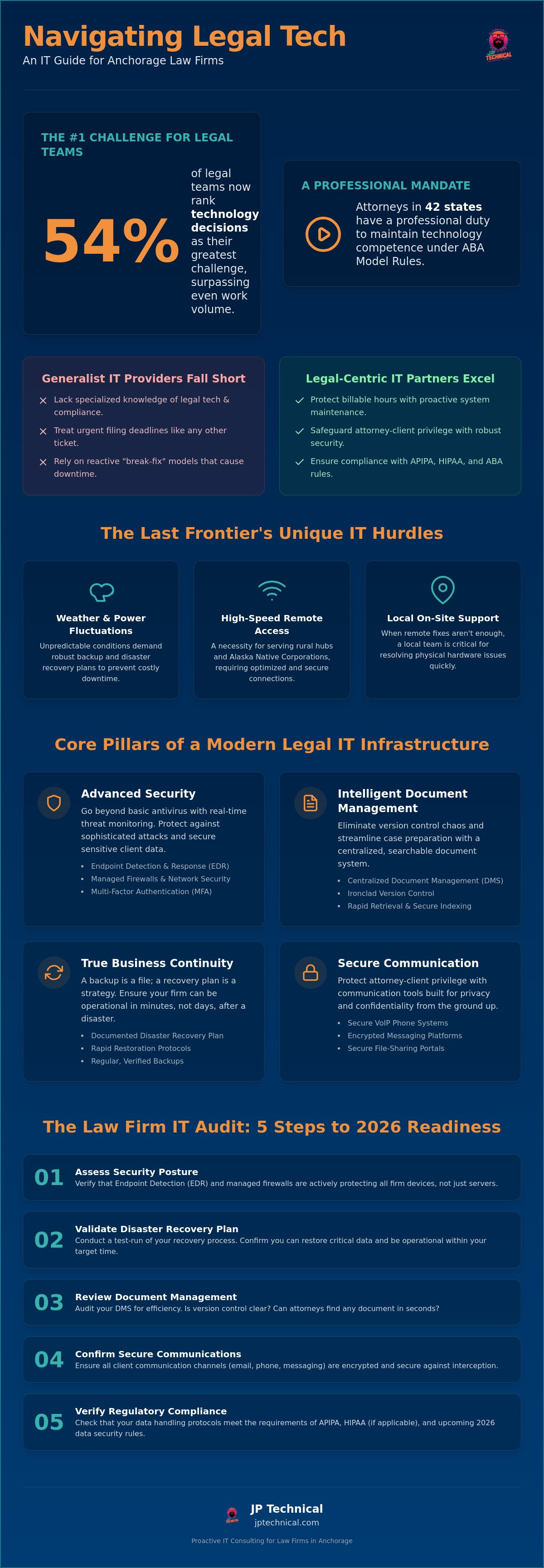
The Law Firm IT Audit Checklist: 5 Steps to 2026 Readiness
Preparing your firm for the technical demands of 2026 requires more than just a passing glance at your server room. A structured audit identifies hidden risks before they evolve into billable hour disruptions or compliance failures. This checklist serves as a baseline for any practice seeking to maintain a high standard of professional responsibility and operational continuity. If you haven’t performed a deep dive into your infrastructure recently, these five steps will help you establish a secure foundation.
Step 1: Inventory all hardware and software. Identify every device and application in use. Pay close attention to end-of-life status. Operating on unsupported hardware or software creates security gaps that even the best firewalls can’t fully bridge.
Step 2: Test your disaster recovery plan. Don’t just assume your backup is running. A true test involves actually restoring data to ensure the process is fast and the files are uncorrupted. If your restoration takes days, your plan is insufficient.
Step 3: Audit user permissions. Review who has access to which folders. Implementing a strict “need-to-know” policy prevents internal errors and limits the potential damage if a single set of credentials is compromised.
Step 4: Review physical security. Digital protection is only half the battle. Ensure your server room is locked and monitored by surveillance. Verify that access controls for your physical office are functioning and logged.
Step 5: Schedule a professional assessment. Expert IT consulting for law firms in Anchorage provides an outside perspective that internal teams might miss. A professional cybersecurity assessment identifies vulnerabilities in your specific local network.
Taking these steps ensures your firm remains a stable environment for your clients and your staff. If you find gaps during this process, don’t wait for a crisis to address them. You can request a comprehensive IT audit to get a clear, expert view of your current standing.
Assessing Your Current Security Posture
One of the most common risks we see is “shadow IT.” This occurs when staff use unauthorized apps or personal cloud storage to get work done faster. These tools often bypass your firm’s security protocols, creating unmonitored exit points for sensitive data. Your audit should also include a review of password policies. Ensure that credential management is centralized and that multi-factor authentication is active on every single entry point. Finally, check the physical environment of your onsite data storage. A simple power surge or a cooling failure in a cramped server closet can be just as devastating as a hacker.
Optimizing for Remote and Hybrid Legal Work
Attorneys often work from home in Wasilla or handle cases from the Kenai Peninsula. This makes VPN performance a critical factor for your firm’s efficiency. If your remote connection is slow or unstable, it directly impacts billable time. You must also ensure that all mobile devices, including tablets and smartphones used for case work, are managed by the firm. This allows you to remotely wipe a device if it’s lost or stolen in the field. For more detailed strategies, read our guide on Secure Remote Work Solutions for Anchorage Teams. Maintaining a high-performance, secure connection for your team is essential for a modern practice.
Why JP Technical is the Choice for Anchorage Legal IT
Choosing a partner for IT consulting for law firms in Anchorage requires finding someone who values reliability as much as you do. We’ve spent over 30 years serving the Anchorage business community, building a reputation for steady, protective vigilance. Our team doesn’t just act as a distant vendor. We operate as a seasoned local guardian, ensuring your technical infrastructure remains a stable foundation for your practice. If you value direct communication and a straight-shooter approach, we provide the honest guidance your firm needs to grow without technical friction.
Our “Legal Guardian” approach recognizes that your firm’s security extends beyond the digital realm. We integrate high-level technical expertise with a deep understanding of the local landscape. This means we’re prepared for the specific challenges Anchorage firms face, from connectivity issues in rural cases to the strict requirements of HIPAA-compliant solutions. We focus on long-term partnerships, meaning we stay calm under pressure and show up when things get difficult. You can rely on us to handle the complex technical and regulatory hurdles so you can stay focused on your billable hours.
Our Managed IT & Cybersecurity Solutions
We take a proactive stance on maintenance to prevent downtime before it occurs. Our team manages all updates and patches quietly in the background, closing security gaps without interrupting your staff’s workflow. By implementing expert EDR and antivirus management, we stop behavioral threats in their tracks. If you want to see how this fits into a broader strategy, read our Managed IT Services in Anchorage: The 2026 Guide. We ensure your systems remain predictable and secure every day.
Securing Your Firm’s Physical and Digital Assets
True security for a law firm involves protecting both case files and physical evidence. We integrate professional security camera systems directly with your IT network, providing a comprehensive view of your office’s safety. Our advanced access control solutions ensure that only authorized personnel can enter sensitive areas like evidence rooms or server closets. This dual focus on physical and digital assets provides the peace of mind that comes from total firm protection. Contact us today for a neighborly, no-nonsense assessment of your firm’s specific needs.
Securing Your Firm’s Future in the Last Frontier
The right technical partner does more than just fix computers; they act as a guardian for your billable hours and a shield for your client’s most sensitive data. We’ve explored how proactive maintenance and specialized legal knowledge are essential for meeting the regulatory standards of 2026. By moving away from reactive “break-fix” models, your firm can achieve the stability required to scale effectively in a competitive legal landscape. This shift ensures that your technology remains a silent partner in your success rather than a source of constant anxiety.
Finding reliable IT consulting for law firms in Anchorage means choosing a partner who understands our unique local challenges. Since 1996, we’ve provided steady, specialized support to the Anchorage business community. We’re specialists in HIPAA-compliant managed IT and offer dedicated local support across Anchorage, Wasilla, and the Kenai Peninsula. Our goal is to handle the technical threats in the background so you can focus on the practice of law.
Schedule your firm’s IT and Security Assessment with JP Technical today to ensure your practice is protected from every angle. We’re ready to help you navigate these technical hurdles with a no-nonsense, neighborly approach that puts your firm’s continuity first.
Frequently Asked Questions
What is the difference between general IT support and IT consulting for law firms?
General IT support typically focuses on hardware repairs and basic network connectivity for any business type. In contrast, IT consulting for law firms in Anchorage addresses the specific fiduciary duties and software requirements of a legal practice. A legal specialist understands how to manage document management systems and ensures that your data storage protocols strictly protect attorney-client privilege.
How does IT consulting help with ABA Model Rule 1.1 (Technology Competence)?
We help you fulfill your professional duty of technology competence by managing the technical safeguards required under ABA standards. This involves implementing robust encryption, secure file sharing, and proactive monitoring to protect sensitive client information. Our role is to handle the technical complexities so you can focus on your practice while remaining compliant with evolving professional rules.
Does our Anchorage law firm really need a local IT consultant?
Local expertise is vital for navigating the unique operational risks found in Alaska, such as weather-related power fluctuations and connectivity challenges. If a physical hardware failure occurs in your office, a local partner can provide immediate on-site support. National helpdesks often lack this physical presence and don’t understand the specific geographic hurdles that Anchorage firms face daily.
Can an IT consultant help us with HIPAA compliance if we handle medical records?
We provide specialized HIPAA compliance services designed for firms handling protected health information in personal injury or healthcare cases. This includes configuring encrypted storage environments and maintaining the detailed audit logs required by federal law. Our proactive approach ensures that your firm meets these strict standards without disrupting your team’s workflow.
What are the biggest cybersecurity threats facing Alaska law firms in 2026?
The most significant threats in 2026 involve sophisticated phishing attempts and ransomware that targets fragmented systems. With the Alaska Personal Information Protection Act (APIPA) in effect, any data breach can lead to mandatory notifications and potential legal liabilities. We use EDR and managed firewalls to catch these behavioral threats before they can compromise your case files.
How much does IT consulting for law firms typically cost in Anchorage?
Industry reports from early 2026 indicate that specialized legal IT consulting rates in the region generally fall between $175 and $375 per hour. Many practices find that a managed service model is more cost-effective than hourly billing. This approach provides predictable monthly costs and focuses on proactive maintenance rather than expensive, reactive repairs after a system failure.
Will switching IT providers cause downtime for our billable hours?
Switching to a new provider shouldn’t interrupt your team’s billable continuity. We use a methodical onboarding process that migrates your security protocols and data in the background. If the transition is planned correctly, your staff can continue working while we stabilize your infrastructure and implement our “Legal Guardian” approach to firm security.
How do IT consultants handle remote access for attorneys traveling in rural Alaska?
We implement optimized VPN solutions and managed mobile devices to ensure secure access from rural hub communities across the state. If you are working in an area with limited bandwidth, we configure your remote tools to provide the best possible performance. This ensures you can access your document management system securely whether you are in the office or traveling for a case.
 Article by
Colter Hobbs